If you’ve ever opened a thick Chinese grammar book, sighed, and quietly closed it again… you’re not alone.The good news is that you don’t need to memorize every rule to help your child (or yourself) actually use Chinese. Chinese grammar is much more about patterns, word order, and little helper words than about long tables of verb endings.
Think of grammar as a map:
It shows where words like to stand in a sentence.
It tells you which tiny particles (的 / 了 / 过 / 吗) change meaning.
It helps your child turn “individual words” into “real sentences.”
In this guide, we’ll walk through:
what makes Chinese grammar different from English,
the core patterns beginners really need,
the most common mistakes English-speaking kids make,
and simple ways to practice grammar without turning your home into a grammar classroom.
And when you’re ready for someone else to carry part of the load, you’ll see how a free LingoAce trial lesson can give your child live, structured practice with those same patterns—so they don’t stay stuck in rule books.
1. What Chinese Grammar Actually Is (and Isn’t)
Let’s clear up one big misunderstanding first.
Chinese grammar is not:
long conjugation charts
dozens of tenses
weird exceptions hiding in every corner
In fact, compared with many European languages, Chinese is surprisingly regular:
No verb conjugation: The verb doesn’t change for I / you / he / she / they. One form usually works for all.
No masculine/feminine nouns: You don’t have to memorize gender.
No plural endings on nouns: Often the same word can be “apple” or “apples,” and context tells you which.
So what does matter?
1.1 The big building blocks of Chinese grammar
Here’s a quick bird’s-eye view:
Building Block | What It Is in Simple Terms | Example |
Word order (语序) | The usual order words appear in a sentence | Subject–Time–Place–Verb–Object |
Sentence patterns (句型) | Common “frames” you can plug words into | “I want…”, “There is…”, “Because…” |
Little particles (助词) | Short words like 的, 了, 过, 吗 that tweak meaning or tone | 我吃了。你去过吗? |
Measure words (量词) | Words you put between numbers and nouns | 一个苹果,一本书 |
Aspect & time words | How Chinese shows “when” and “finished / not yet” | 了, 过, 正在, 已经, 还没 |
Most good grammar references, including the Chinese Grammar Wiki, organize grammar by these kinds of patterns and levels rather than overwhelming learners with everything at once. The trick for families is not to learn all of this, but to choose a small set of patterns that your child can actually use in real life.

2. Start with Word Order: The “Backbone” of Chinese Sentences
If grammar is a map, word order is the main road.
The default Chinese sentence often follows:Subject + Time + Place + Verb + Object
For example:
我 明天 在学校 吃午饭。
Wǒ míngtiān zài xuéxiào chī wǔfàn.
I will eat lunch at school tomorrow.
You can think of it like building a train:
The subject (who) is the engine.
Time and place are the middle cars.
Verb + object (do what / to what) are at the back.
If you help your child feel this order early, a lot of other “grammar rules” become easier to digest later.
2.1 Easy word-order practice at home
Ask your child to “rebuild” a jumbled sentence card by card.
Keep one pattern and swap one part:
今天在家吃饭。
今天在学校吃饭。
明天在学校吃饭。
Don’t worry about perfection; you’re just helping their brain feel the rhythm of Chinese sentences.
3. The 7 Core Sentence Patterns Beginners Should Know
You don’t need 50 patterns on day one. For kids and beginners, even 7 solid patterns can cover a lot of real life.
3.1 Patterns at a glance
Pattern Type | Frame (Pinyin simplified) | Example (English meaning) |
1. Basic “A is B” | A 是 shì B | 他是老师 – He is a teacher. |
2. “Have / there is” 有 | 有 yǒu… / 没有 méiyǒu… | 我家有狗 – We have a dog. |
3. “Want to do” | 我/你/他 想/要 + Verb + Object | 我想喝水 – I want to drink water. |
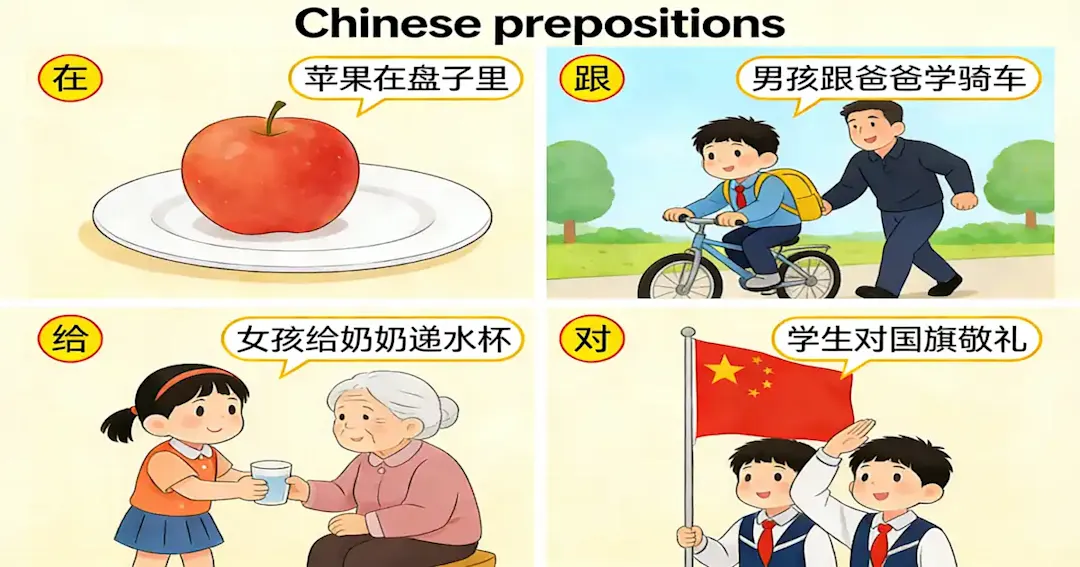
4. Location with 在 | A 在 B + Verb | 他在学校学习 – He studies at school. |
5. “Can / be able to” 会 / 能 | 会/能 + Verb | 我会说中文 – I can speak Chinese. |
6. “Preference” 我喜欢… | 我喜欢 / 不喜欢 + Noun / Verb Phrase | 我不喜欢咖啡 – I don’t like coffee. |
7. “Have done / experience” 过 | Verb + 过 guò | 我去过北京 – I have been to Beijing. |
Many beginner grammar syllabi, including the HSK 1–2 grammar lists, build around simple patterns like these.
3.2 What to actually practice with kids
You can turn each pattern into a mini “game of the week”:
Week 1: “A is B”
Have your child label things:
这是桌子。
这是我的书。
Week 2: “I want…”
Make it the “snack sentence”:
我要吃苹果。
我要喝牛奶。
Week 3: “Like / don’t like”
Use it at dinner or when choosing shows:
我喜欢这个。
我不喜欢这个。
You don’t have to talk about “patterns” with your child. Just model the sentences and let them repeat and reuse them.
4. The “Little Words” That Do Big Work: 的, 了, 过, 吗
Most learners don’t panic about “I, you, he.” They panic about tiny particles.
You don’t need to explain everything about 的, 了, and 过 in one sitting. But giving your child a few simple, kid-level uses early on will save a lot of confusion.
4.1 Quick, family-friendly explanations
的 de – often links describers to nouns
我的书 (my book)
漂亮的衣服 (pretty clothes)
了 le – often shows a completed action or a change of situation
我吃了。 (I ate / I’ve eaten.)
他回家了。 (He has gone home.)
过 guò – often means “have done / have experienced”
我去过北京。 (I have been to Beijing.)
吗 ma – turns a statement into a yes/no question
你累吗? (Are you tired?)
你吃饭了吗? (Have you eaten?)
Grammar references like the Chinese Grammar Wiki have dedicated pages for these small words with clear examples, which can be helpful for parents checking details.
4.2 Simple home activities for particles
Turn 你累 into 你累吗? and let your child hear the difference.
Ask them to add 了 to show something is finished:
你刷牙了没有?
Use 过 when talking about trips or foods:
你吃过寿司吗?
Keep explanations short. The goal is to tie each particle to a clear feeling (finished, experienced, question) rather than to technical grammar terms.
5. The Measure Word Problem (and a Gentle Fix)
Measure words are another classic headache: 一只狗, 一条鱼, 一本书…
Instead of handing your child a big list, think in mini packs.
5.1 Start with just a handful
Measure Word | Used With… | Example |
个 gè | “Default” for people, many things | 一个苹果,一个人 |
本 běn | Books, notebooks | 一本书,一本本子 |
只 zhī | Many animals, some single items | 一只狗,一只猫 |
条 tiáo | Long, thin things | 一条鱼,一条裤子 |
辆 liàng | Vehicles | 一辆车 |
That’s enough for a lot of kids’ conversations.
5.2 Make measure words feel physical
Act them out: stretch your arms for 条, clap “one book” for 本.
Ask for “wrong but funny” combinations: 一条书 on purpose, then fix it together.
Create a tiny “measure word museum” with 5 objects and sticky notes.
Again, you’re aiming for feel, not flawless theory.
6. Common Grammar Mistakes English-Speaking Kids Make
If your child speaks English at home, they’ll bring some English “habits” into Chinese. That’s normal.
Here are a few typical mistakes—and how to gently nudge them in a better direction.
6.1 English word order inside Chinese
❌ 我吃饭在学校。 wǒ chīfàn zài xuéxiào.
✅ 我在学校吃饭。 wǒ zài xuéxiào chīfàn.
Fix: remind them of Subject–Time–Place–Verb–Object like a little chant.
6.2 Skipping measure words
❌ 我有三狗。 wǒ yǒu sān gǒu.
✅ 我有三只狗。 wǒ yǒu sān zhī gǒu.
Fix: whenever there’s a number + noun, ask: “What measure word fits in the middle?”
6.3 Using 是 too often
❌ 我是喜欢苹果。 wǒ shì xǐhuān píngguǒ.
✅ 我喜欢苹果。 wǒ xǐhuān píngguǒ.
Fix: explain that 是 is usually “A is B,” not “A is do something.”
6.4 Translating “do not have” too literally
❌ 我不有钱。 wǒ bù yǒu qián.
✅ 我没有钱。 wǒ méiyǒu qián.
Fix: for “don’t have,” just memorize 没有 méiyǒu as a chunk.
6.5 Overusing 了 or putting it everywhere
❌ 昨天我去了学校了。 zuótiān wǒ qù le xuéxiào le.
✅ 昨天我去了学校。 zuótiān wǒ qù le xuéxiào.
Fix: keep it simple: use 了 once on the main action; don’t throw it at every verb.
6.6 Forgetting questions need 吗 / question structure
❌ 你会说中文? nǐ huì shuō Zhōngwén?
✅ 你会说中文吗? nǐ huì shuō Zhōngwén ma?
Fix: encourage your child to “hang a little 吗 ma at the end” when they’re asking yes/no questions.
Many HSK grammar overviews list these same issues at beginner levels—word order, question forms, particles, and measure words—as the core trouble spots.

7. How to Practice Chinese Grammar Without “Doing Grammar Exercises”
So far, this might still sound like theory. Let’s bring it down to earth.The secret is to practice grammar through tiny, repeated sentences in real situations, not only via worksheets.
Here are some practical ways:
7.1 “One pattern per week” system
Pick one sentence pattern for the week and sprinkle it everywhere.
Example: Pattern “I want…”
At snack time: 我要吃饼干。
At dinner: 我要喝汤。
Before playtime: 我要玩游戏。
You’re not announcing it as a “grammar week.” You’re just modeling the pattern until it feels normal.
7.2 Little “grammar missions”
Turn patterns into mini missions:
“Today, we’ll use 在 three times to show where things happen.”
“Tonight’s bedtime story must include 了 at least twice to show things are finished.”
Kids don’t need to know the rule’s name; they just need to hear and use it.
7.3 Story cards with fixed frames
Make 4–5 cards that show a fixed grammar frame:
昨天我在___。
明天我要___。
我最喜欢的___是___。
Let your child fill in different words each time. Same grammar, fresh content.
7.4 Correcting gently, not constantly
If your child says:我明天去学校了。
You can simply repeat in a natural tone:嗯,你明天去学校。
You’ve just given them the correct grammar without turning the moment into a test.
7.5 Use reference tools in the background (for you, not for them)
When you’re unsure about a pattern, you can quickly check:
a reliable Chinese grammar reference such as Chinese Grammar Wiki
or a trusted online Chinese–English dictionary like MDBG to confirm example sentences and usage.
Your child doesn’t need to see that you’re checking; they only need the benefit of clearer examples.
8. Authoritative Grammar Resources You Can Bookmark (Parent Corner)
You asked for authoritative external links—here are a few that work well behind the scenes:
Chinese Grammar Wiki (AllSet Learning) – A structured grammar reference arranged by level (from beginner to advanced), with explanations and plenty of example sentences. Great for quickly checking how a pattern is used in real life.
HSK Grammar & Vocabulary Overviews – Sites that break down grammar points by HSK level (1–9) help you see which patterns are typical at each stage. For example, HSK 1–3 focus heavily on basic word order, questions, negation, and simple particles.
MDBG Chinese–English Dictionary – A widely used online dictionary with pinyin, example sentences, handwriting input, and extra tools. Handy when you want to double-check the usage of a word inside a sentence.
You can quietly use these to support your child without sending them down a rabbit hole of complicated explanations.
9. When to Bring in a Teacher: Turning Rules into Real Speaking
You can do a lot at home:
helping your child feel Chinese word order,
playing with simple patterns,
introducing particles like 的 and 了 in stories,
fixing small mistakes gently as you go.
But there’s a limit to how far you can go on your own, especially if:
you’re not fully confident in your own Chinese,
you’re short on time, or
your child needs more listening and speaking than you can provide.
That’s where live, interactive lessons matter.
A good teacher will:
choose grammar patterns that match your child’s level,
recycle those patterns in different stories and games,
correct mistakes kindly but clearly,
and link grammar directly to speaking, not just workbook pages.
This is exactly how LingoAce is designed to work: teachers use age-appropriate stories, visuals, and tasks to slip grammar patterns into every class, so kids absorb them naturally while they talk, listen, and play—not while staring at a giant rule book.
One Simple Next Step: Book a Free LingoAce Trial Lesson
If this guide made Chinese grammar feel a little less scary and a bit more “doable,” that’s a win already.You now know that:
you don’t need to memorize every rule,
word order and a few sentence patterns do most of the heavy lifting,
small particles like 的, 了, 过, and 吗 can be introduced with simple, real examples,
and grammar can be practiced through stories, routines, and tiny daily missions—not just worksheets.
If you’d like your child to hear and use these patterns with a professional teacher, the lowest-stress way to start is simple:
👉 Book a free LingoAce trial lesson.Bring a few of the grammar patterns from this article—maybe “I want…”, “I like…”, or “A is B”—and watch how a trained teacher turns them into:
listening activities,
speaking games,
and real conversation practice.
From there, you and your child can decide together how far you want to go.No thick rule book required—just clear patterns, kind guidance, and a lot of chances to speak.