
If you grew up in or around a Chinese family, you might remember bits and pieces like “this year is better for marriage” or “the house feels out of balance, maybe it’s the feng shui.” Very often, behind those comments sits a quiet framework: the Chinese 5 Elements, or Wu Xing (五行, wǔ xíng).
People today don’t always call it by name, but the idea is still there. It shows up when relatives talk about health, when someone mentions a “fiery” personality, or when a grandparent gives advice that sounds half-poetic, half-practical.
This guide is written for readers who are curious about Chinese culture—many of you might be overseas Chinese, some not Chinese at all—who want a clear but down-to-earth explanation of the Chinese 5 Elements, and how they connect to daily life. If you also have kids or younger relatives learning Chinese, even better: Wu Xing can become a natural bridge between language and culture.
We’ll walk through what the elements are, how they interact in the famous cycles, how they map onto seasons and emotions, where they appear in language and idioms, and finally how you can actually use this framework at home in a very ordinary week. No prior background in philosophy or medicine required.
What Are the Chinese 5 Elements (Wu Xing 五行)?
In Chinese, Wu Xing (五行, wǔ xíng) is often translated as the Chinese 5 Elements:
Wood 木 (mù)
Fire 火 (huǒ)
Earth 土 (tǔ)
Metal 金 (jīn)
Water 水 (shuǐ)
If you take the translation literally, it sounds like five materials on a list. But that’s not really how the system works. A more accurate way to think about Wu Xing is: five ways things move and change, five patterns that repeat in nature and in human life.
Ancient Chinese thinkers didn’t use the Chinese 5 Elements just to describe objects. They used them as a kind of “map” or “tagging system.” You can group:
Seasons and directions
Organs and bodily functions (in Traditional Chinese Medicine)
Emotions and personality tendencies
Colors, flavors, even types of weather
under one of these five elements. Once you accept that it’s a symbolic, flexible map—not a scientific periodic table—it becomes much easier to make sense of.
You’ll find Wu Xing quietly influencing:
Traditional Chinese Medicine (TCM) and acupuncture
Feng shui layouts in homes and offices
Certain martial arts systems
Chinese astrology and the zodiac
Poetry, food culture, and many everyday expressions
The more you read or listen, the more you notice the Chinese 5 Elements in places you didn’t expect.

The Five Elements One by One
Below is a quick walk-through of each element. We’ll keep the Chinese characters and pinyin visible, because if you’re learning or teaching the language, those details matter.
Wood 木 (mù)
Wood, 木 (mù), feels like a young tree pushing up through soil. In the Chinese 5 Elements system, Wood is often linked with:
Spring energy, those first days when everything starts to grow again
Planning, setting goals, stretching toward the future
Flexibility with direction: a branch can bend, but it still “knows” where it’s headed
In people, Wood energy might show up as ambition, creativity, or sometimes a tendency to push too hard. Someone who loves starting new projects, gets frustrated when blocked, and hates feeling stuck might casually be described as having “a lot of Wood.” No one measures this, of course—it’s more of a cultural shorthand.
Fire 火 (huǒ)
Fire, 火 (huǒ), is usually the easiest of the Chinese 5 Elements to imagine. Think of summer evenings: warm air, loud laughter, crowded meals. Fire is:
Heat and passion
Visibility, performance, being seen
Quick, bright, joyful, but also sometimes a bit too intense
Someone who talks with big gestures, laughs loudly, and loves being around people might be called very “fiery.” In Chinese, we even say 火气大 (huǒqì dà) when someone is easily annoyed—literally “big fire energy.” The same element that gives warmth can also burn when it’s overdone.
Earth 土 (tǔ)
Earth, 土 (tǔ), is the feeling of solid ground under your feet. In the Chinese 5 Elements framework, Earth is not just mud or soil; it is:
Stability and support
The energy of “being in the middle,” connecting other parts
Nourishment—both physical food and emotional care
Earth is often associated with the transitions between seasons, the in-between times that hold everything together. In families, Earth energy feels like home cooking, routines, and someone making sure the household keeps running. On the downside, too much Earth can show up as worry or overthinking, a kind of mental heaviness.
Metal 金 (jīn)
Metal, 金 (jīn), has the crisp, clear quality of autumn. Among the Chinese 5 Elements, Metal stands for:
Structure and order
Rules, standards, discipline, and cutting away what’s unnecessary
Refinement, value, and sometimes a cool kind of beauty
Imagine clean lines, a tidy desk, a carefully organized schedule—that’s very Metal. In language, expressions about “gold” and “value” tie into this element, hinting at quality and precision. When Metal goes too far, it can feel rigid, critical, or emotionally distant.
Water 水 (shuǐ)
Finally, Water, 水 (shuǐ). At first glance it seems simple, but in many ways it is the most mysterious of the Chinese 5 Elements. Water represents:
Winter, rest, and quiet storage of energy
Depth, memory, intuition, long-term thinking
The ability to adapt to any shape while gradually carving stone, given enough time
A person with strong Water energy might enjoy solitude, deep conversations, or quiet observation. Too much Water, unchecked, can slide into fear or avoidance; too little may look like impulsivity, with no time taken to reflect.
Again, none of this is a medical diagnosis or a fixed label. It’s a vocabulary set—a way Chinese culture talks about patterns we all notice but sometimes struggle to describe.
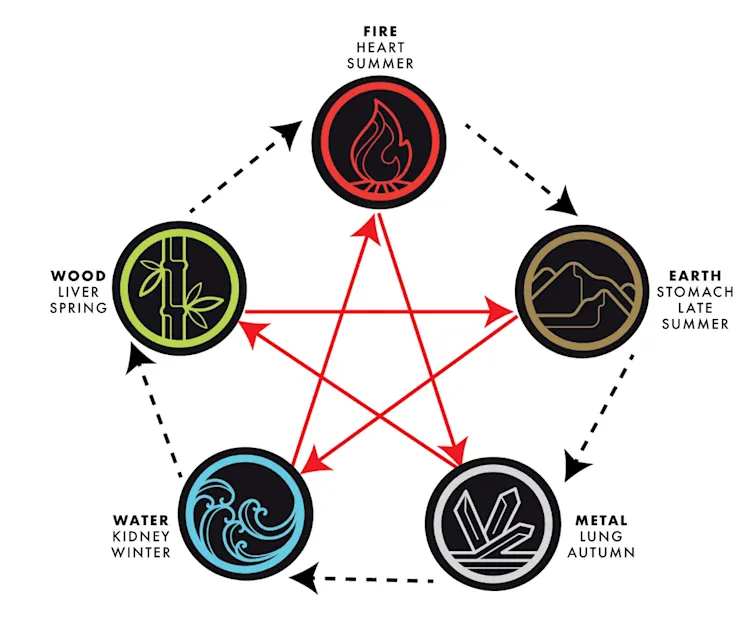
The Generating Cycle (相生): How the Chinese 5 Elements Support Each Other
So far we’ve looked at each element separately. The real magic of the Chinese 5 Elements shows up when you see how they interact. The first pattern is called the generating cycle, or 相生 (xiāngshēng).
In this cycle, each element naturally “feeds” the next one. A very common way to memorize it is:
Wood → Fire → Earth → Metal → Water → back to Wood
Instead of just reciting the order, picture small, almost obvious scenes:
Wood becomes fuel; when you burn wood, you get Fire. Fire burns things down and leaves ash behind; that ash returns to and enriches the Earth. Deep inside Earth, under pressure and time, metal ore forms—so Earth gives birth to Metal. Metal, cold and smooth, can collect tiny water droplets on its surface; in practice, metal tools also direct Water, like pipes or channels. Water, in turn, nourishes plants and trees, bringing Wood back to life.
Round and round it goes.
Within the Wu Xing system, this generating cycle is used to talk about supportive relationships—whether between organs in TCM, between people, or between habits. If you hear someone say two things “generate” each other in a Wu Xing sense, they usually mean that the relationship is nurturing, additive, and generally helpful.
For example, a stable daily routine (Earth) might support clear thinking and structure (Metal), which then makes it easier to rest properly (Water). The actual mapping can be flexible, but the intuition—that one pattern gently gives rise to another—is at the heart of how the Chinese 5 Elements are used.
The Controlling Cycle (相克): How the Chinese 5 Elements Keep Balance
If everything only grew and never got checked, life would feel chaotic. That’s where the controlling cycle, 相克 (xiāngkè), comes in. This is the second major pattern of the Chinese 5 Elements.
Here, each element gently restrains another element, preventing things from going too far. The typical sequence is:
Wood → Earth → Water → Fire → Metal → back to Wood
Again, it’s easiest to understand through pictures:
Wood controls Earth Tree roots dig into soil, break it up, and prevent Earth from becoming overly hard or dominant.
Earth controls Water Banks and dams are made of earth; they shape rivers and keep Water from flooding everywhere.
Water controls Fire This part is intuitive: water puts out, or at least cools, fire.
Fire controls Metal Fire melts and reshapes Metal, turning rigid objects into something new.
Metal controls Wood Metal tools—axes, saws, knives—cut down or prune Wood.
Together, the generating and controlling cycles say something quite simple: too much of any one element throws things off, and balance comes from interaction, not from one element dominating the others.
In daily life, this idea can be surprisingly helpful. You might not say, “I need to invoke Metal to control my excess Wood,” of course; but you might notice that endless new projects (Wood) need structure and boundaries (Metal) to feel sustainable. The Chinese 5 Elements provide a friendly, story-like way to talk about that balance.
Correspondences: How the Chinese 5 Elements Map to Seasons, Organs, Colors, and Emotions
One reason Wu Xing has stayed influential for so long is that it connects many parts of life into a single, memorable map. Different lineages put slightly different things in each box, but a widely shared version looks like this:
Element | Chinese | Season | Direction | Typical Color | Main Organs (TCM view) | Emotion Tendency |
Wood | 木 mù | Spring | East | Green | Liver / Gallbladder | Anger, drive, assertive |
Fire | 火 huǒ | Summer | South | Red | Heart / Small Intestine | Joy, excitement |
Earth | 土 tǔ | Late summer / transitions | Center | Yellow / earthy tones | Spleen / Stomach | Worry, care |
Metal | 金 jīn | Autumn | West | White / metallic | Lungs / Large Intestine | Sadness, letting go |
Water | 水 shuǐ | Winter | North | Deep blue / black | Kidneys / Bladder | Fear, deep reflection |
A few clarifications, so this doesn’t get misunderstood:
First, the organ column comes from Traditional Chinese Medicine. It doesn’t mean the liver is literally made of Wood or that the kidneys are literally Water. Instead, each organ system is seen as part of a larger pattern of functions, emotions, and relationships, and the Chinese 5 Elements provide the labels.
Second, emotions in this table are not “good” or “bad.” Each one has a healthy side and an unhealthy side. A bit of Fire joy makes life brighter; too much becomes restlessness. Some Water-style fear keeps us cautious; too much becomes paralysis. The real focus is on proportion and flow—how easily you move in and out of each state.
For culture learners, this sort of table is useful in two ways: it helps you remember vocabulary and it explains why Chinese sayings, poems, and health advice often tie together seasons, feelings, and body language in ways that might otherwise feel random.
The Chinese 5 Elements in Language, Idioms, and Everyday Life
Once you know the framework, you start hearing the Chinese 5 Elements in ordinary language. Not every phrase is strictly “Wu Xing,” but the flavor is there.
Take Wood 木 (mù), for example. You might hear someone jokingly called 木头人 (mùtou rén)—literally “wooden person,” meaning stiff, shy, or not very expressive. On the positive side, a person who grows steadily, adapts, and keeps moving forward is often described in spring-like, Wood-ish terms, even if the speaker doesn’t explicitly mention the element.
With Fire 火 (huǒ), we already mentioned 火气大 (huǒqì dà) for a person with a short temper. There’s also the more flattering sense of “fiery” or “hot”: a 火红 (huǒhóng) career is booming, full of opportunities. Fire in the Chinese 5 Elements gives the language a way to talk about energy that is visible—good for celebrations but sometimes overwhelming.
Earth 土 (tǔ) is more subtle. When someone is called 土气 (tǔqì), it can mean “earthy” in a rustic, not-very-fashionable way. At the same time, phrases like 脚踏实地 (jiǎo tà shí dì)—“feet firmly on solid ground”—praise a practical, reliable attitude. That mix of “down-to-earth but maybe not trendy” is classic Earth energy.
For Metal 金 (jīn), a lot of expressions involve gold and value. 金子一般的心 (jīnzi yībān de xīn), literally “a heart like gold,” praises kindness and integrity. 黄金时代 (huángjīn shídài), “golden age,” uses Metal to describe a period of peak quality. In the Chinese 5 Elements, Metal gives structure, clarity, and standards—qualities that show up all over modern Mandarin.
With Water 水 (shuǐ), you see both flexibility and mystery. The word 风水 (fēngshuǐ) itself—“wind-water”—connects directly to geomancy and environmental balance, where the Chinese 5 Elements are one of the key tools. Describing bright, lively eyes as 水灵灵 (shuǐlínglíng) uses Water’s sense of sparkle and life.
Once you tune into this, TV dramas, pop songs, and even casual family conversation start to sound different. The underlying pattern of the Chinese 5 Elements is there, even when nobody points at it.
FAQ: Common Questions About the Chinese 5 Elements
1. Are the Chinese 5 Elements the same as the Western four elements?
They sound similar on the surface, but they’re built differently. The Western system (fire, water, air, earth) usually treats elements as substances. The Chinese 5 Elements—Wood, Fire, Earth, Metal, Water—are closer to processes or “modes of change.”
Wu Xing focuses on how the elements generate and control one another. It is less about “what everything is made of” and more about “how things influence each other over time.” Because of this, the Chinese system is widely used as a tool for mapping relationships, not just describing materials.
2. Is the Chinese 5 Elements theory scientific?
If we’re being strict, the Chinese 5 Elements are not science in the modern experimental sense. They came out of ancient observation, philosophy, and medical practice, not laboratory tests.
That said, dismissing them as “just superstition” misses the point. Many people worldwide still find value in the way Wu Xing connects lifestyle, emotions, and environment. Whether in TCM, feng shui, or daily self-reflection, the Chinese 5 Elements act as a story framework—a way to organize complex experience into something easier to talk about.
3. How do I know which element I am?
There are a few different approaches. One popular method, especially online, connects your birth year to an element–animal pair in the Chinese zodiac cycle. Each year belongs to a combination like “Wood Dragon” or “Metal Ox.”
These labels can be fun and sometimes eerily accurate, but they’re not destiny. For most learners, the practical benefit is that they introduce more chances to use the language and notice how the Chinese 5 Elements vocabulary appears in birthday talk, relationship advice, and light-hearted personality quizzes.
4. Do I have to “believe” in the Chinese 5 Elements to learn Chinese?
Not at all. You can treat the Chinese 5 Elements the way you might treat Greek myths or personality archetypes: as meaningful stories that reveal how people think, without demanding blind belief.
Understanding Wu Xing makes a lot of things easier: why some idioms look the way they do, why TCM talks about organs the way it does, or why relatives might use certain metaphors for mood and health. It’s a cultural key. You can appreciate the key even if you don’t want to unlock every door with it.
5. Is this useful for parents and kids, or mainly for adults?
Both, honestly. Adults curious about Chinese philosophy can go quite deep with the Chinese 5 Elements. At the same time, the basic ideas of Wood, Fire, Earth, Metal, and Water are very visual and story-friendly, which makes them surprisingly suitable for children too.
If you’re raising kids, you can use Wu Xing to:
Turn vague concepts like “balance” into concrete images and cycles
Tie Chinese vocabulary to stories and drawings rather than just textbooks
Create gentler conversations about emotions, using elements instead of labels like “good” or “bad”
Even if your main interest is your own cultural connection, having this shared language at home can turn everyday moments into small Chinese lessons without forcing it.
Conclusion: The Chinese 5 Elements as a Living Cultural Language
By now, Wood 木, Fire 火, Earth 土, Metal 金, and Water 水 should feel a bit less mysterious. They’re still part of an old system, but they’re also part of how many Chinese families—especially older generations—talk about life, health, and change.
The Chinese 5 Elements remind us that balance is not a straight line. It’s a constant conversation: sometimes life needs more Fire, sometimes it calls for Water; Earth brings us home, Metal gives structure, Wood pushes us forward. Even without formal study, just having these five words in the back of your mind can shift how you read stories, listen to elders, and think about your own habits.
If you’re overseas Chinese, Wu Xing can feel like reconnecting with a hidden “operating system” you vaguely noticed as a child. If you’re not Chinese but deeply interested in the culture, it gives you a respectful way to engage with traditions like TCM, feng shui, and the zodiac without getting lost.
And if you’d like to move beyond reading and actually use this knowledge in real conversations—talking about seasons, health, or personality in natural Mandarin—structured learning helps a lot. A live class makes it easier to hear the tones, try the idioms, and ask your own questions.
That’s exactly where LingoAce comes in. In our online Chinese courses, teachers weave cultural frameworks like the Chinese 5 Elements into stories, dialogues, and real-life examples, so Wu Xing is not just something you’ve read about once—it becomes part of how you and your family use Chinese in everyday life. If this guide sparked your curiosity, booking a trial class is a simple next step to turn that curiosity into confident language skills.