If your child’s Mandarin sounds like it’s built from “vocabulary bricks” (correct… but stiff), chinese adverbs are often the missing glue. They’re the small words that make sentences feel human: already, still, often, really, quietly, again.
And yes, kids can learn chinese adverbs without turning your home into a grammar classroom. You’ll see tiny, copy-paste sentence patterns below—stuff you can use at dinner, in the car, or while packing a lunch.
Quick Start: 8 chinese adverbs kids use every day
Try one per day. Keep the sentence short. Repeat it in real life.
现在 xiànzài — “now”
我现在要去。Wǒ xiànzài yào qù. (I’m going now.)
也 yě — “also”
我也想要。Wǒ yě xiǎng yào. (I want that too.)
不 bù — “not”
我不喜欢。Wǒ bù xǐhuān. (I don’t like it.)
很 hěn — “very” (or sometimes just a “linking” word)
这个很难。Zhège hěn nán. (This is hard.)
还 hái — “still” / “also” (context decides)
我还没写完。Wǒ hái méi xiě wán. (I still haven’t finished.)
已经 yǐjīng — “already”
我已经吃了。Wǒ yǐjīng chī le. (I already ate.)
常常 chángcháng — “often”
他常常迟到。Tā chángcháng chídào. (He’s often late.)
再 zài — “again (later)”
我们再试一次。Wǒmen zài shì yí cì. (Let’s try again.)
What are chinese adverbs (and why they matter for kids)?
Chinese adverbs are words that add extra information about an action or description—when, how often, how much, how, whether it’s already done, whether it’s still happening, and so on.
In English, adverbs often end with “-ly” (quickly, slowly). In Mandarin, chinese adverbs don’t change form like that. They usually stay the same, and meaning is driven by placement and context. That’s why kids can know the word but still sound “off.”
chinese adverbs word order—where they go
Here’s the rule you can actually remember:
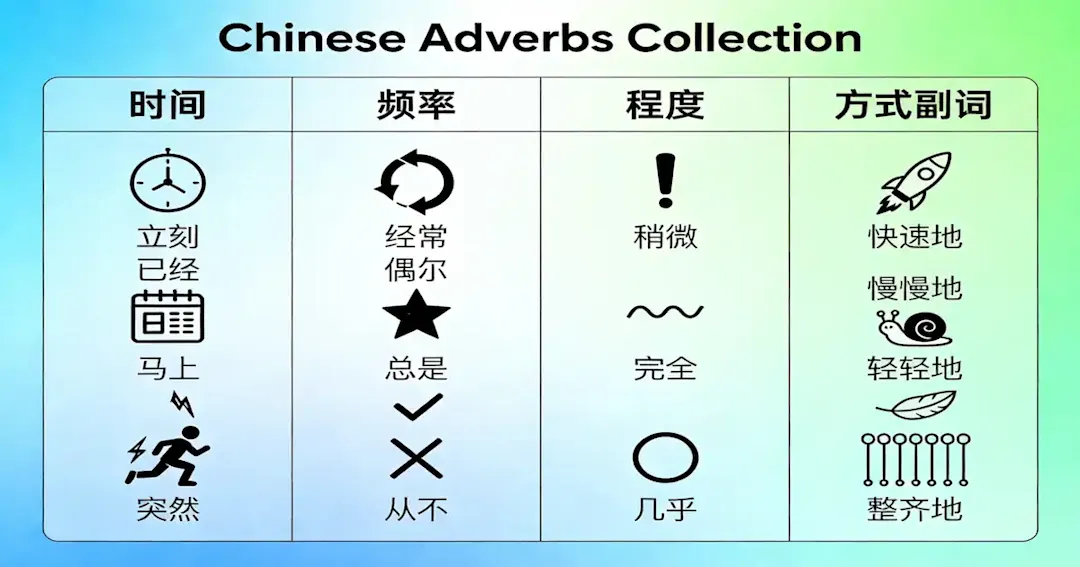
Time chinese adverbs usually go before the verb. Frequency chinese adverbs usually go before the verb. Degree chinese adverbs usually go before adjectives (and sometimes before verbs). Manner chinese adverbs often go before the verb; if you’re using 地 (de), it’s adjective + 地 + verb.
A very usable “default” pattern is:
Subject + Time + Frequency + Manner + Verb + Object
Not every sentence needs all of that, obviously. But when kids stack chinese adverbs randomly, this pattern is a good “reset button.”
Tiny example (same meaning, different smoothness)
Incorrect Expression:我吃饭现在。Wǒ chīfàn xiànzài.
Correct Expression:我现在吃饭。Wǒ xiànzài chīfàn.

chinese adverbs of time—when something happens
Time chinese adverbs are the ones kids need constantly, because their day is basically a timeline: now, later, still, already, just now, soon.
Core chinese adverbs of time
现在 (now)
刚才 (just now)
马上 (right away / soon)
已经 (already)
还 (still)
以前 (before)
后来 (later / afterward)
The “already vs still” pair
Kids mix 已经 and 还 because English doesn’t force them to think about it as precisely.
已经 = the change is done
我已经写完了。Wǒ yǐjīng xiě wán le. (I already finished.)
还 = the change is not done / the state continues
我还没写完。Wǒ hái méi xiě wán. (I still haven’t finished.)
Put this on your fridge if you want. Or don’t. But if you repeat these two sentence frames for a week, your child will start using these chinese adverbs correctly without knowing they learned “grammar.”
chinese adverbs of frequency—how often
Frequency chinese adverbs are parent gold because you can tie them to real life: chores, reading, screen time, practicing piano, speaking Mandarin at home.
Core chinese adverbs of frequency
总是 zǒngshì — always
经常 jīngcháng — often
常常 chángcháng — often (slightly more conversational)
有时候 yǒushíhou — sometimes
很少 hěn shǎo — rarely
从不 cóng bù — never
And yes, these chinese adverbs usually go right before the verb:
我经常练习。Wǒ jīngcháng liànxí. (I often practice.)
If you’re thinking: “I can model these chinese adverbs, but I’m not sure I’ll catch mistakes consistently,” you’re not alone. A teacher’s real superpower is real-time correction and repetition that doesn’t turn into parent-child tension.
If you want support, LingoAce is one option families use to practice natural speaking patterns (including chinese adverbs word order and those tiny words like 才/就/再/又) with live feedback. You can book a LingoAce trial lesson and treat it like a “language check-up,” not a long-term commitment decision.

A scan-friendly table (keep it practical)
Frequency adverb | Meaning | Kid example | Best real-life moment |
总是 | always | 我总是忘记。 | morning rush |
经常 | often | 我经常说中文。 | after class recap |
常常 | often | 他常常笑。 | family stories |
有时候 | sometimes | 我有时候不想去。 | honest feelings |
很少 | rarely | 我很少吃糖。 | snacks talk |
从不 | never | 我从不迟到。 | goals / promises |
If your child is younger, let them pick the sentence that matches them. Kids like accuracy. Also kids like arguing. Both work here.
chinese adverbs of degree—how much
Degree chinese adverbs are where kids overuse 很. It’s understandable. It’s easy. But if every adjective uses 很, their Mandarin starts sounding like a robot reading flashcards.
The most useful degree chinese adverbs for kids
很 (very / sometimes just “linking”)
真 (really, genuinely)
非常 (very, extremely)
特别 (especially)
太…了 (too… / so…!)
有点 (a bit)
更 (even more / comparative)
The “upgrade ladder” (so you can vary speech naturally)
A quick parent note: you don’t need all of these at once. Pick one upgrade at a time.
Basic: 我很累。(I’m very tired.)
Slightly more natural: 我真累。(I’m really tired.)
Stronger: 我非常累。(I’m extremely tired.)
Emphatic kid style: 我太累了!(I’m sooo tired!)
Also, 有点 is a lifesaver because it softens tone:
这个有点难。Zhège yǒudiǎn nán. (This is a bit hard.)
chinese adverbs of manner—how something is done
Manner chinese adverbs answer: How did you do it? quietly, carefully, happily, quickly.
In Mandarin, the most common pattern is:
Adjective + 地 + Verb
Examples:
他认真地写字。Tā rènzhēn de xiězì. (He writes carefully.)
她开心地唱歌。Tā kāixīn de chànggē. (She sings happily.)
孩子慢慢地走。Háizi mànmàn de zǒu. (The child walks slowly.)
When kids shouldn’t force 地
Here’s the thing: kids (and adult learners) sometimes overuse 地 and everything sounds like a textbook.
In casual speech, you’ll often hear:
他认真写。 (dropping 地)
你慢慢说。 (dropping 地)
So if your child is speaking, it’s okay to keep it simple. If they’re writing, 地 can make sentences clearer and more “school appropriate.” Different contexts, different choices. That’s normal human language, not a rule you need to memorize.

FAQ
1) What are chinese adverbs, in simple terms?
Chinese adverbs are small words that describe when, how often, how much, or how something happens. Kids use chinese adverbs to sound natural instead of speaking in short “noun + verb” chunks.
2) What is the correct chinese adverbs word order for kids?
Subject + Time + Frequency + Manner + Verb + Object. Most chinese adverbs come before the verb, especially time and frequency adverbs. If your child is confused, move only the time word first—that alone fixes a lot.
3) What are the most common chinese adverbs of frequency?
For kids, the most useful are: 总是、经常、常常、有时候、很少、从不. Start with just 经常 and 有时候, because they match how kids describe routines.
4) How do you use 地 (de) for chinese adverbs of manner?
Adjective + 地 + Verb, like 认真地写 or 开心地说. In casual speech, kids can sometimes drop 地 (认真写, 慢慢说) and still sound natural. In writing, 地 can make sentences clearer.
5) What’s the difference between 才 vs 就 in chinese adverbs?
才 suggests “only then / later than expected,” while 就 suggests “already / earlier than expected.”
八点才睡 = didn’t sleep until 8
八点就睡 = slept as early as 8 Same clock time, different meaning—this is why these chinese adverbs matter so much.
Conclusion
In 2026, kids learning Mandarin don’t just need vocabulary—they need the connectors that make sentences flow. That’s what chinese adverbs do. Time words (现在、已经、还) help kids tell real stories. Frequency words (经常、有时候) help them describe routines. Degree words (真、有点、太…了) help them express feelings without sounding stuck. Manner patterns (慢慢说、认真地写) make speech and writing more precise.
If you want a next step that’s structured—especially for the tricky chinese adverbs like 才/就/又/再/还—consider booking a LingoAce trial class as a low-pressure way to see your child’s level and get teacher feedback on word order and natural phrasing. It’s often the fastest way to stop guessing and start hearing real progress.