If your child knows animal vocabulary in Mandarin but still answers in one-word Chinese, chinese animal idioms can help. They’re short, image-based, and common in kids’ stories and everyday family talk.
Below are 25 animal 成语 (chéngyǔ). Each one includes a quick meaning, a tiny memory hook, and a sentence you can reuse at home. Don’t try to “teach them all.” Pick three this week and let repetition do the heavy lifting.
A 60-Second Cheat Sheet for Chinese Animal Idioms
Chengyu (成语) are set idioms—often four characters—whose meaning can come from older stories, so literal translation can mislead.
The #1 parent pitfall with chinese animal idioms: translating word-by-word, then wondering why it sounds odd.
Quick pick table (choose 1–2 to start)
Chengyu | Pinyin | Simple meaning | Best “home” moment |
马马虎虎 | mǎmǎhūhū | so-so / careless | rating homework |
狼吞虎咽 | láng tūn hǔ yàn | eat too fast | dinner reminder |
鸡飞狗跳 | jī fēi gǒu tiào | total chaos | rushed mornings |
亡羊补牢 | wáng yáng bǔ láo | fix it after | mistakes + reset |
如鱼得水 | rú yú dé shuǐ | perfectly suited | praise after class |
画蛇添足 | huà shé tiān zú | ruin by adding | over-editing |
If your child likes these but struggles to use them out loud, a structured speaking routine helps. One option is a LingoAce trial class, where teachers can practice a few chengyu in short dialogues.

The 25 Chinese Animal Idioms
1) 马马虎虎 — mǎmǎhūhū
So-so; careless. Memory hook: “half horse, half tiger,” not quite right. Example: 今天作业我做得马马虎虎,明天认真点。 Tip: Good for “not great.” Mistake: don’t use it as praise.
2) 对牛弹琴 — duì niú tán qín
Explaining to someone who won’t get it. Example: 我讲了三次,他还是不懂,像对牛弹琴。 Tip: describe the situation. Mistake: saying it to your child mid-argument.
3) 守株待兔 — shǒu zhū dài tù
Waiting for luck instead of effort. Example: 别守株待兔,先把错题改了。 Tip: great for “hoping it fixes itself.” Mistake: confusing it with patient practice.
4) 画蛇添足 — huà shé tiān zú
Ruin it by adding extra. Example: 你答案对了,别再画蛇添足。 Tip: homework + crafts. Mistake: using it when details are required.
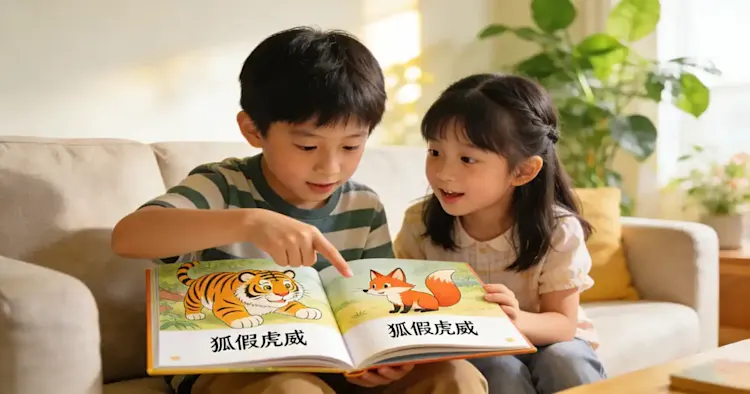
5) 狐假虎威 — hú jiǎ hǔ wēi
Bullying with borrowed power. Example: 他跟大孩子一起就狐假虎威。 Tip: playground dynamics. Mistake: using it for real confidence.
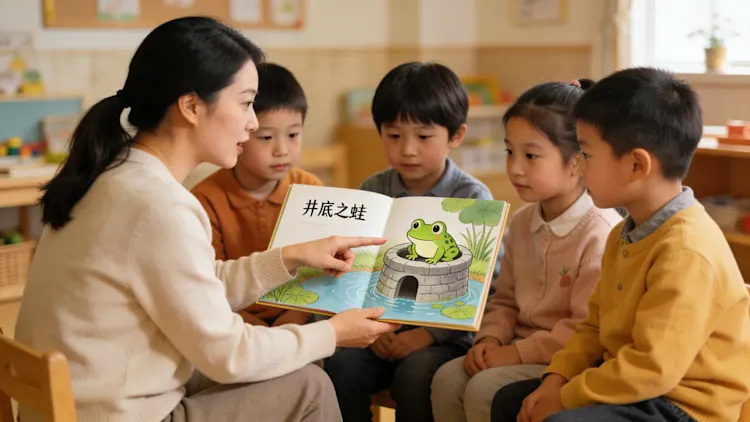
6) 井底之蛙 — jǐng dǐ zhī wā
Narrow perspective. Example: 我们多看看别的方法,别当井底之蛙。 Tip: problem-solving talks. Mistake: labeling your child as “the frog.”
7) 如鱼得水 — rú yú dé shuǐ
Perfectly comfortable; thriving. Example: 她在中文课里如鱼得水。 Tip: strong, warm praise. Mistake: using it for “just okay.”
8) 生龙活虎 — shēng lóng huó hǔ
Full of energy. Example: 他今天上课生龙活虎。 Tip: better than “hyper.” Mistake: using it when someone looks exhausted.
9) 龙马精神 — lóng mǎ jīng shén
High spirits; drive. Example: 新学期要有龙马精神。 Tip: encouragement notes. Mistake: it can sound formal—use sparingly.
10) 鹤立鸡群 — hè lì jī qún
Stand out (usually positively). Example: 她这次演讲鹤立鸡群。 Tip: praise effort + result. Mistake: avoid “better than everyone” tone.
11) 鸡飞狗跳 — jī fēi gǒu tiào
Chaos everywhere. Example: 早上出门前家里鸡飞狗跳。 Tip: very parent-friendly. Mistake: not for formal writing.
12) 狼吞虎咽 — láng tūn hǔ yàn
Eat too fast. Example: 慢点吃,别狼吞虎咽。 Tip: keep it playful. Mistake: using it to shame.
13) 惊弓之鸟 — jīng gōng zhī niǎo
Easily startled after a bad experience. Example: 上次摔倒后他有点惊弓之鸟。 Tip: empathy phrase. Mistake: dismissing fears.
14) 亡羊补牢 — wáng yáng bǔ láo
Fix it after a mistake; better late than never. Example: 忘了复习没关系,亡羊补牢。 Tip: growth mindset. Mistake: using it to mean “too late.”
15) 笨鸟先飞 — bèn niǎo xiān fēi
Start early; steady effort. Example: 我们笨鸟先飞,每天10分钟中文。 Tip: make it about strategy. Mistake: never translate as “my kid is dumb.”
16) 叶公好龙 — yè gōng hào lóng
Love the idea of something, fear the real thing. Example: 他说喜欢中文,可一开口就躲,有点叶公好龙。 Tip: use gently for “I’m not ready yet.” Mistake: embarrassing a shy kid.
17) 虎头虎脑 — hǔ tóu hǔ nǎo
Sturdy, lively-looking (often about kids). Example: 这孩子虎头虎脑的,很精神。 Tip: warm family description. Mistake: not for formal contexts.
18) 打草惊蛇 — dǎ cǎo jīng shé
Act too soon and alert the target. Example: 先别问他,别打草惊蛇。 Tip: surprises + strategy. Mistake: using it for accidental slips.
19) 放虎归山 — fàng hǔ guī shān
Let trouble go; invite future trouble. Example: 这次不立规矩,等于放虎归山。 Tip: boundaries talk. Mistake: don’t call a child “the tiger.”
20) 兔死狐悲 — tù sǐ hú bēi
Feel sad because someone similar suffered. Example: 同学被批评后我也难过,有点兔死狐悲。 Tip: teach empathy. Mistake: it’s not about jealousy.
21) 引狼入室 — yǐn láng rù shì
Invite danger in. Example: 把验证码发给陌生人是引狼入室。 Tip: strong for online safety. Mistake: too harsh for small errors.
22) 一丘之貉 — yī qiū zhī hé
No real difference; same (often bad) kind. Example: 这两个谣言差不多,一丘之貉。 Tip: media literacy. Mistake: don’t use it to label people.
23) 指鹿为马 — zhǐ lù wéi mǎ
Call a deer a horse; twist facts. Example: 明明没完成却说完成,这是指鹿为马。 Tip: truth vs excuses. Mistake: avoid using it as a “gotcha.”
24) 螳螂捕蝉,黄雀在后 — tángláng bǔ chán, huángquè zài hòu
Focus on one thing, miss a bigger risk behind you. Example: 只顾着赢游戏,没发现时间快到了。 Tip: priorities + strategy games. Mistake: don’t force it daily (it’s long).
25) 鸟语花香 — niǎo yǔ huā xiāng
Beautiful, peaceful scenery. Example: 公园里鸟语花香,我们用中文描述一下。 Tip: a gentle “positive ending” idiom. Mistake: it’s about scenery, not animal behavior.
FAQ: Chinese Animal Idioms
What are chinese animal idioms, and are they always four characters?
Many are chengyu and often four characters, but not every idiom is strictly four. “Chengyu” usually signals a fixed phrase with a story-based meaning.
Which chinese animal idioms are best for beginners (and kids)?
Start with home-friendly ones: 马马虎虎, 狼吞虎咽, 鸡飞狗跳, 亡羊补牢, 如鱼得水, 画蛇添足. You’ll use them more, so they stick.
Is “ma ma hu hu” (马马虎虎) really an animal idiom—what does it mean?
It’s remembered for the animal words, but it’s used as “so-so” or “careless,” not literal horses and tigers.
Do chinese animal idioms help language growth?
Idioms are often associated with more natural, higher-level expression in second-language use.
Conclusion
Use chinese animal idioms like seasoning: a little, often, in the right moment. Pick a tiny set, role-play short dialogues, and keep it kind.If you’d like guided speaking practice that turns these phrases into real conversation, consider trying a LingoAce trial class. Some parents highlight engaging teachers and flexible scheduling in reviews, which can make weekly practice easier to keep up.