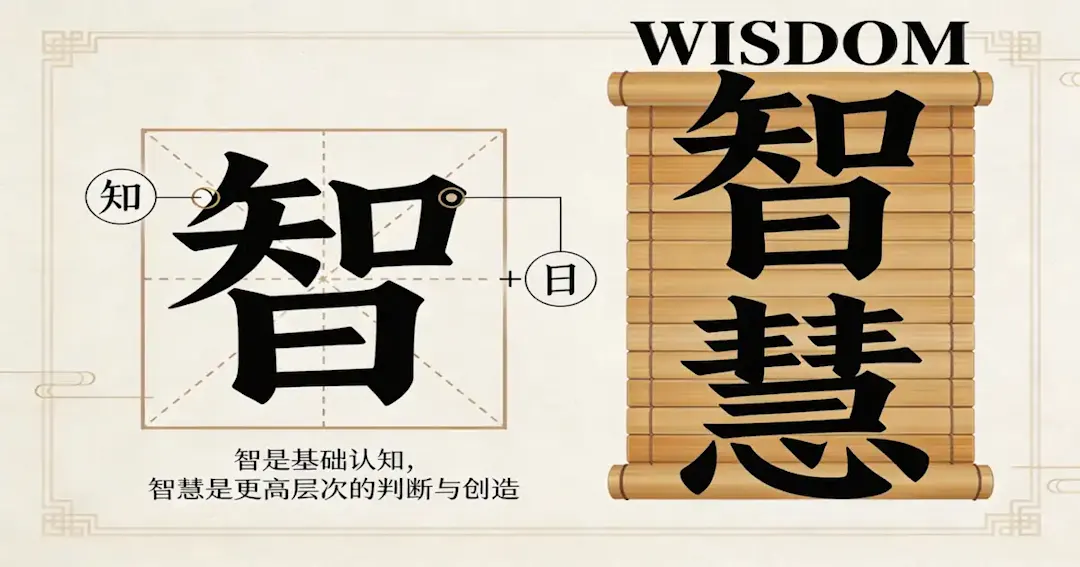
In the Chinese language, the character most commonly associated with "wisdom" is *Zhì* (智); however, in modern spoken and written contexts, the more natural and frequently used term is *Zhìhuì* (智慧).
If you are searching for "what is the Chinese character for wisdom," you are likely also interested in three related topics: What exactly is the difference between the characters *Zhì* (智), *Huì* (慧), and *Zhī* (知)? What aspects does "wisdom" emphasize within Chinese culture? And how can children learn about this concept without finding it tedious or difficult?This guide will clarify these questions using minimal technical jargon, while also providing practical phrases, idioms, and parent-child exercises that you can put to immediate use.
Chinese character for wisdom — the short answer (智 vs 智慧)
When people ask this question, they’re usually asking one of two things.
“What single character means wisdom?”
That’s 智 (zhì). You’ll see it inside words about judgment, strategy, and being wise.
“What word do people actually say?”
That’s usually 智慧 (zhìhuì)—a two-character word that feels complete and natural in modern Mandarin.
Copy-and-use examples:
他很有智慧。 (He has wisdom.)
这不是聪明的问题,是智慧的问题。 (This isn’t about being clever; it’s about being wise.)
Kids learn faster when the character lives inside a real word they can say, not as an isolated symbol they only recognize on flashcards.
what 智 actually means (not just “smart”)
In English, “smart” covers everything: test scores, quick comebacks, even being good at Minecraft. In Chinese, 智 leans more toward discernment—thinking clearly and choosing well.
A simple way to explain it to a child:
聪明 (clever) is “I can figure it out.”
智慧 (wise) is “I can choose the right thing to do.”
Two real-life examples:
Your child learns how to negotiate extra screen time by asking the “yes” parent after the “no” parent. That’s clever.
Your child says, “I’m mad, so I’m going to cool down first,” and then comes back to solve the problem. That’s closer to 智.
It gives you vocabulary for emotional regulation and decision-making—skills you already teach, now with language that matches the lesson.
The confusion zone:智 vs 慧 vs 知
Search results can make it look like 智, 慧, and 知 are interchangeable. They’re not, and sorting this out is often the difference between “my kid remembers the word” and “my kid actually uses it.”
A parent-friendly cheat sheet:
智 (zhì):practical wisdom, judgment, choosing well.
慧 (huì):insight, inner clarity; often feels more reflective.
知 (zhī):to know / knowledge (useful, but not “wisdom” by itself).

Why 智慧 is the default modern “wisdom”
智慧 blends the “good judgment” flavor of 智 with the “insight” flavor of 慧. That’s why it’s the go-to word in school materials, books, and everyday speech.
If your child tries to use 知 alone for wisdom, steer them to:
知道 / 知识 for “to know / knowledge”
智 / 智慧 for “wisdom”
why 智 matters in Chinese culture (without the lecture)
Parents sometimes worry cultural explanations will turn into a history class. You don’t need that. What you need is this: in many Chinese family contexts, wisdom is judged by behavior, not trivia.
In other words, 智 isn’t “I know a lot.” It’s “I choose well.”
The “wisdom” words families actually say
In everyday parenting talk, you’ll hear praise that points to judgment and social awareness:
懂事 (considerate, “gets it”)
有分寸 (knows boundaries)
会看情况 (reads the situation)
Those phrases are cultural, yes—but they’re also practical. They describe the kind of maturity parents want kids to build.
If you’re thinking, “This is helpful, but I can’t be the curriculum every week,” that’s normal. A structured class can keep speaking, reading, and culture moving forward without you building lesson plans at 9 p.m. If you want a simple next step, you can book a LingoAce trial class and see whether guided lessons fit your family’s routine.
Idioms and phrases you can actually use at home
This is the section most parents come back to. Idioms are “advanced,” but they’re also memorable—especially when you tie them to a moment your child just lived.
Pick two or three. Use them for a week. Let them become family language.
智慧 (zhìhuì)— wisdom Example: 这次你先道歉,很有智慧。 (Apologizing first was wise.)
理智 (lǐzhì)— level-headed Example: 我知道你生气,但我们先理智一点。 (I know you’re upset, but let’s be rational.)
明智 (míngzhì)— sensible, wise choice Example: 你先完成作业是明智的。 (Finishing homework first was sensible.)
睿智 (ruìzhì)— wise and insightful (a “grown-up compliment”) Example: 这个决定很睿智。 (That decision was very wise.)
智谋 (zhìmóu)— strategy Example: 下棋靠的不只是运气,也要有智谋。 (Chess takes strategy, not just luck.)
智勇双全 (zhì yǒng shuāng quán)— wise and brave Example: 你敢举手发言,也想得很清楚,智勇双全。 (You spoke up and thought clearly—wise and brave.)
大智若愚 (dà zhì ruò yú)— great wisdom may look simple Example: 有时候不争,也是智慧。大智若愚。 (Sometimes not arguing is wisdom.)
智者 (zhìzhě)— a wise person (great for stories) Example: 故事里的智者先听,再说。 (The wise person listens before speaking.)
How kids can learn 智/智慧 without turning it into a fight
If you’ve tried “just write it 20 times,” you already know the outcome: tears, frustration, and a character that still won’t show up in speech.
Try this instead.
Ages 3–6: attach meaning to a moment (no writing pressure)
Say it in context: “That was a wise choice—很有智慧。”
Add one dinner question: “What was your wise choice today?”
Use one bedtime story and label the “wise moment.”
Ages 7–10: build the word first, then the character
Teach 智 inside 智慧 first (kids remember two-character words well).
One neat copy, then one spoken sentence.
Play “spot it”: find 智 in books, posters, or subtitles.
This is the age when many families see a gap—kids understand home Chinese, but can’t express “bigger” ideas like fairness, self-control, or good judgment. Learning the chinese character for wisdom (and the word 智慧) gives them language for those moments.
Ages 11–15: level up with idioms and real-life decisions
Choose 2 idioms (明智, 理智, 智勇双全) and tie them to school life.
Ask one opinion question: 你觉得这样做明智吗?为什么? (Was that sensible? Why?)
Connect it to online behavior and friendships—places teens need “wisdom” daily.
FAQ
1) Is 智 or 智慧 more natural in everyday Mandarin?
Most people say 智慧 in conversation. 智 shows up a lot inside compounds (明智、智者、智谋), and it also appears in names and formal contexts.
2) Does 智慧 mean “intelligent”?
Not exactly. 智慧 points more to wise judgment than raw intelligence. A child can be聪明 (clever) and still need智慧 (wise decision-making).
3) What are easy wisdom phrases for kids?
Start with 明智 (sensible), 理智 (level-headed), and 智勇双全 (wise and brave). They fit school and family situations naturally.
4) How do you pronounce 智 and 智慧?
智 is zhì (fourth tone). 智慧 is zhìhuì (fourth tone + fourth tone). If tones are hard at first, keep the rhythm consistent and refine over time.
5) Is 智慧 a good choice for a tattoo or gift design?
Often yes, because it clearly reads as “wisdom.” Keep the font readable and avoid adding extra characters unless you’re sure the phrase sounds natural.
Conclusion
If you started with a search for the chinese character for wisdom, the most useful takeaway is simple: 智 is the core character, and 智慧 is the everyday word you can use with your child. From there, make it practical—praise a sensible choice (明智), coach calm thinking during conflict (理智), and borrow one memorable idiom that fits your family.
If you’d like your child to build this kind of vocabulary with steady speaking practice—so “wisdom words” become natural instead of forced—you can try a LingoAce trial class and see how guided lessons support confidence and literacy over time.