
Intro: The Power of Conjunction Words—See the Difference
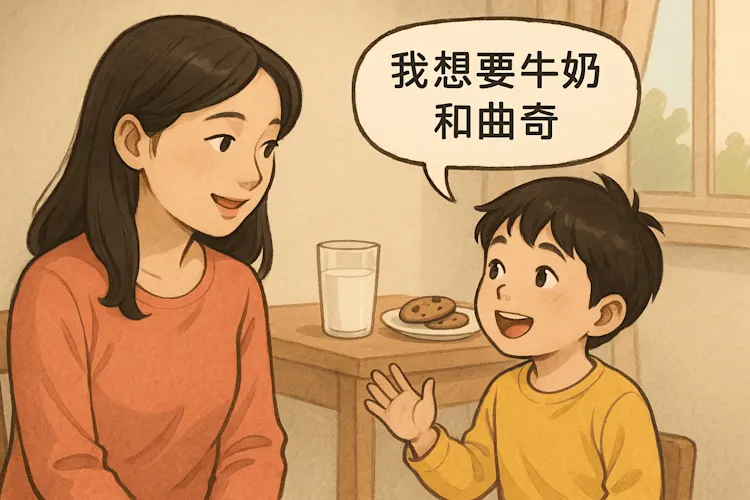
Does your child's Chinese sound like this: "I want milk. I want cookies." Or maybe: "Go to park. Play on slide. Go home."?
The words are all correct, but the flow is missing. Now, what if, with one small change, they could say this instead? "I want milk and cookies, but I want to play first."
That huge leap isn't about more words. It's about connecting them. The magic ingredient is the "language glue"—Chinese Conjunction Words.
Teaching these connectors is the key to moving your child from simply stacking words to actually telling stories. It’s the fastest way to make their speech sound natural and fluent.
In this ultimate guide, we, as experts in children's language education, will walk you through, step-by-step, how to teach the most essential Chinese Conjunction Words. By the end, you will know exactly how and when to use these tools to help your child improve their Chinese and sound more confident and far more fluent.
Step-by-Step Guide: 5 Steps to Mastering Chinese Conjunction Words
Learning these connecting words isn't about memorizing a long list. It's a 5-step journey that takes you (and your child) from basic addition to complex hypothesizing. Let's begin.
Step 1: Mastering "Addition" - How to Connect Parallel Ideas
This is the foundation: teaching your child to say 'and' and 'also'. But be careful, this is where many learners (and parents) make their first big mistake.
和 (hé) – and
How to Use: The golden rule: 和 (hé) connects only nouns (people, objects, places). It cannot link verbs, adjectives, or whole sentences.
Example: He loves his toy car and teddy bear. (他喜欢他的玩具车 和 泰迪熊。 Tā xǐhuān tā de wánjù chē hé tàidíxióng.)
也 (yě) – also / too
How to Use: Use 也 (yě) to show a shared action or state (it links the verb/adjective). Its position is non-negotiable: it goes before the main verb/adjective.
Example: Your brother is tall. You are also tall. (哥哥很高,你 也 很高。 Gēgē hěn gāo, nǐ yě hěn gāo.)
还 (hái) – also / in addition
How to Use: 还 (hái) emphasizes an extra, supplementary item/action—something added on top of what’s already been mentioned.
Example: He wants milk, and he also wants a cookie. (他要牛奶,还 要饼干。 Tā yào niúnǎi, hái yào bǐnggān.)
Step 2: Creating "Contrast" - How to Say "But" Naturally
Once your child can add ideas, the next step is to contrast them. This is what makes their conversation dynamic. This is a crucial part of learning how to use Chinese conjunctions.
但是 (dànshì) - but
How to Use: Think of 但是 (dànshì) as the main, "go-to" word for "but." It's the most standard, neutral connector. It works perfectly in any situation to state a clear, direct contrast.
Example: He wants to play outside, but it's raining. (他想出去玩,但是 下雨了。 Tā xiǎng chūqù wán, dànshì xià yǔle.)
可是 (kěshì) – but / however
How to Use: 可是 (kěshì) is the close cousin of 但是. They're almost interchangeable, but this one has a different feeling. 可是 (kěshì) sounds a bit more conversational and often implies a slight sigh or a touch of regret.
Example: She really likes that toy, but it's too expensive. (她很喜欢那个玩具,可是 太贵了。 Tā hěn xǐhuān nàgè wánjù, kěshì tài guìle.)
Step 3: Explain "Cause & Effect" – Answer "Why" Logically
This step is core to logical expression. Mastering this structure allows your child to build arguments, explain their decisions, and form sophisticated thoughts.
因为... 所以... (yīnwèi... suǒyǐ...) – because... so...
How to Use: The classic cause-effect structure. 因为 (yīnwèi) introduces the reason, 所以 (suǒyǐ) introduces the result.
Example: Because he finished his homework, so he can play games. ( 因为 他做完作业了,所以 他可以玩游戏。 Yīnwèi tā zuò wán zuòyèle, suǒyǐ tā kěyǐ wán yóuxì.)
Authoritative Pro-Tip: Unlike English (where "because" and "so" never pair), Chinese often uses both together. It’s not redundant—it’s grammatically complete and makes the logic crystal clear for a child. This is a key feature of Chinese Conjunction Words.
Step 4: Narrate "Sequence" - How to Tell a Story
When describing their day or a story, sequential conjunctions turn your child's simple statements into a flowing narrative.
然后 (ránhòu) – then
How to Use: The most common word for "then." It simply states that action B happens after action A—casual and flexible.
Example: Let's read a story, then go to sleep. (我们读一个故事,然后 去睡觉。 Wǒmen dú yīgè gùshì, ránhòu qù shuìjiào.)
先... 再... (xiān... zài...) – first... then...
How to Use: This emphasizes a planned, ordered sequence (first do A, then do B). It's fantastic for teaching your child routines.
Example: First finish your dinner, then you can have dessert. ( 先 吃完饭,再 吃甜点。 Xiān chī wán fàn, zài chī tiándiǎn.)
Step 5: Handle "Conditions & Choices" – The Final Fluency Step
This advanced step lets your child talk about hypotheticals ("if") and choices ("or")—a sign of true fluency.
如果... 就... (rúguǒ... jiù...) – if... then...
How to Use: The standard conditional structure. 如果 (rúguǒ) introduces the condition, 就 (jiù) introduces the result. This is perfect for setting expectations.
Example: If you clean up your toys, then we can go to the park. ( 如果 你收拾好玩具,我们 就 去公园。 Rúguǒ nǐ shōushí hǎo wánjù, wǒmen jiù qù gōngyuán.)
还是 (háishì) vs. 或者 (huòzhě) – or
Critical Rule: This is a make-or-break distinction for learners.
还是 (háishì): Used for choices in questions (asking "which one?").
或者 (huòzhě): Used for choices in statements (stating options).
Question Example: Do you want an apple or a banana? (你要苹果 还是 香蕉? Nǐ yào píngguǒ háishì xiāngjiāo?)
Statement Example: You can have an apple or a banana. (你可以吃一个苹果 或者 一个香蕉。 Nǐ kěyǐ chī yīgè píngguǒ huòzhě yīgè xiāngjiāo.)
Mastering this single rule in your child's Chinese grammar for beginners journey will make them sound significantly more professional.
Chinese Conjunction Words Core Cheat Sheet
Congratulations on completing the 5 steps! Here is a cheat sheet you can save for a quick review and comparison of the most common Chinese conjunctions.
Conjunction | Pinyin | English Meaning | Function | The Golden Rule (How to Use) |
和 | hé | and | Addition | Connects Nouns ONLY. (e.g., apple and banana) |
也 | yě | also / too | Addition | Connects Verbs/States. Must be before the verb. (e.g., I also like) |
但是 | dànshì | but | Contrast | The most standard, all-purpose "but." |
可是 | kěshì | but / however | Contrast | Slightly softer and more informal than 但是. |
因为...所以... | yīnwèi... suǒyǐ... | because... so... | Cause & Effect | Often used together in Chinese (unlike English). |
然后 | ránhòu | then | Sequence | Used for simple "A, then B" order. |
还是 | háishì | or | Choice (Question) | Used ONLY in questions. (e.g., Tea or coffee?) |
或者 | huòzhě | or | Choice (Statement) | Used ONLY in statements. (e.g., We can have tea or coffee.) |
如果...就... | rúguǒ... jiù... | if... then... | Condition | The classic "if..." structure. |

3 Common Chinese Conjunction Words Mistakes (And How to Fix Them)
You've learned the 5 steps! Now, let's look at the "traps" that almost every learner—and parent—falls into. If you hear your child make these mistakes, don't worry! They are easy to fix.
Mistake 1: Using 和 (hé) to connect verbs or sentences.
Incorrect: "I like singing and dancing." (我喜欢唱歌 和 跳舞。 Wǒ xǐhuān chànggē hé tiàowǔ.)
The Fix: Remind them that 和 (hé) connects things (nouns). When connecting actions (verbs), native speakers just use a comma. (e.g., "我喜欢唱歌、跳舞。" Wǒ xǐhuān chànggē, tiàowǔ.)
Mistake 2: Using 或者 (huòzhě) in a question.
Incorrect: "Do you want to play inside or go out?" (你想在家玩 或者 出去玩? Nǐ xiǎng zàijiā wán huòzhě chūqù wán?)
The Fix: This is a non-negotiable rule. Questions always use 还是 (háishì).
Mistake 3: Putting 也 (yě) at the end of the sentence.
Incorrect: "He likes Chinese. I like also." (他喜欢中文,我喜欢 也。 Tā xǐhuān Zhōngwén, wǒ xǐhuān yě.)
The Fix: 也 (yě) is an adverb; it must be placed before the verb it modifies. The correct way is: "我 也 喜欢。" (Wǒ yě xǐhuān.)
FAQs About Chinese Conjunction Words
1. How do you really use "and" in Chinese? (The 和 vs. 也 rule)
This is the most common question for a reason. The rule is simple: 和 (hé) is used ONLY to connect nouns (e.g., "tea and coffee"). 也 (yě) is used to show a shared action or state, and it must go before the verb (e.g., "I also like tea."). You cannot use 和 (hé) to connect two sentences.
2. What is the absolute difference between 还是 (háishì) and 或者 (huòzhě)?
This is another critical rule from our guide. It's simple and very consistent:
还是 (háishì) is ONLY used in Questions. (e.g., "Do you want tea or coffee?")
或者 (huòzhě) is ONLY used in Statements. (e.g., "I am free on Saturday or Sunday.")
3. Is it a mistake to use 因为 (yīnwèi) and 所以 (suǒyǐ) together?
No, it is not a mistake! In English, saying "Because... so..." is a major grammar error. However, in Chinese, using the full 因为...所以... structure is considered grammatically complete, correct, and the clearest way to state cause and effect. You can use them together.
4. What is the best way to practice how to use Chinese conjunctions?
The fastest way to master common Chinese conjunctions is through active use and correction. Reading helps, but you will only internalize these rules by actively producing sentences in real conversation. This is why guided, 1-on-1 online classes are so effective, as a professional teacher can correct your mistakes in real-time before they become habits.
Conclusion: It's Time to Practice
Your child is no longer a learner who only speaks in "robotic" Chinese. You have the "language glue" to help them.
Through these 5 steps, you've learned how to teach your child Chinese Conjunction Words to add (和/也), contrast (但是), explain (因为/所以), sequence (然后), and choose (还是/或者). You've also learned the 3 most common mistakes to fix.
The theory is now in your hands. The next step is to turn it into muscle memory. The best way to practice is to have your child be guided and corrected by a professional in a live conversation.

Book your first free trial class at LingoAce today. Let our certified, native-speaking teachers help your child confidently use these essential Chinese connecting words in fluent, natural conversations.