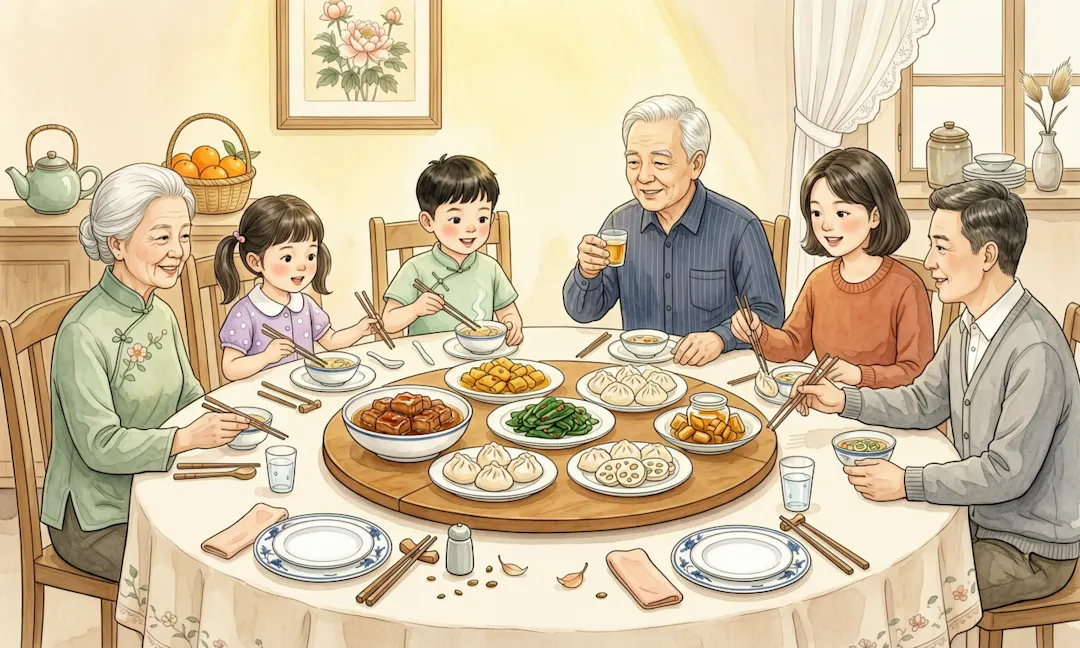

You don’t need to “know all the rules” to enjoy a Chinese meal. But… a few basics of chinese dining etiquette can save you from that awkward moment where everyone pauses and you realize you just did the one thing you weren’t supposed to do.
This guide is for parents, families, and anyone who wants to feel relaxed at a Chinese restaurant, a Lunar New Year dinner, or even a work banquet. We’ll cover what people actually notice: when to start eating, who sits where, chopstick taboos, and how to toast without panic. Along the way, I’ll slip in kid-friendly ways to practice—because table manners are basically culture + language in action.
What is chinese dining etiquette—and why it feels “different” at first?
At a typical Western meal, your plate is your territory. In many Chinese meals, the table is a shared space: dishes in the middle, people offering food, and subtle signals about respect and togetherness.
A big part of chinese dining etiquette is not “being perfect.” It’s showing you’re tuned in—watching the host, noticing elders, pacing yourself with the table, and treating shared food with care. Official culture guides often frame it this way: follow the host’s lead and respect communal norms.
If you’ve ever wondered why toasting can feel intense, researchers who study Chinese dining contexts point out that toasting isn’t just about drinks—it’s a ritual that builds relationships and signals hospitality.
That’s the “why.” Now the useful part.
Chinese dining etiquette for seating: who sits where (and why anyone cares)
If you walk into a Chinese banquet room and see a big round table, there’s a decent chance seating is not random—even if there are no name cards.
The common pattern (especially at banquets)
Many guides describe a “main seat” concept—often the seat that feels most prominent (sometimes facing the door, sometimes centered). The host and guest of honor placement can follow hierarchy.
Everyday family dinner vs banquet seating
Casual family meal: seating is looser, but elders still often get the most comfortable spot.
Banquet / formal dinner: you may be guided to a seat. If you’re the honored guest, expect a little ceremony.
Business dinner: seating can be strategic. If you’re unsure, don’t guess confidently—hover politely.
The polite move when you don’t know
Try this simple script (it works because it signals respect):
“Where would you like me to sit?”
“Please, you first.”
It sounds small, but this is classic chinese dining etiquette: show you’re considerate, not in a rush to claim the best chair.
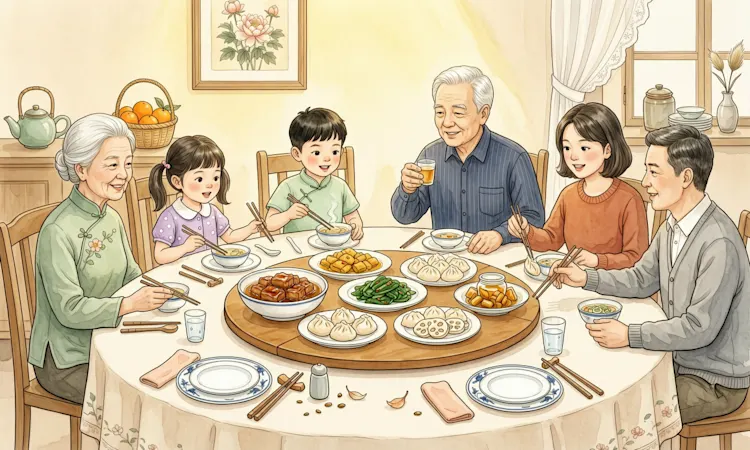
Chinese dining etiquette for starting, serving, and handling shared dishes
If you remember one thing: don’t start eating like you’re racing the clock.
Many travel and etiquette guides make the same point—wait for the host or elders to begin, or for a clear cue like “let’s eat.”
When do you start eating?
Good default:
Host sits.
Elders settle in.
The host welcomes everyone (sometimes with tea, sometimes with a toast).
Then eating starts.
If food arrives early and you’re starving—same answer: follow the room.
Serving others first (without turning it into a performance)
A practical “parent version” of chinese dining etiquette:
Offer a bite to grandparents/elders first.
If you’re closest to a dish, rotate it toward others before taking your portion.
If there are serving spoons/chopsticks, use them.
And yes, the “serving others” thing can feel intense if you’re not used to it. People on forums talk about the awkwardness of others placing food into your bowl, especially when personal chopsticks are involved—some find it sweet, some find it… kind of gross. That tension is real.
Lazy Susan manners (the spinning tray)
Rotate gently.
Don’t spin it like a game show wheel and grab.
Take from the near side; don’t reach across people.
This shows you understand chinese dining etiquette in a shared setting.
If you want your child to respond more naturally at the table—ordering food, thanking relatives, accepting or politely declining a toast—some parents use scenario-based Chinese lessons to rehearse these exact moments (restaurant ordering, serving elders, toast responses, polite refusals) with a teacher guiding pronunciation and confidence. You can also book a LingoAce trial class to see whether this “use Chinese in real life” style fits your family’s routine.

Chinese dining etiquette with chopsticks: the taboos people actually notice
Chopsticks are where most newcomers worry—fair. The good news: most people are forgiving. The bad news: a couple of chopstick actions are genuinely jarring in Chinese culture.
The “top 7” chopstick don’ts
Don’t stick chopsticks upright in rice (it resembles funerary offerings).
Don’t point with chopsticks (at people or across the table).
Don’t spear food like a fork (unless it’s a super casual setting and you’re clearly struggling).
Don’t drum chopsticks on bowls/plates (often read as rude).
Don’t hover and “dig” through a dish hunting the best piece.
Don’t lick chopsticks or wave them while talking (yes, people do this without realizing).
Don’t use your chopsticks to move communal food around like you’re sorting laundry.
“But what if there are no serving chopsticks?”
Some families use personal chopsticks for everything; others insist on serving chopsticks/spoons for shared dishes. If none are provided and you’re a guest, follow the group’s norm.
If you want to be extra polite (especially with mixed-company tables), you can ask:
“Do we have serving chopsticks?”
If not, just take from the edge, cleanly.
Chinese dining etiquette for toasting: ganbei without panic
Toasting is the part of chinese dining etiquette that makes adults sweat—especially at business dinners.
Researchers studying toasting in Chinese dining contexts describe it as a structured social ritual: it can show warmth and connection, and it can also apply pressure depending on context.
What “ganbei” really means
Ganbei is commonly understood as “empty the glass,” and in some settings people treat it literally.
But there are softer options and polite ways to sip instead, especially if you have health, religion, pregnancy, or simply “I don’t drink” reasons.
On discussion boards, people explicitly connect full-drink expectations to “face” in certain business environments—especially in parts of China where drinking culture is intense.
The respectful glass-height rule
A well-known rule: when clinking glasses with a senior, keep your glass slightly lower to show respect.
Polite ways to decline alcohol (that don’t kill the mood)
Use a reason + enthusiasm:
“I’d love to toast with you—may I do tea/juice today?”
“I’m driving, but I’m very happy to toast!”
In many rooms, it’s not the alcohol that matters—it’s the participation.
FAQ
What is the single most important rule in chinese dining etiquette?
Follow the host and elders. If you wait for the cue to start eating and keep your pace with the table, you’ll avoid most awkward moments.
How does Chinese banquet seating order work?
Seating can follow an unspoken hierarchy, especially at formal banquets. If you’re unsure, ask the host where you should sit—it’s considered polite, not clueless.
What are the biggest chopstick etiquette taboos?
The most widely mentioned taboo is sticking chopsticks upright in rice, because it resembles a funerary offering. Also avoid pointing, drumming, or “hunting” through a dish.
What are the key ganbei toasting rules in China?
“Ganbei” is often treated as “finish the drink,” but social expectations vary. A respectful approach is to participate in the toast, keep your glass slightly lower than elders’ when clinking, and use a polite alternative drink if needed.
How do I teach chinese dining etiquette for kids without making them anxious?
Use one rule per meal and short role-plays. Kids learn faster when etiquette is tied to simple phrases and predictable steps (“wait,” “offer,” “thank you”). Keeping it light is the point.
Conclusion
You don’t have to be perfect at chinese dining etiquette. You just need a few anchors: wait for the host, respect elders, handle chopsticks thoughtfully, and treat toasting as connection—not a drinking contest.
If your family wants to go one step further, try practicing a couple of polite phrases at home before your next dinner out. And if you’d like your child to build real-world confidence—ordering food, thanking relatives, responding to toasts politely—consider booking a LingoAce trial class to see if guided scenario practice fits your routine.