
If you’re deciding between Chinese, Japanese, and Korean for your child, you’re not really asking “Which is hardest?” You’re asking a more practical question: which language will my kid actually stick with long enough to make progress—without turning your evenings into a negotiation.
Chinese vs Japanese vs Korean: what “difficulty” really means for kids
Parents often talk about “difficulty” like it’s one score. Kids don’t learn like that.
A language can feel easy in Week 1 and suddenly get sticky in Month 3. Or it can feel confusing at first… then click because the learning path is well-designed (and the kid gets small wins early).
When families compare chinese vs japanese vs korean, it helps to split difficulty into four buckets:
Speaking & listening (Can your child hear and repeat accurately?)
Reading (Can they decode and understand what they see?)
Writing (Do they have to remember symbols, spellings, stroke order?)
Staying motivated (Do they want to come back tomorrow?)
That last one is not a “soft factor.” It’s the factor.
A practical note that’s oddly calming: the U.S. Foreign Service Institute groups Mandarin Chinese, Japanese, and Korean as “exceptionally difficult” for native English speakers when measured to professional-level proficiency. That’s adult training for high-level outcomes, not a child learning conversation basics—but it explains why parents feel intimidated.
So instead of “hard vs easy,” we’ll use a parent decision lens:
What’s hardest at the beginning?
What becomes hardest later?
What keeps kids engaged long enough to build momentum?

Pronunciation: tones, pitch, and the “can my kid even hear it?” worry
If you’ve heard “Chinese is hard because of tones,” you’re not wrong… but it’s also not the whole story.
Chinese pronunciation: tones are real, but kids learn them differently than adults
Tones matter because a syllable with a different pitch contour can change meaning. That sounds scary until you remember: kids are pattern machines. If they get consistent input and quick feedback, they adapt.
Research on tone learning shows learners can improve tone perception with structured exposure (even within a short period). The big takeaway for parents is not “tones are impossible,” it’s “tones need an intentional plan.”
What helps at home (simple, not fancy):
Micro-listening: play a short clip, have your child point to the “same” vs “different” sound.
Echo games: you say it, they copy, you exaggerate once, then normalize.
Tone + meaning together: don’t drill tones as abstract music; tie them to meaning so it sticks.
Japanese pronunciation: easier entry, then “sounding natural” becomes the challenge
Many kids can imitate Japanese sounds comfortably early on. The later challenge is rhythm, long vowels, and subtle pitch patterns in natural speech. Parents often don’t notice this at first—because beginners still sound “good enough.” That’s okay.
Korean pronunciation: fast start for some kids, tricky spots for others
Korean can be friendly in the beginning (especially if your child enjoys crisp consonants and clear syllables). But some learners find specific contrasts tricky, and speaking speed can feel like it ramps up quickly.
If you want one sentence to remember: pronunciation difficulty changes by child, not just by language. This is why a quick trial lesson (with real feedback) is more useful than a hundred opinions online.
Writing systems: Hanzi vs Kanji vs Hangul
If pronunciation is the first big worry, reading/writing is the thing that quietly determines how long the journey feels.
The core difference
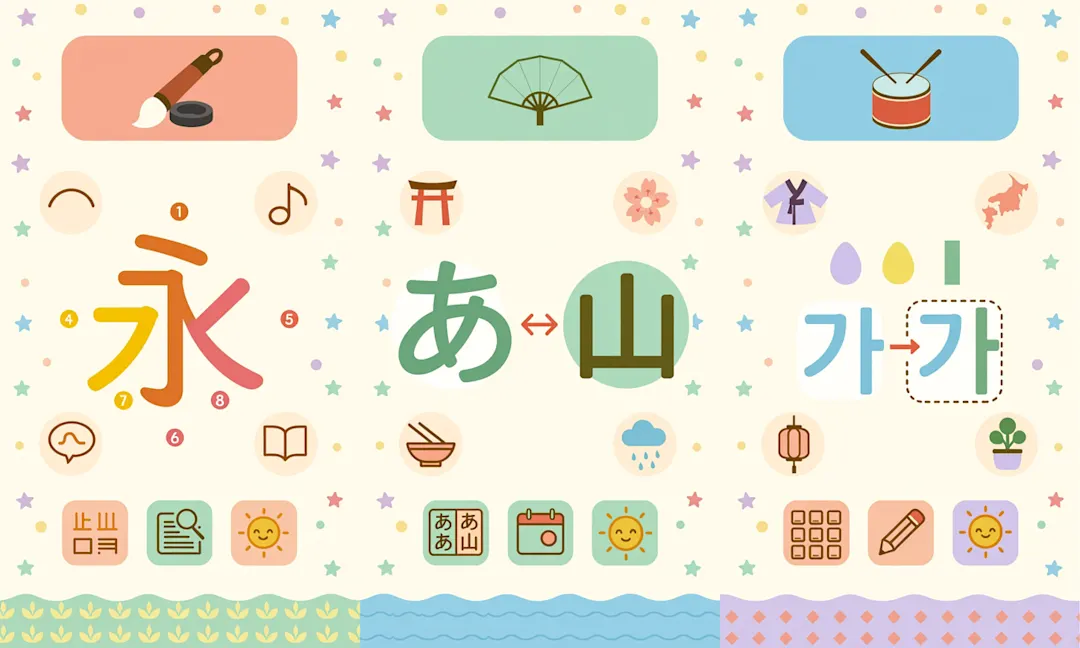
Chinese uses Hanzi characters. Reading progress depends on character recognition patterns and repetition.
Japanese uses a mix (kana + kanji), which means kids juggle two systems plus kanji readings.
Korean uses Hangul, which is highly systematic—many learners can decode quickly, and then vocabulary/grammar becomes the heavier lift.
This is why families arguing about chinese vs japanese vs korean often talk past each other. One person is thinking “Can I read quickly?” Another is thinking “Can I speak?” Both are valid.
Quick comparison table
Skill area | Chinese | Japanese | Korean |
Early reading start | Slower start (characters) | Mixed start (kana helps, kanji adds load) | Faster start (systematic alphabet) |
Writing load | High (characters) | High (kana + kanji) | Lower at first (spelling + later vocab) |
“Hidden” challenge | Tones + character retention | Kanji readings + formal/informal patterns | Fast speech + nuance + later grammar depth |
Best early win strategy | Speak early + character patterns later | Kana confidence early + small kanji sets | Hangul decoding early + phrase building |
This doesn’t mean Chinese is “the hardest” or Korean is “the easiest.” It means the stress points are different.
This is also the moment where many parents decide they don’t want to DIY the entire plan. If you choose Chinese but want a structured path with live teachers who can correct pronunciation and keep momentum, booking a Lingoace trial class can quickly show you your child’s current level and what to focus on first.
Vocabulary and transfer: does learning one help with the others?
This is the part parents want to be true: “If we start with one, the others will be easy later.”
Reality is… mixed.
There can be conceptual transfer: how to study, how to memorize, how to use spaced repetition, how to practice speaking without freezing.
There can be character exposure transfer between Chinese and Japanese in specific contexts (recognizing some kanji origins), but that doesn’t automatically make reading easy—Japanese kanji usage and readings add complexity.
Between Korean and Japanese, some learners notice patterns in grammar style, but it’s not a magic shortcut.
Online learner discussions often summarize it like this: Chinese grammar may feel simpler, Japanese/Korean grammar can feel heavier, and literacy demands vary depending on the writing system.
So if your family is choosing based on “future transfer,” choose based on your actual next 12 months. Pick the path your child will do consistently, because consistency creates the real transfer: confidence.
FAQ
1) Which is easiest for English-speaking kids: chinese vs japanese vs korean?
It depends on which “easiest” you mean. Korean often feels easier to decode early due to Hangul. Chinese can feel more straightforward in early grammar, but tones require intentional practice. Japanese can feel comfortable to imitate early, while literacy complexity grows later.
2) Is Chinese harder than Japanese or Korean because of tones?
Tones add a real layer, yes. But learners can improve tone perception with structured exposure, and kids often adapt well with consistent feedback.
3) Hanzi vs Kanji vs Hangul: which writing system is hardest for children?
Hanzi and kanji generally require more memorization, while Hangul is more systematic. Japanese literacy can feel complex because kids manage kana plus kanji and different readings. The “hardest” is the one introduced too fast without a plan.
4) If my child starts with Chinese, will Japanese be easier later?
Some character familiarity and study habits can transfer, but Japanese has its own usage patterns and readings. Transfer helps, but it’s not a shortcut that replaces practice.
5) What’s the best age to start chinese vs japanese vs korean?
A workable answer is: start when your family can be consistent. Younger kids benefit from listening/speaking habits; older kids can handle more explicit learning. The best age is the age you can protect a routine.
6) How long until my child can have a real conversation?
If your child practices most weeks and gets feedback, many families see meaningful speaking progress within the first year—especially for daily routines (introductions, preferences, simple questions). What changes the timeline most is consistency, not “the perfect language.”
Conclusion
If you’re stuck choosing between chinese vs japanese vs korean, don’t try to predict the next ten years. Choose the next year.
Pick the language that matches your child’s motivation and your family’s real schedule.
Plan early wins (speaking wins for Chinese, decoding wins for Korean, structured wins for Japanese).
Get feedback early so your child doesn’t practice mistakes for months.
If you’re leaning toward Chinese and want a clear starting level and a structured path that keeps kids engaged, consider booking a Lingoace trial class to see what your child can already do and what to prioritize first.