If you searched “chinese manga,” chances are you were trying to answer a very parent question: “Is this the same thing as manga… and is it something my kid can read?” Maybe your child is already obsessed with comic panels, or maybe you’re looking for a hook—anything—that gets them to look at Chinese characters without a fight.
Here’s the reassuring truth: “Chinese manga” is usually what English speakers call manhua—Chinese-language comics. And yes, it can be a surprisingly practical stepping-stone into real Chinese reading, especially for kids who would rather read speech bubbles than textbooks.
This guide is built for busy parents. You’ll get: the clearest definitions (without a lecture), the differences that actually matter for families, a simple “starting lane” based on your child’s age and reading comfort, and a low-stress way to turn one chapter into steady literacy growth.
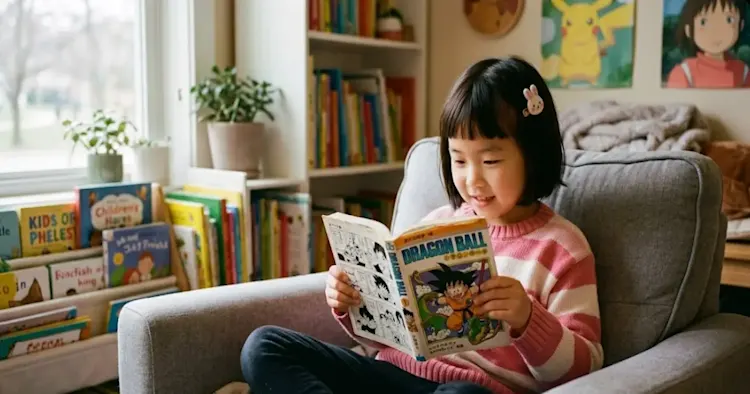
What is “Chinese manga”?
When people say “Chinese manga,” they’re typically pointing at manhua: Chinese-language comics created in Greater China and written in Chinese characters. The naming is confusing because the words manhua (Chinese), manga (Japanese), and manhwa (Korean) look and sound like cousins—and in English conversations they often get used loosely.
A useful way to think about it at home:
Manga = comics from Japan
Manhwa = comics from Korea
Manhua = comics from Chinese-speaking regions
You’ll also see “webcomics” and “webtoons.” Those describe format more than origin: vertical scrolling, full color, short episodes—perfect for phones, and very common in modern manhua.
One more family-friendly note: “Chinese manga” doesn’t mean a single style. Some manhua looks like Japanese manga, some looks like a glossy illustrated novel, and a lot of it is built for scrolling. So if you tried one title and thought, “This isn’t for us,” it may have been the wrong format—not the wrong idea.
Chinese manga vs manga vs manhwa: the differences that actually matter
Parents don’t need an art-history unit. You need to know what changes your child’s reading experience.
1) Reading direction and layout
Many Japanese manga (especially print) is read right-to-left.
Many modern manhua and manhwa—especially digital-first series—read left-to-right or scroll vertically.
Why you care: reading direction affects frustration. A child who’s new to comics can spend more energy figuring out panel order than decoding characters. If your goal is reading confidence, the “easier layout” wins.
2) Color and visual density
Manhua is often full color and visually rich. That can be great for comprehension: pictures do real work. But it can also hide the fact that your child is skimming text. (More on how to handle that without ruining the fun.)
3) Names, cultural references, and language load
Even if your child already loves Japanese manga in English, switching to Chinese-language comics adds:
Chinese names (which can be tricky to remember at first)
culture-specific humor and historical references
character load: more unique characters than alphabet-based reading
Here’s the good news: speech bubbles tend to repeat. Kids see the same high-frequency verbs, reactions, and connectors again and again. That repetition is exactly what you want when building literacy.
Is Chinese manga OK for kids?
Some is. Some isn’t. And the labels are not always reliable—especially on unofficial repost sites. The goal is not to police every story; it’s to avoid unpleasant surprises and choose a few “safe wins.”
A quick 3-minute parent preview
Before you hand over a new title, skim three spots:
First episode: sets the tone
A random mid-episode: shows what “normal” looks like
The comments/ad section (if it’s an app): you’re checking for mature content, spoilers, and weird links
A practical checklist (you can do this fast)
Violence: slapstick? fantasy combat? graphic injury?
Romance: innocent crushes or adult themes?
Power dynamics: bullying, coercion, humiliating “punishment” jokes
Body focus: fan service, sexualized framing
Nighttime reading: if a title is spooky, it may be “fine” but not bedtime-friendly
If your child is 6–10, you’ll usually want shorter chapters, simpler vocabulary, and gentler themes. If they’re 11–15, you can go broader—but it’s still worth setting a “talk to me if this gets weird” rule, the same way you’d handle YouTube.
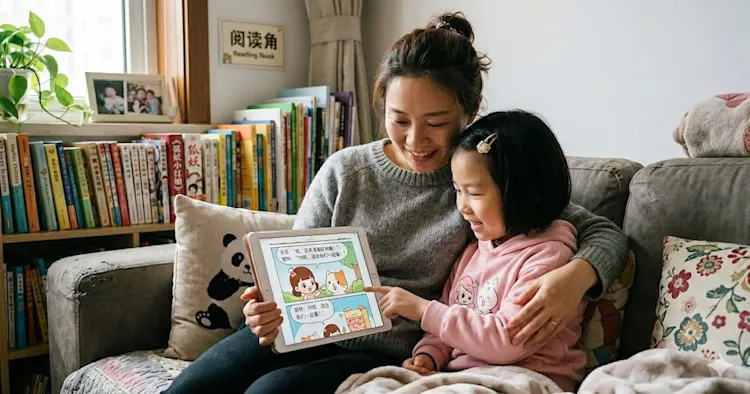
What are good Chinese manga (manhua) starting points for beginners?
This is where most guides fall apart: they throw a huge list at you. What parents actually need is a starting lane.
Lane A: Early readers (or kids who love pictures)
Your goal: build “I can read a bubble” confidence. Look for:
short speech bubbles
repeated phrases (“快点”, “不要”, “真的?”, “没关系”)
clear facial expressions that support meaning
Avoid:
long narration boxes
dense historical settings with lots of proper nouns
At home, you can set a tiny rule that still feels playful: “Read me two bubbles per page. You can narrate the rest in English.” That alone moves a child from pure skimming into actual decoding.
Lane B: Heritage kids who can speak but can’t really read
This is a very common North American profile: strong listening, good speaking, shaky reading stamina. Look for:
everyday dialogue, school life, family scenes
humor that relies on reaction phrases (great for high-frequency vocabulary)
stories with recurring settings so the vocabulary stabilizes
A helpful parent move: keep a sticky note (digital or paper) with 8–12 “bubble words” your child keeps seeing. Not a giant list. Just the ones that keep showing up.
Lane C: Non-heritage beginners (starting from scratch)
Be honest: most native-targeted manhua will feel too hard at first. Look for:
bilingual editions (Chinese + English) or simplified-level readers in comic format
children’s comics with strong picture support and minimal text
titles where you can enjoy the story even if you only catch 40% of the words
If your child is motivated but you’re not sure where their level is, that’s usually the moment parents start wanting a more reliable plan—something that tells you what to read next and why, instead of guessing.
Lane D: Tweens/teens who want “real” genres
Here the problem isn’t interest. It’s time. Teens will happily binge, but they won’t pause to study. So pick genres that keep them turning pages while still being readable:
modern school life
light fantasy with repeated skill terms
comedy with short dialogue
Set a reasonable goal: “Read for 10 minutes, then pick five words you actually care about.” Five. Not fifty.
How to tell if a title is “too hard” in 60 seconds
Pick any page and do a quick scan with your child:
Can they recognize at least a few “anchor” characters (我, 你, 他/她, 不, 要, 好, 去)?
Are the bubbles short enough that they’ll attempt them?
Does the art clearly show what’s happening even if the text is fuzzy?
A simple rule: if your child can follow the basic plot while only reading some bubbles, it’s workable. If they can’t tell who is doing what after a few pages, the frustration cost is too high. Put that title on a “later” shelf and choose something lighter.
A parent script that keeps confidence intact
Kids can smell a test. So instead of “Read this,” try:
“Want to tell me what’s happening in this panel?”
“Which bubble do you think is the funniest?”
“Can you find the word you saw yesterday?”
Those questions keep the story in the driver’s seat, while still nudging attention toward text.
If you’re choosing for siblings at different ages
One kid might want goofy humor; another wants action. You don’t have to force a single series.
Share the routine (10 minutes + five keepers) even if the titles differ.
Keep one shared “family word wall” for the most common reactions and connectors, so everyone benefits from overlap.
A note about “beginner-friendly” lists
A lot of recommendation lists are written for entertainment, not literacy. That’s fine—just don’t assume “popular” equals “readable.” When you’re choosing for learning, readability is the product.
How to learn Chinese with Chinese manga without turning it into homework
If you try to make comics feel like worksheets, kids will drop them. The trick is to separate reading for enjoyment from reading for growth.
The two-pass method (parent-proof)
Pass 1: Read for the story (no stopping)
Your child reads however they naturally read.
You only interrupt if they ask. This keeps motivation alive.
Pass 2: Read for five “keepers” Right after the chapter, ask: “What were five words or short phrases you noticed twice?”
Examples kids naturally pick:
reaction words (“哇”, “啊”, “行”, “不是吧”)
tiny connectors (“然后”, “但是”, “因为”)
verbs that carry the action (“想”, “去”, “来”, “看”)
Write the five keepers somewhere visible. Next time, your child will spot them again and feel smart. That feeling is the engine.
Bubble reading strategies that work in real houses
Read bubbles, ignore narration boxes at first. Narration is often harder.
Focus on names + verbs + “emotion words.” Those unlock the scene.
Use pictures as clues, not as cheating. Comprehension is still comprehension.
When stuck, ask a choice question: “Is the character angry or surprised?” It nudges them to read tone words without pressure.
What to do when your child asks, “Can you just tell me?”
This is the moment that can go two ways. If you translate everything, reading turns into passive listening. If you refuse to help, motivation drops. Try this middle path:
Ask them to point at the one character they think they know.
Give one tiny hint (a synonym, a gesture, or a single key word).
Let them guess the meaning of the whole bubble.
You’re training problem-solving, not perfection.
A 10-minute routine that actually fits a weekday
If your evenings are chaotic, aim for something you can repeat without negotiating:
Minute 1: Pick the chapter and set a timer.
Minutes 2–8: Read (no stopping).
Minutes 9–10: Choose five keepers and say them out loud once.
That’s it. Consistency beats intensity.
How to make progress visible (so you don’t quit too early)
Comics can feel “invisible” to parents because there’s no worksheet to point to. Try one of these:
Take a photo of your child’s five keepers each week and keep them in an album.
Circle the keepers in the next chapter when they reappear.
Once a month, have your child read an old chapter again and notice how much smoother it feels.
When kids notice their own progress, they start reading more on their own—and that’s the whole point.
What to ignore (for now)
rare idioms
decorative calligraphy
historical title soup (官/王/宗/府… all at once)
long exposition dumps
If you do nothing else, do this: Make a “repeat word jar.” Every time a word shows up in multiple chapters, it earns a spot. When the jar hits 25 words, your child has built a real foundation—and you did it without drills.
Here’s a common turning point: your child loves comics, but the reading level is either too hard or too easy, and you don’t know how to move them forward. That’s when a structured class can help—not to replace comics, but to make them readable faster. If you want a guided way to build characters, pronunciation, and reading confidence around your child’s interests, you can try a LingoAce trial lesson and ask the teacher to recommend a level and next-step reading goals.
Where to read Chinese manga safely (and what to watch for)
If you only remember one rule: favor official sources. Official platforms and library services are more likely to have consistent quality, clearer content labels, and fewer sketchy ads.
Safer places to start
Your local library’s digital services (many carry comics/graphic novels, and some have Chinese titles)
Official comic apps (look for well-known publishers, clear terms, and parent controls)
Print editions from reputable bookstores (less surprise content, easier to monitor)
What to watch for (especially with kids)
Unofficial repost sites: aggressive ads, pop-ups, and questionable links
Comment sections: spoilers, mature jokes, and occasionally bullying
“Free coin” mechanics: kids clicking through ads or in-app purchases
Data/privacy: avoid creating accounts with unnecessary personal info
A family rule that saves headaches: “No downloading random APKs, no ‘free chapter’ links from comments.” If a platform requires you to click through odd links to read, it’s not worth it.
Common parent problems (quick fixes)
“My kid only looks at pictures.”
That’s normal at the start. Try the “two bubbles per page” rule and keep it tiny. If they can do two bubbles, they’re reading.
“They reread the same chapter over and over.”
Also normal—and actually helpful. Rereading is how vocabulary sticks. Your job is to make reruns slightly more productive: pick one repeated phrase they can “own” each week.
“They get stuck on too many characters.”
Shrink the task. Don’t translate everything. Choose five keepers. If the text is too dense, switch to a simpler title or a more picture-supported series for a while.
“I don’t speak Chinese well enough to help.”
You don’t need to. You need a routine. Your child can use built-in dictionary tools, bilingual editions, or a teacher for the heavy lifting. Your role is consistency: “ten minutes, five keepers.”
FAQ about Chinese manga
Is it the same as manhua?
Most of the time, yes. In English searches, “Chinese manga” is usually a casual way of saying manhua—Chinese-language comics. If you want the precise term when you’re looking for Chinese originals, use “manhua” in your search.
What’s the difference between manhua and manga?
Origin and language are the big differences: manhua is Chinese-language comics; manga is Japanese comics. Format can differ too—many modern manhua is digital-first and full color, while many traditional manga is black-and-white print (though there are plenty of exceptions).
What’s the best Chinese manga for total beginners?
The “best” one is the one your child will actually reread. For total beginners, prioritize short bubbles, repeated phrases, and strong picture support. If your child can’t follow the story at all, step down in level or use a bilingual comic format first.
Can reading manhua really improve Chinese?
Yes, if you give it a tiny structure. Reading for pleasure builds stamina. Then, collecting a handful of repeated words each week builds vocabulary. Over time, your child starts recognizing patterns, not just individual characters.
Where can I find kid-friendly Chinese comics?
Start with official sources: libraries, reputable bookstores, and well-known comic apps with content labels. Avoid unofficial repost sites for kids; even if the story is fine, the ads and comments often aren’t.
Conclusion
If that search brought you here, you don’t need to become a comics expert. With the right chinese manga pick, you can keep the joy and still build real reading skills. You just need a clear definition, a safe starting lane, and a routine that keeps the joy intact. Start with a readable manhua, use the two-pass method, and collect five keepers per chapter. In a few weeks, your child will have real momentum—and you’ll have a simple way to see progress.
And if your child is motivated but you want a clearer path—what level they’re at, what to read next, and how to turn interest into steady literacy—consider booking a LingoAce trial class. Ask the teacher to build a short, realistic reading plan that fits your child’s age, interests, and current character knowledge.