Chinese New Year (also called the Spring Festival) is one of those holidays where kids don’t just learn culture—they feel it: the color red everywhere, the special foods, the phone calls to relatives, the “why do we do this?” questions that pop up at the dinner table.
If you’re here for Chinese New Year Traditions, you probably want two things:
a clear, family-friendly explanation of what the traditions are (and what they mean), and
a realistic plan for how to celebrate in North America—without turning it into a stressful, all-night production.
Before we start, two quick “bookmark these” reads from our LingoAce blog that pair well with this guide:
Now let’s make this easy.
Quick Start Checklist (Save This)
If you only have five minutes, this list gets you 80% of the experience:
Do a light tidy-up (before New Year’s Eve)
Put up something red (a couple of red paper cutouts is enough)
Plan a reunion-style dinner (at home or with friends)
Prep a few simple greetings kids can actually say
Choose 1–2 lucky foods (dumplings or oranges are the easiest)
Decide your red envelope approach (even symbolic is fine)
Pick one “family moment” to anchor the night: a toast, a wish, a countdown
Keep a short “do/don’t” list for Day 1 (no pressure—just the basics)
Do one kid-friendly activity (lantern craft, calligraphy, or a story)
Have a short explanation ready for school/non-Chinese family
What Is Chinese New Year?
Chinese New Year is the start of the lunar new year in many Chinese communities, and it’s traditionally celebrated as a season rather than a single day. In Mandarin, it’s commonly called 春节 (Chūn Jié), “Spring Festival.”
Chinese New Year vs Lunar New Year
In North America, you’ll see both terms:
Lunar New Year is a broader umbrella used by many cultures that follow lunar calendars.
Chinese New Year is specific to Chinese traditions.
For family and school settings, “Lunar New Year” is often the most inclusive phrase, and you can still teach kids the Chinese name (Spring Festival) and the traditions that come from Chinese culture.
How long does it last?
Many families celebrate the most intensely from New Year’s Eve through the first few days. Traditionally, the season runs through the Lantern Festival (the “closing” celebration).
Chinese New Year Traditions Timeline (Family-Friendly)
This timeline is your stress reducer. The goal isn’t to do everything—it’s to know what “belongs” where.
A Simple Timeline Table
When | What families often do | Why it matters | North America-friendly version |
Before New Year’s Eve | light cleaning, shopping, decorations | “reset” the home, welcome new luck | tidy one room, add a red banner/craft |
New Year’s Eve | reunion dinner, staying up, family time | togetherness, “closing” the old year | early dinner + video calls + short countdown |
Day 1 | greetings, red clothing, visiting | start the year with good words and warmth | greet family by phone, do one home ritual |
Days 2–5 | more visits, meals, community events | maintaining connection | a weekend get-together or local event |
Lantern Festival | lanterns, tangyuan (sweet rice balls) | “wrap-up” and light | lantern craft + dessert night |
If you want a printable day-by-day version, link internally to Chinese New Year Timeline for Families here (internal link).
The Core Chinese New Year Traditions (Meaning + How to Do Them)
Below are the traditions most people expect when they search Chinese New Year Traditions. For each one, you’ll get:
what it is
what it means
how to do it in North America
what kids can say (simple Chinese + pinyin)
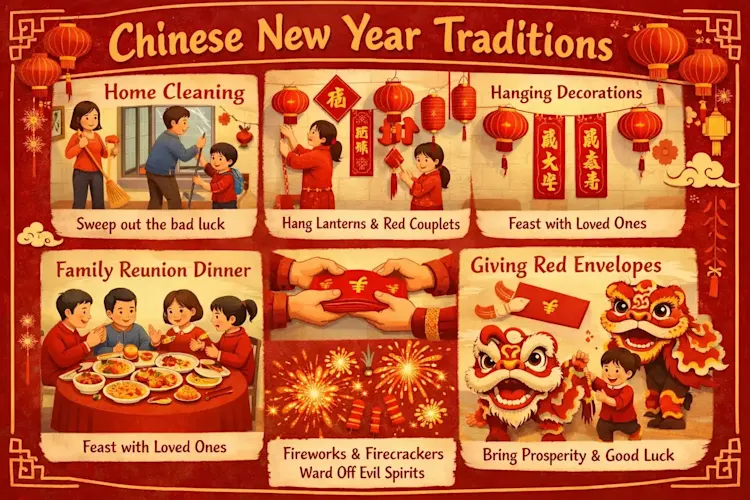
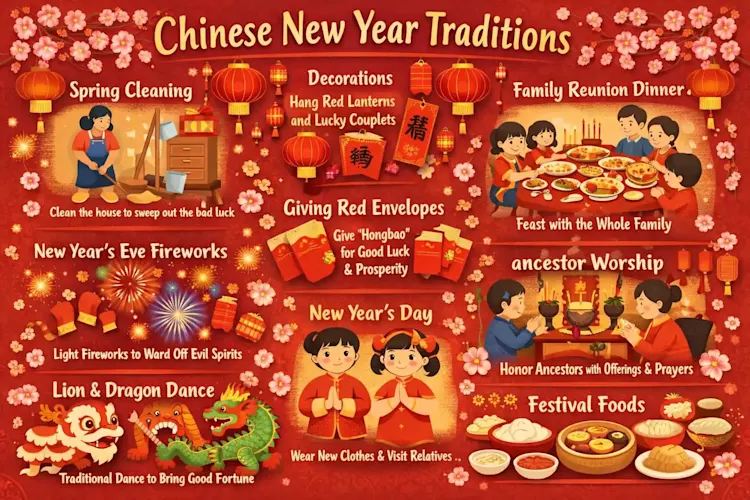
1) The Reunion Dinner (New Year’s Eve)
What it is: A big family meal on New Year’s Eve. Why it matters: It’s about reunion—showing up for each other before the new year begins. North America version:
If relatives are far away, do a “virtual seat at the table” on video.
If schedules are tight, do it on the closest evening—kids won’t care about the exact date as much as the feeling.
What kids can say
新年快乐!(Xīnnián kuàilè) — Happy New Year!
我们一起吃团圆饭。(Wǒmen yìqǐ chī tuányuán fàn) — We’re eating a reunion dinner together.
Lucky foods and what they symbolize
2) Cleaning and “Resetting” the Home
What it is: Cleaning before the holiday begins. Why it matters: Symbolically “sweeping away” old troubles and making room for a fresh start. North America version:
Keep it light. Choose one task kids can own: wiping the table, organizing a shelf, or setting out decorations.
What kids can say
我们整理房间,迎接新年。(Wǒmen zhěnglǐ fángjiān, yíngjiē xīnnián) — We tidy up to welcome the new year.
3) Red Decorations (and Why Red Is Everywhere)
What it is: Red paper cutouts, couplets, lanterns, and “福” decorations. Why it matters: Red is associated with celebration, energy, and protection in many Chinese cultural contexts. North America version:
Print two red signs: one “Happy New Year” and one “福 (Fú)” character.
Let kids make their own “paper lantern” craft and hang it in a window.
What kids can say
红色很喜庆。 (Hóngsè hěn xǐqìng) — Red feels festive.
这是“福”。(Zhè shì “fú”) — This is “good fortune.”
4) Red Envelopes (Hongbao / Lai See)
What it is: Money in red envelopes, often given to children and younger family members. Why it matters: It’s a wish for blessing, luck, and protection—especially for kids. North America version:
Keep it culturally respectful and family-aligned. Some families do symbolic amounts, some do experience-based gifts, some keep it to close relatives.
If you’re blending cultures, you can treat it like a “New Year’s blessing envelope” rather than a big monetary moment.
What kids can say
谢谢!新年快乐!(Xièxie! Xīnnián kuàilè!) — Thank you! Happy New Year!
我祝你身体健康。(Wǒ zhù nǐ shēntǐ jiànkāng) — I wish you good health.
5) Saying Greetings (The Part Kids Actually Remember)
If you do only one “language” tradition, do this one. It’s practical and it sticks.
Easy greetings kids can use
新年快乐!(Xīnnián kuàilè) — Happy New Year!
恭喜发财!(Gōngxǐ fācái) — Wishing you prosperity (classic)
万事如意!(Wànshì rúyì) — May everything go your way
身体健康!(Shēntǐ jiànkāng) — Good health
大吉大利!(Dàjí dàlì) — Great luck and great benefits (festive)
A kid-friendly “script” (two lines)
新年快乐!(Xīnnián kuàilè!)
祝你身体健康,天天开心!(Zhù nǐ shēntǐ jiànkāng, tiāntiān kāixīn!) — Wishing you health and happiness every day.
Chinese New Year Greetings for Kids
6) Lucky Foods (and What They Mean)
You don’t need a banquet. Pick 1–3 foods and attach a simple meaning kids can repeat.
Common options
Dumplings (饺子 jiǎozi): often linked to wealth/fortune shape symbolism
Fish (鱼 yú): sounds like “surplus,” often explained as “may you have extra”
Rice cake (年糕 niángāo): “higher year after year”
Oranges (橘子 júzi): bright, lucky-feeling, easy for kids
North America version
Dumplings can be frozen and pan-fried.
Oranges can become a “gift basket” kids hand to relatives.
If you’re busy, do one “lucky snack plate” and a short story about why it matters.
What kids can say
我们吃饺子,图个好彩头。(Wǒmen chī jiǎozi, tú gè hǎo cǎitóu) — We eat dumplings for good luck.
年年有余!(Niánnián yǒuyú!) — May you have surplus year after year!
7) Staying Up Late (Shousui) — Optional, Not Required
What it is: “守岁 (shǒusuì)” literally means staying up to “keep watch” as the year changes. Why it matters: It’s about accompanying family into the new year. North America version:
For younger kids, “light shousui” works: pick a family countdown time (9:30 pm), do greetings, then bedtime.
For older kids, stay up to midnight if it’s fun—not forced.
What kids can say
我们一起倒计时。 (Wǒmen yìqǐ dàojìshí) — We’re counting down together.
新的一年开始了!(Xīn de yì nián kāishǐ le!) — The new year has begun!
8) Visiting Family and Community (and Basic Etiquette)
What it is: Visiting relatives, hosting guests, community events. Why it matters: The holiday is relationship-centered. North America version:
If travel is hard, swap visits for video calls plus one local community event.
Prepare kids with two polite phrases so they feel confident.
What kids can say
过年好!(Guònián hǎo!) — Happy New Year!
谢谢招待!(Xièxie zhāodài!) — Thanks for having us!
9) Cultural Performances (Lion Dance, Dragon Dance)
What it is: Community performances tied to celebration and festivity. North America version:
Attend a local cultural festival if available.
If not, do a “home parade”: kids make a paper dragon and walk through the living room while playing music.
What kids can say
这是舞狮。 (Zhè shì wǔshī) — This is the lion dance.
好热闹!(Hǎo rènào!) — So lively!
10) Lantern Festival (The “Closing” Celebration)
What it is: A festival marking the end of the New Year season, often associated with lanterns and tangyuan. North America version:
Make lanterns out of paper.
Eat a sweet dessert together and do a “what went well this year” family moment.
What kids can say
我们做灯笼。(Wǒmen zuò dēnglóng) — We’re making lanterns.
元宵节快乐!(Yuánxiāo jié kuàilè!) — Happy Lantern Festival!
Do’s & Don’ts (Simple, Modern, No Panic)
A lot of “taboos” get shared online in a scary way. For families, it’s better framed as: what helps the holiday feel smooth and respectful.
Do
Do keep greetings positive and simple
Do put kids in a role (hand oranges, say one greeting, place one decoration)
Do choose one anchor ritual: toast, wish cards, or a short countdown
Do explain meaning in one sentence—kids remember short stories, not lectures
Don’t (the gentle version)
Don’t turn the holiday into a perfection project
Don’t force staying up late for little kids
Don’t overwhelm guests with “rules”—keep it warm and welcoming
Don’t worry if you can’t do every tradition; consistency matters more than completeness
Traditions for Kids (Ages 3–15): Make It Stick
If you’re raising kids bilingually, the most valuable part of Chinese New Year Traditions isn’t the decorations—it’s how naturally the holiday invites language.
Here are easy, age-friendly ideas.
Ages 3–6: One phrase + one job
Phrase: 新年快乐!(Xīnnián kuàilè!)
Job: hand an orange, stick a paper lantern, or deliver a card
Ages 7–10: Two phrases + one explanation
Phrase set: 新年快乐!/ 万事如意!
Explanation: “We wear red because it feels festive.”
Ages 11–15: Three phrases + a mini story
Phrase set: 新年快乐!/ 身体健康!/ 年年有余!
Mini story: explain hongbao, reunion dinner, and one lucky food meaning
A ready-to-use “School Show-and-Tell Script”
Today my family is celebrating Chinese New Year.
We decorate with red, eat a reunion dinner, and say greetings.
My favorite tradition is ______ because ______.
If you want a more structured set of “kid scripts” and practice lines, link internally to Chinese culture stories for kids.
When “Strict” Learning Backfires, Culture Helps
Some kids thrive on structure. Others shut down when learning starts to feel like pressure: perfect tones, perfect handwriting, perfect repetition—until they’d rather say nothing at all.
The most sustainable progress usually comes when language is tied to something meaningful. That’s why holidays like Chinese New Year are so powerful: they give kids a reason to speak, explain, and participate. When a child can say what a red envelope is, why the reunion dinner matters, or how Lantern Festival “closes” the season, Chinese stops being a subject and becomes a way to connect.
If you want to go beyond a phrase list and help your child build real confidence, LingoAce can be a practical option. We weave authentic cultural topics into speaking-first lessons, and in 1:1 sessions kids can practice more natural, real-life Chinese with a professional teacher—especially the cultural details that many general Chinese programs don’t systematically cover. If that sounds like what your family needs, try a LingoAce trial class (internal link) and see whether your child responds better to a culture-rich, conversation-based approach.

How to Explain Chinese New Year Traditions to Non-Chinese Family & Schools
This is the moment many parents in North America need: the short explanation that’s respectful, simple, and not awkward.
A 30-second explanation (English)
“Chinese New Year (Spring Festival) is the start of the lunar new year for many Chinese families. We treat it as a season: we gather for a reunion dinner, decorate with red, share good wishes, and celebrate community. It’s like New Year’s Eve and New Year’s Day plus family traditions and cultural activities.”
What to bring or do at school (simple + respectful)
A short greeting card activity (kids write “Happy New Year” in English + Chinese)
A red paper craft (lanterns or simple cutouts)
A “lucky foods” show-and-tell with oranges (easy and allergy-friendly)
FAQ: Chinese New Year Traditions (Families Ask These Every Year)
How long does Chinese New Year last?
Many families focus on New Year’s Eve and the first few days, while the traditional season continues until the Lantern Festival.
Is it “Chinese New Year” or “Lunar New Year”?
Both are common in North America. “Lunar New Year” is more inclusive; “Chinese New Year” is specific to Chinese traditions. You can use both depending on the context.
What’s the most important tradition if we can only do one?
For most families: the reunion dinner + one greeting kids can say confidently. That combination delivers meaning and connection.
Do we have to stay up late?
No. “Light shousui” is a modern, family-friendly option—especially for younger kids.
What should we avoid on Day 1?
Keep it simple: start the year with positive words, stay warm with family, and avoid turning the day into a stressful checklist. A calm tone matters more than rule memorization.
How can kids actually learn from these traditions?
Give them a role and a script: one job + one phrase + one “why.” That’s enough to build real language confidence.
Wrap-Up: The Traditions Are the Language Opportunity
Chinese New Year traditions aren’t just rituals—they’re repeatable moments that kids can grow into year after year. When you keep the celebration simple, consistent, and meaningful, your child absorbs both culture and language naturally: greetings, gratitude, family roles, and the ability to explain “why we do this.”
If you’d like your child to move from copying phrases to confidently speaking and explaining these traditions in real life, you can try a LingoAce trial class . It’s a low-pressure way to see whether a culture-rich, conversation-first approach helps your child speak more naturally at home, at school, and during holidays.