A parent-friendly guide to paper cutting that explains the symbols kids actually notice, plus easy first projects (with age-safe options) and a few sneaky ways to build Chinese language exposure while you craft.
If you’ve ever tried a “cultural craft” at home and it turned into… five minutes of excitement followed by twenty minutes of frustration, you’re not alone. The good news: Chinese paper cutting (jianzhi / 剪纸) is one of those rare activities that can be simple, beautiful, and still meaningful—even when your child’s attention span is on airplane mode.
What “paper cutting” means in Chinese culture (Jianzhi), in plain English
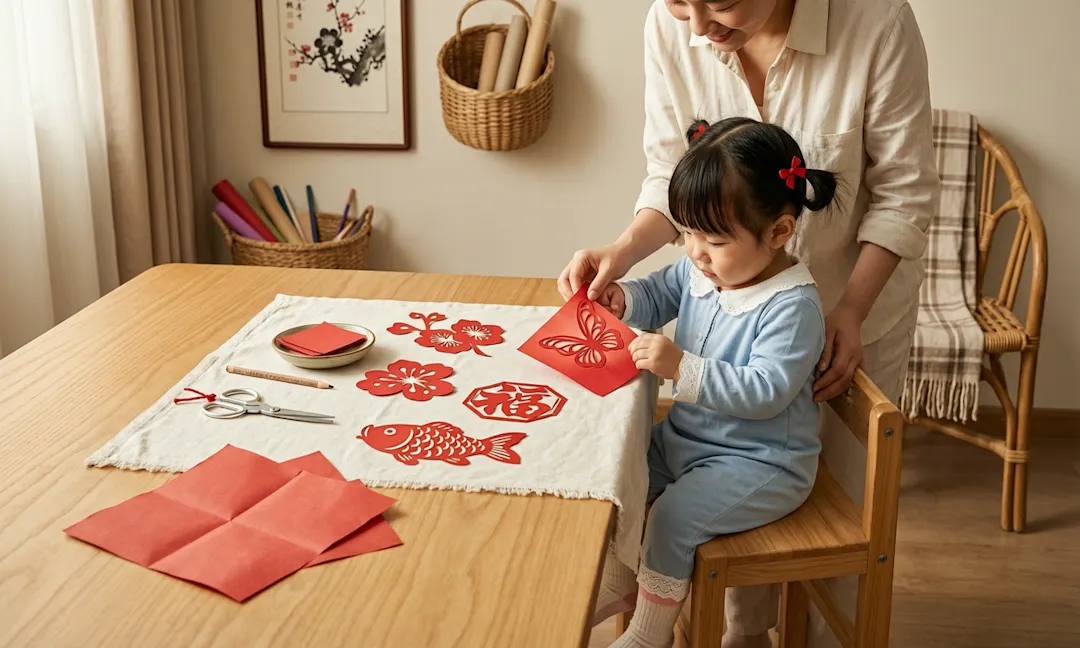
Chinese paper cutting is a traditional folk art where people cut decorative designs—often symmetrical—out of paper. It’s used in everyday life (especially around festivals), not just for galleries. UNESCO describes Chinese paper-cut as a living tradition connected to community life and values, passed down across generations.
Why red shows up so much
Red is strongly associated with celebration and good fortune in many Chinese traditions, so red paper-cut designs became common for festive decoration—windows, doors, gifts, lanterns. (If you’ve ever wondered why the “lucky” character appears on windows around Lunar New Year, this is part of it.)
Where you’ll see it (even if you’re not looking)
Windows and doors (classic “window flower” look)
Lunar New Year and weddings (symbols like 福 and 囍 show up a lot)
Gift wrapping (small cut-outs added as decoration)
School culture events (easy to display, easy to talk about)
The 10 symbols families see most in paper cutting
Here’s the cheat sheet. You don’t need to memorize it. Read it once, pick one symbol your child likes, and you’re good.
1) 福 (fú) — “good fortune”
Often used for happiness/luck. Libraries and cultural institutions commonly highlight 福 as a frequent motif. Where it fits: Lunar New Year window decor, “welcome” vibes near the front door.
2) 囍 (shuāngxǐ) — “double happiness”
Commonly associated with weddings and joyful occasions. Where it fits: Wedding cards, celebration-themed crafts (older kids love the symmetry).
3) Fish (鱼 yú) — abundance (because it sounds like “surplus” 余)
This is a classic “pun symbol” kids actually enjoy when you explain it. Where it fits: New Year crafts, classroom show-and-tell (it’s easy to explain quickly).
4) Rabbit / Dragon / Zodiac animals
Zodiac designs show up a lot in decorative traditions and are a friendly entry point for kids—because animals. Where it fits: Birthday crafts, “year of the…” decorations.
5) Peony — beauty, prosperity
A common floral motif in traditional decoration. Where it fits: Cards for grandparents, window designs that look “fancy” without being hard.
6) Plum blossom — resilience, new beginnings
Often linked to winter-to-spring imagery in Chinese art traditions. Where it fits: End-of-winter, early-spring window decor.
7) Lotus — purity, harmony
You’ll see lotus motifs referenced in cultural explanations of Chinese decorative arts. Where it fits: Calm, “pretty” designs for kids who like flowers.
8) Gourd (葫芦 húlu) — family and protection themes
Some common explanations link gourd imagery to family/longevity-style wishes. Where it fits: Grandparent gifts, family-themed crafts.
9) Lanterns / firecrackers — celebration
Not subtle. Very festive. Where it fits: Lunar New Year, festival units at school.
10) “Spring” (春 chūn) and seasonal characters
Seasonal characters appear frequently in decorative cutting traditions. Where it fits: Seasonal home decor, “welcome spring” windows.
Paper cutting + Chinese practice
If your child is already happy doing paper cutting, you’ve got a small window. Use it gently.
Mini vocabulary set
paper 纸 (zhǐ)
scissors 剪刀 (jiǎndāo)
cut 剪 (jiǎn)
red 红 (hóng)
fish 鱼 (yú)
lucky 福 (fú)
beautiful 漂亮 (piàoliang)
finished 好了 (hǎo le)
Put these on sticky notes near the craft area for a week. That’s enough.
Three one-minute speaking prompts
“What did you make?” — 你剪了什么?(Nǐ jiǎn le shénme?)
“Who is it for?” — 送给谁?(Sòng gěi shéi?)
“What color do you want?” — 你想要什么颜色?(Nǐ xiǎng yào shénme yánsè?)
If you can only do one: do the “who is it for?” prompt. It nudges your child into real communication.
A weekly routine that actually sticks
Pick one symbol per week. Make one small cut-out. Put it somewhere visible.Kids like seeing their work “stay up.” It signals that what they made matters.If your child is enjoying cultural activities but their Chinese exposure is still inconsistent, progress can stay… fuzzy. That’s usually when families look for something more structured than “we’ll do crafts sometimes.”
If you’d like a teacher to guide your child through Chinese in a way that feels interactive (not lecture-y), you can book a trial class with LingoAce and see whether their level, pacing, and style fits your family routine. Some parents specifically mention teachers being patient and encouraging on review platforms.

Paper cutting at home: kid-safe setups by age
For parents, paper cutting usually fails for two reasons: the paper tears, or the tool isn’t age-matched. Fix those and the whole activity feels… weirdly peaceful.
Ages 3–6: fold-and-cut only
Use kid safety scissors
Choose slightly thicker paper (construction paper is forgiving)
Start with simple folds and big shapes (hearts, circles, “cloud” edges)
Ages 7–9: symmetry + simple templates
Fold in half or quarters
Use templates with “bridges” (connected lines) so the design doesn’t fall apart
Encourage “inside cuts first” (more on that soon)
Ages 10–15: craft knife + cutting mat
This is where _paper cutting_ can look genuinely impressive. Also where supervision matters.
Use a cutting mat and a sharp craft blade (dull blades cause tearing and slips)
Cut seated, elbows supported
Make a “blade parking spot” rule (blade goes down in one place only)
If your older child gets into the intricate side of Chinese paper cutting, you’re suddenly supporting focus, patience, and fine motor control in a way that doesn’t feel like “work.”
Three things that stop paper cutting from tearing
Cut the inside details first, then the outside edge (otherwise the paper flops and rips)
Slow down on curves (tiny turns = tiny cuts, not one big twist)
Use the right paper weight (too thin tears; too thick fights back)
There’s also research looking at how children’s paper-cutting performance and scissor control develops with age, which lines up with why age-matching matters.
FAQ
1)What is Chinese paper cutting called, and is it the same as paper cutting?
Chinese paper cutting is commonly called jianzhi (剪纸). It’s a form of _paper cutting_, but it often focuses on symbolic motifs (characters, animals, flowers) tied to wishes for good fortune and celebration.
2)What are the safest paper cutting tools for kids?
For ages 3–6, use safety scissors and thicker paper. Ages 7–9 can use sharper scissors and simple templates. Craft knives are best reserved for older kids (often 10+) with close supervision and a cutting mat.
3)How do I keep paper cutting designs from tearing?
Use slightly thicker paper, cut inside details first, and avoid twisting your wrist on curves. If you’re using a craft knife, a fresh blade helps produce cleaner cuts with less pulling.
4)Where can I find beginner Chinese paper cutting templates?
Libraries and cultural education sites often share activity ideas and examples. A simple approach is to start with basic shapes (fish, lanterns, 福 in block style) and trace from a printed outline until your child understands how “bridges” keep the design connected.
5)Can paper cutting help kids learn Chinese?
It can help by giving Chinese words a real context (tools, colors, symbols) and creating a reason to speak. On its own, it won’t replace structured language input, but it can make vocabulary and cultural concepts stick better—especially when paired with short speaking prompts and routines.
Conclusion
Chinese paper cutting (jianzhi) is an easy, low-prep family craft with a big visual payoff. Remember two rules: cut inside details first, and start with simple shapes like 福, a fish, or a lantern.And if you notice your child is curious about the symbols and wants to say more than “look what I made,” that curiosity is worth feeding while it’s hot.
If you’d like your child to build real Chinese communication skills alongside culture—without you having to plan every activity—consider booking a LingoAce trial class to see if the teacher, pacing, and level fit your family.