You know that moment when your child has plenty of Chinese words… but the sentence still comes out sounding a little “translated”? It’s usually not vocabulary. It’s chinese prepositions—or what many teachers casually call “coverbs”—quietly pulling the sentence structure around.
This chinese prepositions guide is built for busy families who want fast clarity: where these words go, what patterns to copy, and how to help kids actually use them (not just recognize them on a worksheet). You’ll get a cheat sheet, examples you can borrow, a quick quiz, and small home routines that don’t feel like homework.
Quick cheat sheet: the few you’ll meet every day
A lot of families get overwhelmed because lists online look endless. You don’t need endless. Start here, then widen later.
Core item | What it often means | Usual pattern | Quick example |
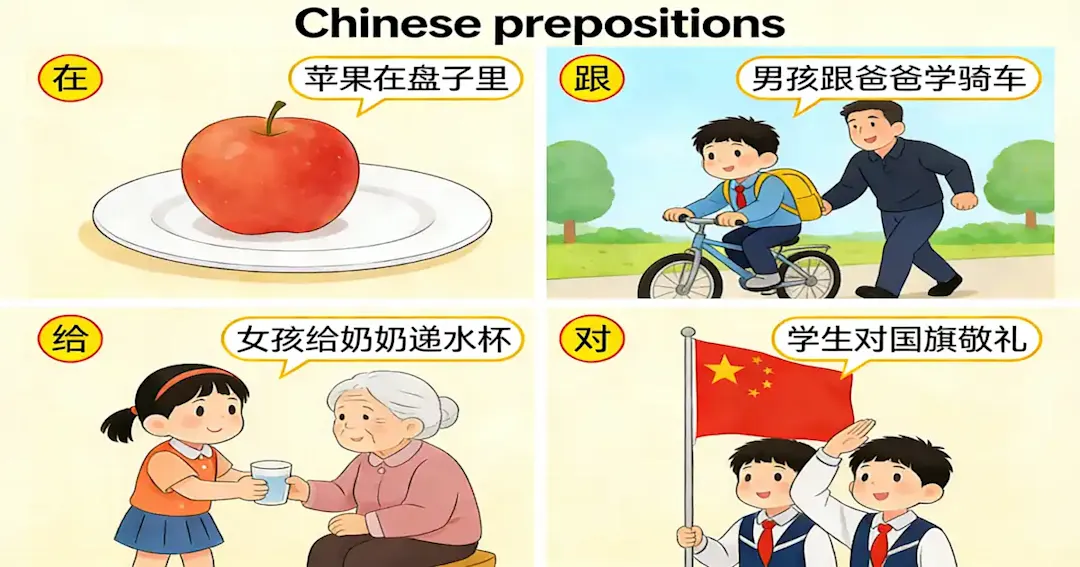
在 zài | at / in | 在 + place + VERB | 我在家写作业。I do homework at home. |
跟 gēn | with | 跟 + person + VERB | 我跟妈妈去超市。I’m going to the store with Mom. |
给 gěi | to / for | 给 + person + VERB | 我给老师写卡片。I write a card for the teacher. |
对 duì | toward / about | 对 + person/thing + (verb/adj) | 我对你很放心。I feel at ease about you. |
从…到… cóng…dào… | from…to… | 从 + start + 到 + end + VERB | 我从学校到家走路。I walk from school to home. |
If your child can comfortably use these five, their sentences will suddenly sound more native-like. Not perfect. Better.
What “chinese prepositions” really are in Mandarin
In English, a preposition is usually a connector sitting in front of a noun phrase: “in the house,” “with my friend,” “to the park.” Mandarin has similar-looking words, but a bunch of them behave like mini-verbs that set up how the action happens. That’s why you’ll hear people say “coverbs.”
Here’s the practical takeaway (not a linguistics lecture, promise): chinese prepositions often introduce extra information—place, time, who you’re with, who receives something—and they usually appear before the main verb.
The #1 word order rule for chinese prepositions
If you only remember one thing from this section, remember this:In most everyday sentences, the “preposition phrase” comes before the main verb.
A simple default template:[Time] + [Place] + [chinese prepositions phrase] + VERB + (object)
Not every sentence needs all parts, but this is a safe “home base.”
Common error you’ll hear (and how to fix it quickly)
Kids (and adults) often do an English-shaped structure:
Incorrect-ish: 我去学校跟我朋友。
Natural: 我跟我朋友去学校。
Another one:
Incorrect-ish: 我说话对老师。
Natural: 我对老师说话。 / 我跟老师说话。 (Depending on meaning)
The “fix” is often just moving the phrase up front. No scolding, no long explanation.

Chinese prepositions for place and location (在 / 到 / 从)
This is the section parents use the most, because it fits daily life.
1) 在 zài: “at/in” where something happens
Pattern: 在 + place + VERB
我在厨房做早餐。I make breakfast in the kitchen.
他在学校学中文。He studies Chinese at school.
我们在车上听故事。We listen to stories in the car.
2) 到 dào: “to” the destination
Pattern: 到 + place + (去/来/走/跑/送…)
我到图书馆去。I’m going to the library.
你什么时候到家?When will you get home?
我把书送到老师那里。I deliver the book to the teacher.
You’ll notice something: 到 often hooks into a movement verb, or implies movement. That’s why “到” can feel strange if the sentence isn’t about reaching a point.
3) 从 cóng and 从…到…: “from” and “from…to…”
Pattern: 从 + start + 到 + end + VERB
我从学校到家走路。I walk from school to home.
我们从周一到周五上课。We have class from Monday to Friday.
她从早上到晚上都很忙。She’s busy from morning to night.
Chinese prepositions for people and relationships (跟 / 给 / 对)
This trio is where sentences start to sound natural, because it’s how kids talk about people.
1) 跟 gēn: “with”
Pattern: 跟 + person + VERB
我跟爸爸看电影。I watch a movie with Dad.
他跟朋友踢球。He plays soccer with friends.
你想跟谁一起去?Who do you want to go with?
Yes, you’ll also see 和. In many casual situations, 跟 and 和 overlap, but 跟 feels very “together with” and pairs smoothly with actions.
2) 给 gěi: “to/for” (and when it’s NOT just the verb “give”)
This one is the big headache. Because 给 can be:
a verb: “to give”
a coverb-like “preposition”: “to/for” before the main verb
If there is a clear “recipient,” and the main action is something else (write, buy, say, send), you’ll often use the preposition-like pattern:给 + recipient + VERB + (object)
我给你讲一个故事。I’ll tell you a story.
他给妈妈买花。He buys flowers for Mom.
我给老师写邮件。I write an email to the teacher.
When 给 is the main action (actually giving), it behaves more like a verb:
我给你一个苹果。I give you an apple.
他把苹果给你。He gives the apple to you. (Different structure, also common.)
If you’re choosing between “give” and “for/to,” ask: “What’s the main action?” If the main action is “write,” “buy,” “say,” “send,” then 给 usually sets up the recipient.
3) 对 duì: “toward / about / in relation to”
Pattern: 对 + person/thing + verb/adj
我对你有信心。I have confidence in you.
这件事对我很重要。This matter is important to me.
你对中文感兴趣吗?Are you interested in Chinese? (Yes, this is common.)
If chinese prepositions still trip your child up in real conversation, it’s usually a feedback problem—not an effort problem. A free LingoAce trial class can help a teacher spot the word-order slips (在/跟/给/对, 从…到…) and give you a simple practice plan to follow at home.

Chinese prepositions for direction (往 / 朝 / 向): small set, huge payoff
These show up in stories, directions, and “what happened next” narratives. If your kid reads Chinese books or tells stories, these words are gold.
Pattern: 往/朝/向 + direction/place + VERB
他往前走。He walks forward.
她朝我笑。She smiles at me.
我向老师道歉。I apologize to the teacher.
Do you need all three right away? Not really. Many families start with 往 for movement (especially with little kids), then add 向 in more formal sentences.
The confusing pairs: where learners get stuck
This section keeps people scrolling because it answers the exact “wait, which one?” questions.
对 vs 对于 (duì vs duìyú)
Both can relate to “regarding/toward,” but 对于 often sounds more formal and more “topic-like,” especially in writing:
对我来说,这很重要。For me, this is important. (Natural, common)
对于这个问题,我们需要讨论。Regarding this problem, we need to discuss. (More formal)
If your child is speaking or writing casual schoolwork, 对 usually covers a lot. Save 对于 for later, or teach it as “essay mode.”
跟 vs 和 (gēn vs hé)
Both can mean “with,” but 和 also commonly means “and” linking nouns:
我和你。You and I.
我跟你去。I’m going with you. (Action focus)
If your kid is forming an action sentence, 跟 often feels smoother.
给 vs 为 (gěi vs wèi)
Both can relate to “for,” but 为 tends to show up in more formal writing and set phrases:
为了孩子… for the sake of the child…
为你感到骄傲 I’m proud of you (more fixed, and not the same as 给)
For everyday “I did this for someone,” 给 is usually the first tool:
我给你做饭。I cooked for you.
If your child tries to use 为 everywhere, you’ll get sentences that feel oddly formal or stiff. Not wrong, just… not kid voice.
FAQ
1) What are chinese prepositions, and are they the same as coverbs?
Many chinese prepositions behave like coverbs because they introduce details (place, person, direction) and sit before the main verb. In practice, you can treat them as “setup words” that tell you how/where/with whom the action happens.
2) Where do chinese prepositions go in a sentence?
Most of the time, the phrase comes before the main verb. If your child keeps putting it at the end, that’s usually English word order showing up.
3) What are the most common chinese prepositions for beginners?
A practical beginner set is: 在, 跟, 给, 对, 从…到…. If you can use these confidently, you can handle a surprising amount of daily conversation.
4) How do I know if 给 is a chinese preposition or the verb “give”?
Ask “what’s the main action?” If the main action is write/buy/say/send, 给 often introduces the recipient: 我给老师写邮件. If the main action is literally giving, 给 functions like a verb: 我给你一个苹果.
5) How do you use 从…到… in chinese prepositions for time?
It works similarly: 从周一到周五… / 从早上到晚上…. If there’s a start and end in time, this pattern is usually correct.
6) Why does my child understand chinese prepositions but still makes word order mistakes when speaking?
Because understanding is not the same as automatic production. They need repeated sentence frames and quick correction in speech. Short daily routines help, and a structured speaking class can help even faster if home practice turns into a battle.
7) How can parents practice chinese prepositions at home without turning into the “strict teacher”?
Use short games: swap-and-fix sentences, toy movement for 从…到…, and sentence cards for 跟/给/对. Keep it 5–10 minutes, stop early, and correct by repeating the right version instead of explaining for two minutes.
Conclusion
If you’re trying to improve your child’s Mandarin quickly, chinese prepositions are one of the highest-return places to focus—because they change the whole sentence shape. Keep the goal small: master the “before the verb” habit, lock in the five core items (在/跟/给/对/从…到…), and practice with real-life frames instead of long word lists.
If you want an easier path than correcting everything yourself, consider booking a LingoAce trial class with a teacher who can spot word order issues in real time and give your child speaking routines that fit their age. —especially when you want progress without nightly grammar debates.