If your child can say a few phrases in Mandarin but freezes when they see a page of characters… you’re not alone. Reading Chinese can look like a wall of “little pictures” with no obvious pattern. And as a parent, you’re stuck between two bad options: memorize everything (impossible), or ignore the parts.
This 2026 guide gives you a chinese radicals list that’s curated for real-life learning: the radicals kids actually meet again and again, plus simple ways to use them for faster recognition, better memory, and fewer tears at homework time.
What are chinese radicals ?
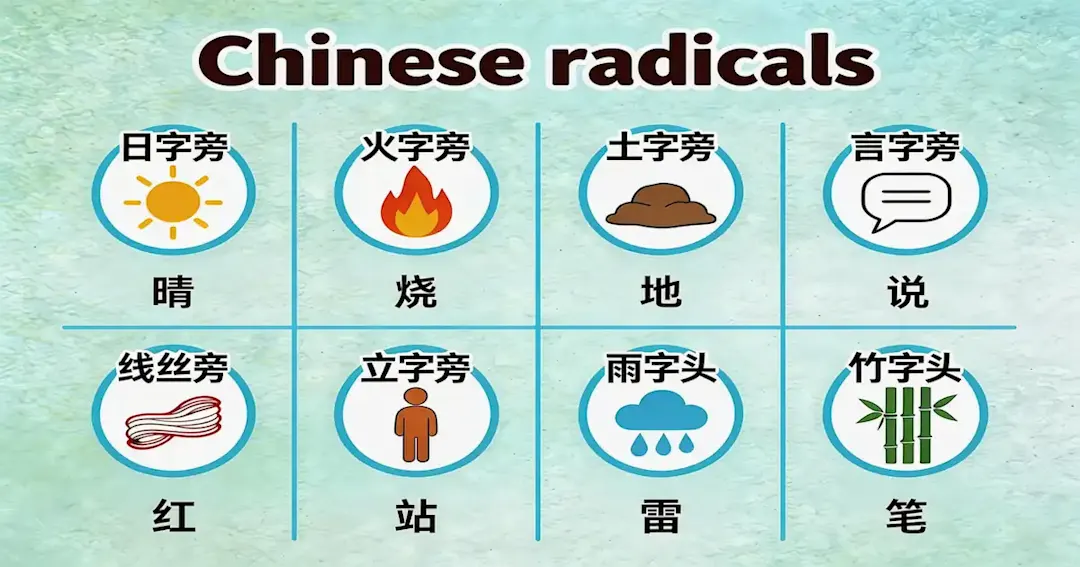
A radical (部首) is the “indexing piece” of a character—traditionally used to organize dictionaries, and often (not always) tied to meaning categories. Many beginner-friendly explanations also point out that the classic system contains 214 Kangxi radicals, which is why you see “214 radicals” everywhere online.
Here’s the part that matters for families: you do not need to learn all 214 chinese radicals to get real benefits. The goal is pattern recognition, not trivia-night perfection.
Radicals vs. components: the “don’t overthink it” rule
You’ll also see the word “component.” In plain language:
Component: any part inside a character;
Radical: the specific component chosen as the character’s dictionary category.
Some blogs emphasize this difference because parents can accidentally teach radicals like they’re the only meaningful “parts.” In reality, kids benefit from noticing common parts—radicals included.
What chinese radicals can do (and can’t do)
They can:
give a meaning neighborhood (water-ish, mouth/speech-ish, heart/feeling-ish).
help kids group characters and remember them.
support dictionary lookup or radical-based browsing tools.
They can’t:
guarantee pronunciation.
magically make reading easy without practice.
A good reminder from a radicals-list blog: radicals can be helpful, but not 100% reliable for meaning or sound. That’s a healthy expectation to set with kids.
The “Most Useful First” chinese radicals list for beginners
This is the heart of the article: a curated chinese radicals list you can actually use. I’m focusing on radicals that show up frequently in common characters and give kids a strong meaning clue—especially useful for early readers. A frequency-based approach (like “top 100”) is a common recommendation for beginners because it avoids wasting effort on rare pieces.

Quick table: 60 high-utility radicals
Radical | Meaning cue | Kid-friendly hook | Example characters | Where kids see it |
氵 | water | “three drops” | 河/海/洗/酒 | nature, daily verbs |
亻 | person | “standing person” | 你/他/休/住 | pronouns, people |
扌 | hand/action | “hand side” | 打/拉/找/推 | action verbs |
口 | mouth/speech | “mouth” | 吃/喝/叫/唱 | eating, speaking |
木 | wood/tree | “tree” | 林/校/杯/桌 | school, objects |
艹 | grass/plant | “two grass blades” | 花/草/茶/药 | food, nature |
忄 | heart/feeling | “heart on the side” | 忙/怕/想/情 | emotions |
女 | female | “girl” | 妈/姐/她/好 | family words |
宀 | roof/home | “little roof” | 家/安/字/室 | home/school |
辶 | walk/road | “road tail” | 这/远/进/近 | very common words |
日 | sun/day | “sun” | 明/时/早/晚 | time words |
月 | moon/month (sometimes body*) | “moon shape” | 朋/期/服/腿 | time + common |
冫 | ice/cold | “two ice dots” | 冷/凉/冻 | weather/feelings |
讠 | speech/words | “words side” | 说/话/语/请 | polite phrases |
目 | eye/see | “eye” | 看/眼/睡 | body, verbs |
足/⻊ | foot/movement | “foot steps” | 跑/跳/路 | movement |
食/饣 | food/eat | “food side” | 饭/饿/馆 | meals |
贝 | money/value | “shell money” | 买/贵/员/财 | shopping/school |
钅 | metal | “metal side” | 钱/钟/铁 | objects |
虫 | insect/creatures | “bug” | 蚂/蛇/蜂 | animals, stories |
If this list already helped, don’t stop at reading it—use it. Pick 3 chinese radicals today and see how many you can spot in your child’s book in 2 minutes. If you want a guided plan, you can book a LingoAce trial class and ask for a radicals-first reading routine.

How to use chinese radicals to guess meaning
If you do one thing with chinese radicals, do this: treat them like a “meaning hint,” not a “meaning guarantee.”
A lot of beginner blogs explain that radicals often point to a meaning category. The word often is the key. Parents who turn it into a rule (“water radical always means water!”) end up in arguments with reality.
A simple parent script that works
When you see a new character, ask:
“Do you recognize a part?”
“What does that part usually remind you of?”
“So… is this word maybe related to water / feelings / talking / plants?”
That’s it. No lecture.
Six fast examples kids can actually understand
氵-shows up in 河 (river), 海 (sea), 洗 (wash) → water-ish
艹 -shows up in 花 (flower), 草 (grass), 茶 (tea) → plant-ish
忄 -shows up in 怕 (afraid), 忙 (busy), 情 (feelings) → emotion-ish
口 -shows up in 吃 (eat), 喝 (drink), 唱 (sing) → mouth action
扌 -shows up in 打 (hit), 推 (push), 找 (find) → hand action
讠 -shows up in 说 (say), 话 (speech), 请 (please) → speaking/politeness
FAQ
1)Do kids really need chinese radicals to learn to read?
They don’t “need” them in the sense of passing a gate. But chinese radicals act like handles—something to grab onto when characters look overwhelming. For many kids, that reduces the “randomness” feeling and makes reading practice less scary.
2)How many chinese radicals should beginners learn first?
A practical target is 30–60 chinese radicals that show up frequently and give strong meaning cues. Many beginner approaches emphasize learning the most common set first, rather than trying to cover every radical.
3)What are the most common chinese radicals for kids?
You’ll see 氵 亻 扌 口 木 艹 忄 女 辶 日 constantly in kid-level content because they appear in common words and school vocabulary. (And yes, once you notice them, you can’t unsee them.)
4)Chinese radicals vs components: what’s the difference again?
A component is any part of a character. A radical is the specific component used for dictionary classification (often one per character). The difference matters mainly so you don’t limit your child to “only radicals matter.”
5)How do chinese radicals help with dictionary lookup or typing?
Traditional lookup systems often organize characters by radical, and many online tools let you browse characters by clicking a radical table. Even if your child mostly types with pinyin, radicals can still help with recognition and meaning prediction—especially when pinyin isn’t enough.
Conclusion
A curated chinese radicals list is a shortcut to confidence: fewer characters feel “random,” more characters feel “guessable,” and practice starts to stick.
If you want it simple, keep it simple:
choose 5 radicals this week
learn 2–3 characters per radical
play “spot it” every day for 2 minutes That’s already progress.
And if you’d rather not be the one designing the learning path (because life is busy and kids can smell hesitation), consider booking a LingoAce trial class and asking for a reading plan that uses chinese radicals inside real vocabulary and age-appropriate texts. It’s often the difference between “we tried for two weeks” and “it quietly became a routine.”