When people ask, "What is the Chinese symbol for family?", more likely than not, they are asking about the Chinese word or character for "family." The short answer is: 家 (jiā). This character means family but directly translates as "home," "family," or "household," radiating warmth and belonging. It's deceptively simple, yet deeply historic.
Etymology of the Chinese symbol for family: A roof and a pig
The character 家 combines 宀 (mián, roof radical) above and 豕 (shǐ, pig) below. In ancient times, China was an agrarian society. This meant that many households had livestock, specifically pigs. It became a symbol of stability and prosperity. To have a pig under your roof meant that you had a self-sustaining home. This pictographic origin explains why 家 often evokes security and plenty.
Compound words using the Chinese Symbol for family
In the Chinese language, one or more characters are often combined to form other words. 家 (jiā) is frequently used for compound words related to family or the home.
亲人 (qīnrén) — close relatives
家人 (jiārén) — family members
家属 (jiāshǔ) — dependents
家务 (jiāwù) — housework
家常菜 (jiācháng cài) — home-style dishes
家庭 (jiātíng) — family (as a unit); household
回家 (huí jiā) — to go home
国家 (guójiā) — country (literally "state + family"), hinting at the idea of the nation as a large household
家乡 (jiāxiāng) — hometown
专家 (zhuānjiā) — expert (another usage of 家 as a suffix meaning "specialist")
Cultural values encoded in the Chinese symbol for family
There are also several Chinese idioms related to family. These four-character expressions are called 成语 (chengyu). These idioms often reflect Confucian values, harmony, and the central role of family in Chinese culture. Here are some meaningful ones:
安居乐业 (ān jū lè yè) – “To live in peace and work happily.” This expression describes a stable, happy family life where people can focus on work and prosperity.
家和万事兴 (jiā hé wàn shì xīng) – “When the family is harmonious, all affairs prosper.” It means that a harmonious family is the foundation for success in all aspects of life.
齐家治国平天下 (qí jiā zhì guó píng tiān xià) – “Cultivate the family, govern the country, bring peace to the world.” From Confucian thought, this idiom conveys the idea that managing one’s family well is the first step toward governing a nation and achieving peace.
修身齐家 (xiū shēn qí jiā) – “Cultivate oneself and put one’s family in order.” This means that a person must improve themselves before they can lead and take care of their family.
家破人亡 (jiā pò rén wáng) – “Family broken, people lost.” This is a tragic idiom describing the destruction of a family and the death or scattering of its members.
Other Chinese characters that are symbols for family
In addition to 家 (jiā, family/home), Chinese culture uses several other characters and symbols that reflect the idea of family, unity, and togetherness. One of the most well-known is 囍 (shuāngxǐ, Double Happiness), which is formed by writing the character for happiness 喜 (xǐ) twice side by side. Traditionally used at weddings, this symbol celebrates the joining of two families and the start of a new generation. It represents not only joy but also harmony between families, prosperity for descendants, and the continuation of the family line. The Double Happiness character is often displayed in red paper-cuts, embroidered on wedding clothes, or pasted on doors, symbolizing blessings for the new couple and their future family.
Another character deeply tied to family is 孝 (xiào, filial piety), which embodies the Confucian ideal of honoring and respecting one's parents and ancestors. Written with the radical for "old" above the radical for "child," the character itself visually conveys the relationship between generations—the young carrying forward the legacy of the old. In Chinese tradition, 孝 is the foundation of family harmony, guiding how children care for their parents and how families maintain continuity across generations. Together with symbols like 福 (fú, blessing/fortune), 和 (hé, harmony), and 团 (tuán, unity/reunion), these characters reveal how Chinese writing encodes not just language but also cultural values, placing family at the center of social and moral life.
Other Chinese symbols for family
Outside of the Chinese word for family, other symbols in Chinese culture represent the concept of "family." For example, family ancestral tablets, known as 神主牌 (shénzhǔ pái) or 神位 (shénwèi), are among the most important cultural symbols of family in Chinese tradition. These wooden or stone plaques are inscribed with the names of deceased family members and are believed to house the spirit of the ancestor. Historically, the practice dates back to the Zhou dynasty (1046–256 BCE), when ancestor worship was central to ritual life. By the Song dynasty (960–1279), standardized wooden tablets had become common, reflecting Confucian values of filial piety (孝 xiào) and the continuity of lineage.
A typical ancestral tablet includes the ancestor's full name, dates of birth and death, and respectful titles such as 显考某公之神位 (xiǎn kǎo mǒu gōng zhī shénwèi), meaning "the spirit seat of the honored father so-and-so," or 显妣某氏之神位 (xiǎn bǐ mǒu shì zhī shénwèi), meaning "the spirit seat of the honored mother of the [X] clan." The phrase 神位 (shénwèi), "spiritual seat," is always included.
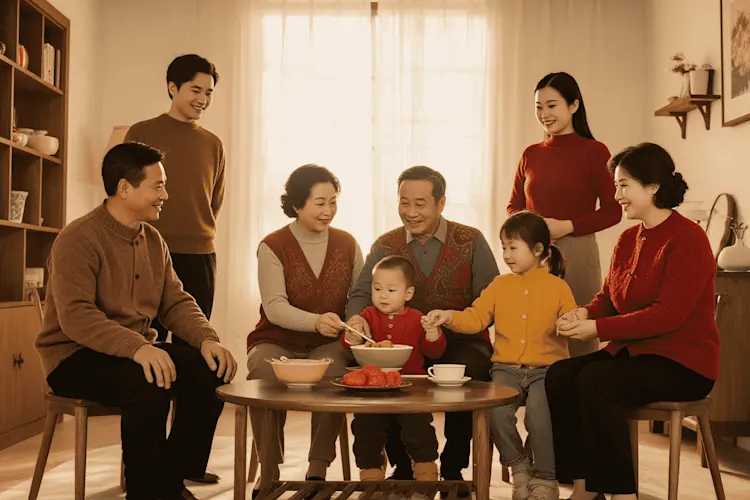
Ritual offerings are made to these tablets during essential times of the year, such as Qingming Festival (清明节 qīngmíng jié) and Ghost Festival (中元节 zhōngyuán jié), as well as on Lunar New Year's Eve, when families invite their ancestors to symbolically join the Reunion Dinner (团圆饭 tuányuán fàn). In some households, incense is lit daily before the tablet, and significant life events such as weddings or births are announced at the altar to include ancestors in the family's ongoing story. Traditionally, tablets are placed in the main hall of the house or on a home altar (神龛 shénkān). However, today they are also kept in temples or clan associations, especially in urban areas or overseas Chinese communities.
The meaning of ancestral tablets extends far beyond ritual. They embody continuity, linking the living and the dead in one extended household. They reinforce filial piety, reminding children to honor and care for their parents both in life and after death, and they serve as a moral compass, since ancestors are believed to "watch over" their descendants. Despite disruptions during the Cultural Revolution, the tradition of ancestral tablets has revived in many parts of China and remains strong among Chinese communities outside of Mainland China.
Looking for an online Chinese class for your kids to learn Mandarin and Chinese culture? LingoAce is one of the best ways for kids to learn Chinese online. Each one-on-one lesson is the product of nearly 200 hours of curriculum development, teacher training, and quality control. LingoAce classes are tailored to meet your child's learning needs.
Experience a redefined Chinese learning experience and book a free trial class with us today.