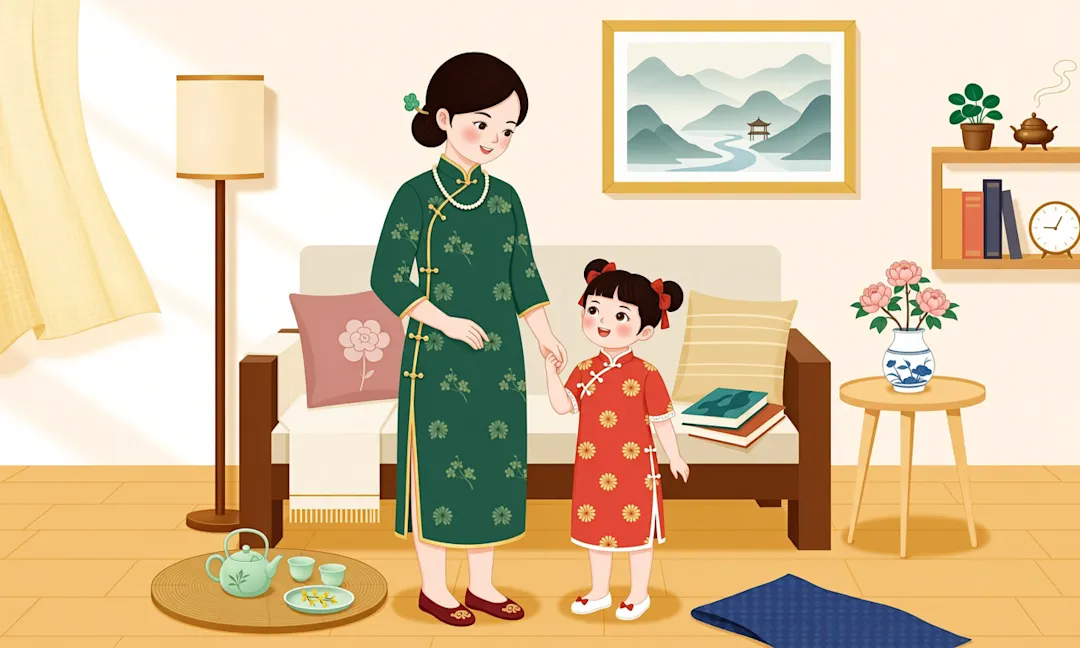
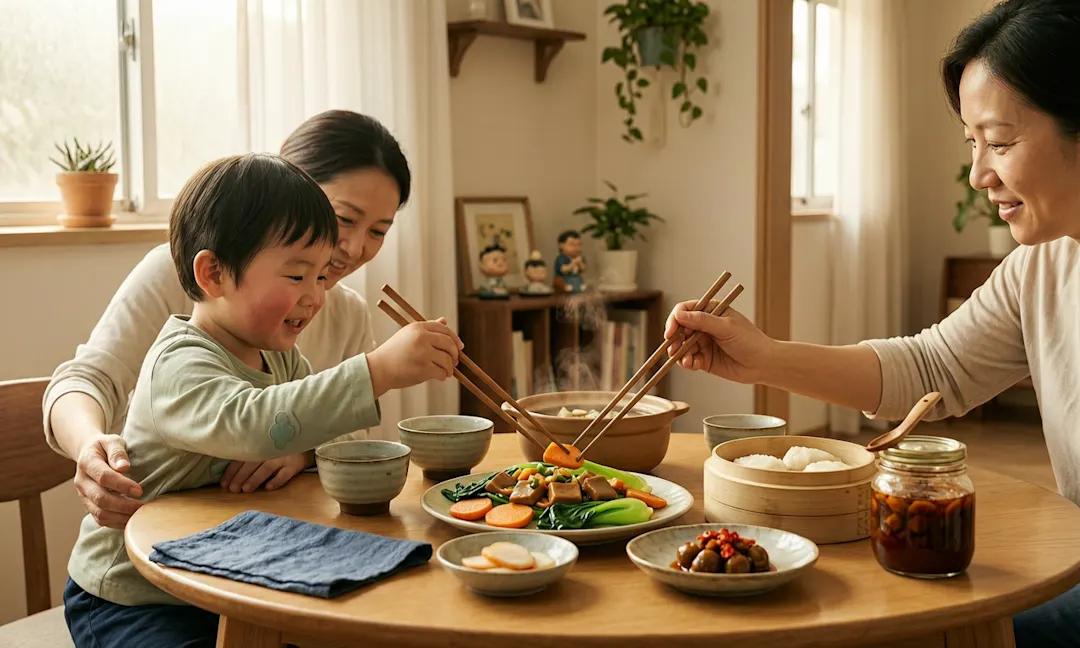
If you grew up in a Chinese-speaking family, you probably heard about 牛郎织女 at some point – maybe in a textbook, maybe from an older relative who told it half as a fairy tale, half as a life lesson. Fast forward to now: you’re living abroad, your child is growing up bilingual, and suddenly you realize they barely know anything about Qixi Festival, also called Chinese Valentine’s Day.
It’s a strange feeling, right? You remember the story, sort of. You know it has something to do with the seventh day of the seventh lunar month, magpies, and a river in the sky. But turning that vague memory into something your child can enjoy – in English and Chinese – is another matter.
This guide is written exactly for that moment. We’ll walk through all the traditions, dates and stories of Qixi Festival.
By the time Qixi Festival 2026 comes around, you already know what to say, what to do, and which Chinese sentences to try.
1. When is Qixi Festival (Chinese Valentine’s Day) in 2026?
For 2026, the Qixi Festival (Chinese Valentine’s Day) falls on:
Gregorian date: Wednesday, August 19, 2026
Lunar date: 农历七月初七 (the 7th day of the 7th lunar month)
A couple of points to help both you and your child make sense of this:
Qixi follows the Chinese lunar calendar, so the exact Western date shifts every year.
The “七夕” in the name literally points to “seven evenings” or “the night of the sevens” – that seventh night of the seventh lunar month.
Even though it’s widely celebrated by couples and appears in shop promotions, it’s not an official public holiday.
2. What is Qixi Festival (Chinese Valentine’s Day)?
If you had to explain Qixi Festival in one or two sentences to a child, you might try something like this:
“Qixi is a Chinese festival that comes from an old love story in the stars. People sometimes call it Chinese Valentine’s Day because it celebrates love and care.”
Cultural side:
Qixi is deeply tied to the legend of Niulang (牛郎) and Zhinu (织女).
People imagine they live as two stars separated by the Milky Way and allowed to meet just once a year.
Historical side:
Long before it became a “Valentine’s Day”, Qixi was a festival for young women and girls.
They would pray for 巧 (qiǎo) – skill, especially in needlework and handiwork, so Qixi has also been called a “Daughters’ Festival”.
Modern side:
These days, shops and brands market Qixi as Chinese Valentine’s Day, with flowers, chocolates, restaurant specials, and romantic campaigns.
Couples go on dates, exchange gifts, and share messages just like on 14 February – but with a different story behind it.

3. History and Origin of Chinese Valentine’s Day – The Story of Niulang and Zhinu
A lot of parents hesitate here. You might think, “I remember this story, but not clearly. What if I get it ‘wrong’?”
Honestly, kids don’t need a perfect academic version. They need a coherent narrative with emotion. You can always adjust details later.
Here is a flexible, child-friendly telling of 牛郎织女 Niúláng Zhīnǚ you can adapt on the fly.
3.1 A simple life on earth
Once upon a time, there was a kind but poor cowherd named Niúláng 牛郎. His days were simple: taking care of cattle, working in the fields, and talking to his one unusual companion – an old ox who, it turns out, wasn’t entirely ordinary.
Far above him, in the heavens, lived Zhīnǚ 织女, a fairy and a talented weaver. She spent her days weaving beautiful clouds for the sky. It looked glamorous, but it was lonely work.
One day, the old ox told Niulang something surprising:
“Tonight, some fairies will come down to bathe in the lake. One of them is the Weaver Girl. Your life might change.” Niulang goes to the lake. He sees the fairies, and among them, Zhinu. Different versions of the story handle what happens next in different ways, but the result is similar:
Zhinu eventually stays on earth.
She and Niulang fall in love, marry, and build a small, warm home together.
They have two children and share an ordinary but happy life – working, talking, raising kids.
3.2 Heaven finds out
Of course, “heaven and earth mixing” is rarely simple in old stories.
When the Queen Mother of Heaven (王母娘娘) discovers that a fairy has married a mortal man and started a family, she is furious. In her view, this isn’t how the world is supposed to work.She sends heavenly soldiers to bring Zhinu back to the sky, away from her husband and children.
Niulang comes home to find his wife gone. The old ox, who has helped him many times, shares a final secret:
“If you use my hide as a magic cloak, you and the children can fly up to the sky.”It’s a heartbreaking moment – Niulang doesn’t want to lose his friend – but he follows the advice. He puts on the magic ox hide, places his two children in baskets on a shoulder pole, and flies upward, chasing after Zhinu.

3.3 A river in the sky and a bridge of birds
Just when Niulang is getting close, the Queen Mother steps in again. She takes a golden hairpin and draws a vast, shining river across the sky. That river becomes the Milky Way (银河).
Niulang and Zhinu end up on opposite sides of this river in the sky, separated again. The children cry, the parents cry. The story doesn’t rush here – it sits in the sadness for a moment.
Their sorrow moves the magpies (喜鹊) on earth. Thousands of magpies fly up, gather in the sky, and form a living bridge across the Milky Way so the family can cross and meet.
Seeing how strong their love and loyalty are, the Queen Mother finally softens a little. She still won’t let them live together all the time, but she agrees to one small mercy:
Once every year, on the seventh night of the seventh lunar month,
The magpies can form a bridge,
And Niulang and Zhinu can meet on the Magpie Bridge (鹊桥).
That night – the night when they reunite – is what we now call the Qixi Festival (Chinese Valentine’s Day).
4. Chinese Valentine’s Day Traditions – in a Qixi Festival List
Traditions around Qixi Festival (Chinese Valentine’s Day) have changed a lot over time. Some of the old rituals might not fit easily into life abroad, while others can be turned into fun home activities. Below is a list-style overview, with ideas that you can actually use.
Stargazing: looking for Niulang and Zhinu
Traditionally, people would look up at the summer sky and search for the stars linked with Niulang and Zhinu, on either side of the Milky Way.
You don’t need to be an astronomy expert. Just picking a clear evening near August 19, 2026, turning off lights, and going outside to “look for the lovers in the sky” makes a strong memory.
乞巧 qǐqiǎo – praying for skill, practicing with your hands
Historically, young women on Qixi would pray to Zhinu for skill, especially in weaving and needlework.
At home, you might:
Thread big beads onto a string with a younger child.
Try a basic sewing kit, paper weaving, or knot-tying with an older child.
While you do it, you can casually say:
“We’re practicing our 巧手 qiǎo shǒu today – clever hands – just like girls did on Qixi long ago.”
Qiao guo 巧果 and small treats
In some regions, Qixi is linked with 巧果, a crispy, fried pastry. Finding it abroad might be tricky, but the spirit is easy to recreate.
You can:
Bake simple cookies and nickname them “our 巧果”.
Decorate them with star shapes or small bridges.
Let your child repeat the word “qiǎo guǒ” a few times while helping. The language sticks better when hands are busy.

4. Fruit and melon creations
Old customs sometimes involved carving patterns into melons to show fine skill.A modern, kid-safe version:
Use cookie cutters to shape melon, watermelon, or other fruit into hearts, stars, or bridge shapes.
Invite your child to build a “fruit Magpie Bridge” on a plate.
5. Homemade Chinese Valentine’s cards
On Qixi, couples in modern China write love notes. You can turn this into a family gratitude activity instead of a romantic one.
Prepare simple cards and guide your child to write:
“妈妈我爱你”
“爸爸谢谢你”
Even if the handwriting is messy, the emotional message is clear.
6. Small gifts with big words
Flowers and chocolates are common gifts for Qixi in cities. At home, the gift can be tiny – a drawing, a favorite snack, a shared walk.
The focus is on saying something in Chinese when giving it, such as:
“七夕快乐,这是给你的礼物。”
5. How to Say Happy Chinese Valentine’s Day in Chinese (Including Vocabulary)
Now to the part that actually pushes language forward.
If Qixi Festival 2026 comes and goes and your child didn’t say a single word of Chinese that day, it’s a missed opportunity. The good news is: you don’t need a whole textbook. A handful of phrases, repeated, works wonders.
Instead of bullets, let’s put the key phrases and words into small tables so you can screenshot or print them if needed.
5.1 Core Qixi and Valentine’s Day greetings
Chinese | Pinyin | English meaning |
七夕快乐! | Qīxī kuàilè! | Happy Qixi Festival! |
七夕节快乐! | Qīxī jié kuàilè! | Happy Qixi Festival Day! |
情人节快乐! | Qíngrénjié kuàilè! | Happy Valentine’s Day! |
七夕快乐,我爱你! | Qīxī kuàilè, wǒ ài nǐ! | Happy Qixi, I love you! |
祝你七夕快乐,天天幸福。 | Zhù nǐ Qīxī kuàilè, tiāntiān xìngfú. | Wish you a happy Qixi and happiness every day. |
For younger kids, you could just focus on:
七夕快乐 (Qīxī kuàilè)
我爱你 (wǒ ài nǐ)
Use them many times on the day: at breakfast, before bed, when giving a small gift. Repetition feels natural in a festival context.
5.2 Qixi Festival key terms
Chinese | Pinyin | English meaning |
七夕节 | Qīxī jié | Qixi Festival |
中国情人节 | Zhōngguó Qíngrénjié | Chinese Valentine’s Day |
牛郎 | Niúláng | the Cowherd (Niulang) |
织女 | Zhīnǚ | the Weaver Girl (Zhinu) |
鹊桥 | Quèqiáo | Magpie Bridge |
银河 | Yínhé | Milky Way |
You can point to the sky and say:
“In the story, Niulang and Zhinu live on different sides of the 银河 Yínhé, the Milky Way. On Qixi, they meet on 鹊桥 Quèqiáo, the magpie bridge.”
5.3 Love, family, and simple “gift” words
Chinese | Pinyin | English meaning |
爱 | ài | love |
我爱你 | wǒ ài nǐ | I love you |
家人 | jiārén | family members |
妈妈 | māma | mom |
爸爸 | bàba | dad |
孩子 | háizi | child / children |
礼物 | lǐwù | gift |
花 | huā | flower(s) |
巧克力 | qiǎokèlì | chocolate |
卡片 | kǎpiàn | card |
约会 | yuēhuì | date (going out) |
Even quite simple mini-dialogues are already enough for one Qixi:
Parent: 七夕快乐!(Qīxī kuàilè!)
Child: 七夕快乐,我爱你!(Qīxī kuàilè, wǒ ài nǐ!)
Or when giving a small drawing as a gift:
Child: 这是给你的礼物。
Parent: 谢谢你,我很喜欢。
The goal is not to cram as many words as possible into their head in one evening. It’s to make emotional moments – hugs, shared snacks, bedtime – happen in Chinese, even if just a few sentences.
Conclusion: Make Qixi Festival a Great Moment to Start Chinese Learning
After a Qixi like this – a bit of story, a bit of stargazing, a couple of Chinese words bravely spoken – many parents notice something:
The child suddenly asks, “How do I say this in Chinese?”
Or they try to retell the story in their own words, mixing English and Chinese.
Or you realize, “My child is interested right now, but I don’t quite know how to follow up properly.”
That’s exactly the window where a structured online Chinese course can help turn a single festival into lasting language growth.

If what you want is for your child to:
Speak more Chinese at home without constant nagging,
Understand words like 七夕节, 牛郎, 织女, 礼物 not just as “vocab” but as part of their own stories,
And feel that being Chinese, or half-Chinese, or just learning the language, is something to feel proud of…
…then Qixi Festival (Chinese Valentine’s Day) 2026 is a natural time to take the next step.
Feel free to book a free Chinese course trial for your child with a professional online program such as LingoAce’s Chinese course.
Tell your child: “In this lesson, you can share the Qixi story and say 七夕快乐 to your teacher.” From that first small sentence, the teacher can slowly expand your child’s vocabulary, confidence, and connection to Chinese – one festival, one story, one class at a time.