There’s a very specific moment of panic when your kid points at something on the table—maybe tofu, maybe cucumber—and asks, “How do you say this in Chinese?” You’ve seen the word before… it just disappears right when you need it.
This chinese words food list is built for real family life: ingredients first (because they show up every day), plus a small set of verbs, taste words, and restaurant phrases you’ll actually repeat. Use five words a day, one sentence at dinner, and stop there—keep it easy enough to stick.

Chinese words food for kitchen basics: the big ingredient list
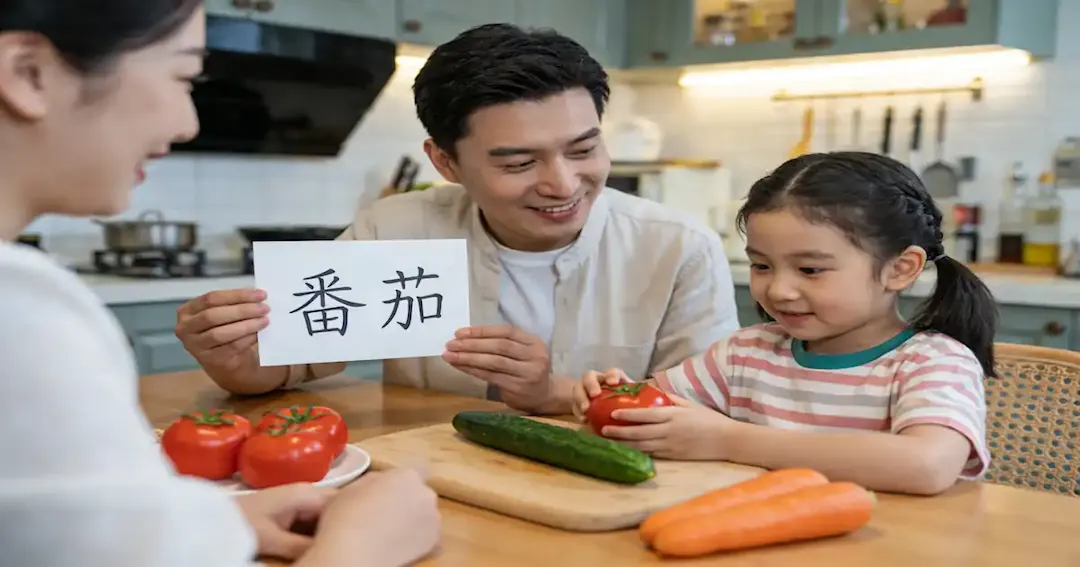
This is the core of the article—the chinese words food you can point to, hold, wash, peel, cut, and eat. Ingredients are honestly the easiest entry point for kids because they’re concrete. No abstract grammar lesson needed. Just: “This is garlic. 大蒜.”
Chinese | Pinyin | English | Use it like this (quick example) |
米饭 | mǐfàn | cooked rice | 我想吃米饭。(I want rice.) |
面条 | miàntiáo | noodles | 今天吃面条。(Noodles today.) |
面包 | miànbāo | bread | 你要面包吗?(Want bread?) |
饺子 | jiǎozi | dumplings | 我们点饺子。(Let’s order dumplings.) |
bāozi | steamed bun | 包子很热。(The bun is hot.) | |
粥 | zhōu | porridge | 早上喝粥。(Porridge in the morning.) |
米粉 | mǐfěn | rice noodles | 我喜欢米粉。(I like rice noodles.) |
dòufu | tofu | 豆腐很软。(Tofu is soft.) | |
鸡蛋 | jīdàn | egg | 给我一个鸡蛋。(Give me an egg.) |
鸡肉 | jīròu | chicken | 我不吃鸡皮。(No chicken skin.) |
牛肉 | niúròu | beef | 牛肉面很好。(Beef noodles are great.) |
猪肉 | zhūròu | pork | 这是猪肉吗?(Is this pork?) |
鱼 | yú | fish | 鱼有刺。(Fish has bones.) |
虾 | xiā | shrimp | 我想吃虾。(I want shrimp.) |
蟹 | xiè | crab | 蟹很香。(Crab smells great.) |
牛奶 | niúnǎi | milk | 牛奶不要太冷。(Not too cold.) |
酸奶 | suānnǎi | yogurt | 我喜欢酸奶。(I like yogurt.) |
水 | shuǐ | water | 可以给水吗?(Can I have water?) |
茶 | chá | tea | 我喝热茶。(Hot tea for me.) |
果汁 | guǒzhī | juice | 果汁太甜了。(Too sweet.) |
苹果 | píngguǒ | apple | 苹果洗了吗?(Was it washed?) |
香蕉 | xiāngjiāo | banana | 香蕉熟了。(It’s ripe.) |
橙子 | chéngzi | orange | 我剥橙子。(I peel an orange.) |
草莓 | cǎoméi | strawberry | 草莓很甜。(Strawberries are sweet.) |
葡萄 | pútao | grapes | 我要葡萄。(I want grapes.) |
西红柿 | xīhóngshì | tomato | 西红柿炒蛋。(Tomato eggs.) |
黄瓜 | huángguā | cucumber | 黄瓜很脆。(Cucumber is crunchy.) |
土豆 | tǔdòu | potato | 土豆泥。(Mashed potato.) |
胡萝卜 | húluóbo | carrot | 胡萝卜切小点。(Cut it smaller.) |
洋葱 | yángcōng | onion | 洋葱有点辣眼睛。(Makes eyes sting.) |
蘑菇 | mógu | mushroom | 我不喜欢蘑菇。(I don’t like mushrooms.) |
青菜 | qīngcài | leafy greens | 多吃青菜。(Eat more greens.) |
大蒜 | dàsuàn | garlic | 少放大蒜。(Less garlic.) |
生姜 | shēngjiāng | ginger | 生姜味很重。(Strong ginger.) |
葱 | cōng | scallion | 加点葱。(Add scallion.) |
酱油 | jiàngyóu | soy sauce | 加一点酱油。(Add a bit.) |
醋 | cù | vinegar | 我想要醋。(I want vinegar.) |
盐 | yán | salt | 盐别放多。(Not too much.) |
糖 | táng | sugar | 少放糖。(Less sugar.) |
油 | yóu | oil | 油有点多。(A bit oily.) |
辣椒 | làjiāo | chili pepper | 这个有辣椒吗?(Any chili?) |
花生 | huāshēng | peanuts | 我不要花生。(No peanuts.) |
芝麻 | zhīma | sesame | 芝麻很香。(Sesame is fragrant.) |
米醋 | mǐcù | rice vinegar | 米醋在哪?(Where’s the rice vinegar?) |
酱 | jiàng | sauce/paste | 这个酱好吃。(This sauce is good.) |
If you’ve noticed your child can repeat words like “rice,” “egg,” and “milk,” but freezes when it’s time to make a full sentence—yeah, that’s incredibly common. You can try the “5 words a day” routine from this post for a week first; if it still feels hard to keep them speaking consistently without someone guiding the practice, you might book a LingoAce Chinese trial class so a teacher can turn these food words into real table talk and simple dialogues.

Chinese words food for cooking talk: 6 verbs
You asked to reduce the other tables, so here’s the tiny-but-mighty version. These chinese words food verbs help you speak while doing something your family already does: making food.
Chinese | Pinyin | English | Quick use |
切 | qiē | cut | 切西红柿。(Cut the tomato.) |
洗 | xǐ | wash | 洗水果。(Wash fruit.) |
加 | jiā | add | 加盐。(Add salt.) |
炒 | chǎo | stir-fry | 炒鸡蛋。(Stir-fry eggs.) |
煮 | zhǔ | boil/cook | 煮面条。(Boil noodles.) |
蒸 | zhēng | steam | 蒸包子。(Steam buns.) |
Chinese words food for opinions: 6 taste/texture words
Not every meal needs a review… but kids will review it anyway. These chinese words food are the ones you’ll hear (and probably repeat).
Chinese | Pinyin | English | Kid-friendly example |
好吃 | hǎochī | tasty | 这个好吃!(So good!) |
难吃 | nánchī | not tasty | 这个有点难吃。(Not great.) |
甜 | tián | sweet | 太甜了。(Too sweet.) |
咸 | xián | salty | 有点咸。(A bit salty.) |
辣 | là | spicy | 好辣!(So spicy!) |
脆 | cuì | crispy | 这个很脆。(So crunchy.) |
Chinese words food for restaurants: 3 phrases that save the moment
Three only. Because honestly, if you remember these, you’re already calmer. And calmer parents get more language out of kids—funny how that works.
Chinese | Pinyin | English | When you’ll use it |
不辣 | bù là | not spicy | Ordering for kids |
打包 | dǎbāo | to-go / pack up | Leftovers |
买单 | mǎidān | pay the bill | End of meal |
FAQ
1) What are the best chinese words food for beginners to start with?
Start with the ingredients your child sees daily: 米饭, 面条, 鸡蛋, 牛奶, 苹果, 香蕉. Add one restaurant phrase (不辣 or 买单). That’s a strong first week.
2) How can I teach chinese words food to a 4–6 year old?
Make it physical: touch the item, say the word once, repeat it during the same meal. Short and playful beats “sit and study.” If they only remember 饺子 for days… it’s fine.
3) What if my child mixes up similar food words in Chinese?
Normal. Kids do that in English too. Keep your correction light: repeat the right word naturally and move on. Too much correcting can shut down speaking.
4) Do we need characters for chinese words food, or is pinyin enough?
Pinyin is enough to start speaking quickly, especially for parents. Characters matter more once your child is reading/writing regularly. Speaking first is often the smoother path for families.
Conclusion
This chinese words food list leans hard into ingredients on purpose—because ingredients show up every day, and daily repetition is how kids actually keep vocabulary. Use the big table, pick five words, repeat them at dinner, and let the rest build slowly.
If you want your child to turn these chinese words food into real conversations—asking for foods, describing tastes, ordering politely—consider booking a LingoAce trial class. A teacher can guide the speaking practice so you don’t have to “teach” at the dinner table.