
In the winter of 2025, a family did something that, to their relatives at least, sounded a bit extreme: they booked Christmas… in China.
When the parents broke the news, their daughter’s first reaction wasn’t excitement. It was a very long stare across the dinner table.
“So, no Grandma’s house? No cookie marathon? Do people there even have Christmas?”
Her questions weren’t dramatic; they were honest. Most of what the family knew about China came from photos of bright shopping streets and high-rises, not from stockings, hot chocolate, or snowmen on front lawns.
Still, a handful of ornaments and a short strand of lights went into the suitcase, tucked between sweaters, “just in case.”

The holiday they eventually experienced was not a copy-and-paste version of home. It wasn’t the opposite either. It sat somewhere in the middle: part shopping festival, part date night, part cultural puzzle—and, as they realized later, a gentle doorway into Mandarin for their child.
We chose to share this story today because it shows very simply how Christmas in China can become more than a travel memory. It can turn into a starting point for language and culture learning, even for kids who begin the journey feeling skeptical.
Seeing Christmas in China in 2025 Through My Child’s Eyes
The family landed on a weekday afternoon. Technically, it was “Christmas season.” The view from the taxi didn’t seem to agree.
Office workers marched past in dark coats, phones in hand. Children in uniforms wheeled bicycles home. Street vendors stirred noodles in big metal woks. No glowing reindeer. No plastic sleighs. No houses trying to out-do each other with light displays.
From the back seat, the daughter watched in silence for a while, fogging up the taxi window with her breath. “Are you sure it’s almost Christmas?” she finally asked.
A few minutes later, the driver turned onto a main shopping street—and suddenly there it was.
A tall, glittering tree stood in front of a department store. Speakers on a loop blasted a very energetic remix of “Jingle Bells.” Near the entrance, a costumed 圣诞老人 (Shèngdàn Lǎorén, Santa Claus) laughed loudly and posed for photos… with teenagers and young adults. No long line of toddlers in sight.
Inside, it was even louder. Tinsel on escalators, fake snow sprayed on windows, red-and-green banners announcing sales. Instead of toy aisles, the daughter saw makeup counters, sneaker displays, bubble tea stands, and big posters for “Christmas deals.”
At one point she looked up at mall Santa and whispered to her parents, half joking, half serious: “Did Santa move here? Is he working retail now?”
The parents didn’t turn the moment into a formal lesson, but they did slow down in front of a sign and read the characters together as best they could:
圣诞节 (Shèngdànjié) – Christmas
圣诞快乐 (Shèngdàn kuàilè) – Merry Christmas
It wasn’t perfect pronunciation, and that was fine. What mattered was that the child saw Christmas in China not as “they don’t celebrate,” but as “they celebrate, just… differently, and in Chinese.”
How Christmas in China Differs From Our Traditions at Home
As the days passed, the daughter began keeping a small list in her notebook. At the top she wrote, in slightly wobbly letters: “Stuff That Feels Weird About Christmas Here.” Every time something didn’t match her idea of the holiday, she added another line.
Reading that list now, it offers a very clear snapshot of how Christmas in China in 2025 differed from a typical North American celebration.
1. It isn’t the big stay-home family holiday
In her home country, Christmas usually means everything slows down. Schools close, many offices shut, and traffic eases. The day itself stretches into pajamas, board games, and relatives dropping by with desserts.
In the Chinese city they visited, December looked different. On Christmas Day, office lights were still on. Children walked to and from school. Delivery riders zig-zagged through traffic. It felt like an ordinary weekday with extra decorations.
For many local families, Christmas is a light-hearted imported festival. The main family gathering holiday is still Chinese New Year (春节, Chūnjié). Once the daughter understood that “the big family holiday” simply sits on a different date, the sense that people “didn’t care about Christmas” faded. Christmas started to look like a warm-up for something bigger.
2. Christmas in China feels closer to Valentine’s Day plus a sale
On Christmas Eve—平安夜 (Píng’ān Yè)—the family expected a quieter mood. Instead, they stepped into crowded streets full of young people. Couples took photos in front of trees. Groups of friends wore light-up headbands and carried shopping bags. Restaurants had waiting lists.
The daughter, used to board games and cocoa on Christmas Eve, frowned slightly. “Where are all the little kids in pajamas?”
Her parents explained that in many cities, Christmas in China has grown into a “go out and celebrate” evening—part social outing, part shopping event. The kid-centered, home-focused experience she knew was present mainly in expat and Christian communities.
To her, it felt strange at first. Later, she described it more like this: “It’s like Valentine’s Day put on a Santa hat and went to the mall.”
3. The Peace Apple tradition came out of nowhere
The most memorable moment, however, was quiet. One evening, a local student the family knew stopped by with a small, neat box. Inside lay a single apple, carefully wrapped.
“平安果 (píng’ānguǒ),” the girl said. “Peace apple.”
Back at the hotel, the parents connected the dots with their daughter: 苹果 (píngguǒ), apple, sounds similar to 平安 (píng’ān), peace or safety. So giving an apple on Christmas Eve is a way of saying, “I wish you a safe, peaceful year.”
The child didn’t rush to eat it. For a while, the apple sat on the hotel desk like an extra decoration. When the family realized they couldn’t take it through customs, she finally sliced it on the flight home, eating it slowly, as if trying to hold onto the moment.
Later, when someone asked what Christmas in China was like, she didn’t talk about the giant tree first. She talked about the apple.

Finding Familiar Joy: The Similarities That Comforted My Child
If every single part of the holiday had felt unfamiliar, the daughter might have closed off. What kept her eyes open were the small things that felt strangely familiar—tiny bridges between her Christmas and Christmas in China.
1. Lights, music, and that “something is happening” feeling
Even with offices and schools still running, evenings in the city carried a festive tone. Public squares lit up with tall trees. Cafés taped paper snowflakes to their windows. A bakery near the hotel set out a slightly crooked plastic reindeer that looked as though it had survived many seasons already.
And then there was the soundtrack. “Jingle Bells” followed the family almost everywhere—upbeat dance versions in clothing stores, gentle jazz in cafés, instrumental versions in the background of a supermarket. At some point the daughter started counting how many times she heard it in one day, then declared that “overplaying ‘Jingle Bells’ might be the real global tradition.”
Underneath the new details, the pattern was familiar: people used light, color, and music to push back a little against winter’s darkness. In that sense, Christmas in China wasn’t a different planet. It was the same instinct, expressed in local ways.
2. A small church that felt familiar, just in another language
On one walk, the family noticed a modest Christian church tucked between shops. A simple sign announced a Christmas service, so they went in.
Inside, the structure was easy to recognize: carols, short readings, a small play performed by children in slightly crooked costumes, then snacks and conversation. The words were in Chinese, but the rhythm—the stand, sit, sing, listen—felt much like churches at home.
For the daughter, seeing local families celebrate the holiday in their own language made Christmas feel bigger, not smaller. It stitched her familiar faith traditions to the broader idea of Christmas in China, instead of positioning them as opposites.
3. Children everywhere ask the same kind of questions
Another small bridge appeared at a neighborhood playground. A girl about the same age circled for a few minutes, clearly debating whether to come over. Eventually she walked up and tried out a sentence in careful English:
“Do you… have Christmas?”
That one question set off a burst of laughter and a short conversation. With help from the adults, the two children traded phrases:
圣诞节 and 圣诞快乐 from one side
“Merry Christmas” from the other
Pronunciation wasn’t perfect. It didn’t matter. For the visiting child, this was the moment when Christmas in China stopped being “their holiday” and became shared ground—something she could talk about, even across languages.

Turning Cultural Differences Into Chinese Learning Moments
No one in this family had created a formal “curriculum” for the trip. Yet looking back, the cultural differences around Christmas in China turned into some of the most effective Mandarin learning moments of the year.
For other parents, a few patterns from this story can be adapted easily, even without going abroad.
1. Attach new words to real scenes, not just lists
Instead of sitting a child down with a printed vocabulary sheet, the family encountered new words at the exact moment they were needed:
圣诞节 on mall posters and digital screens
圣诞快乐 stretched across a shop entrance in big red characters
平安夜 printed on bakery advertisements for Christmas Eve cakes
苹果 and 平安果 on the little box that held the Peace Apple
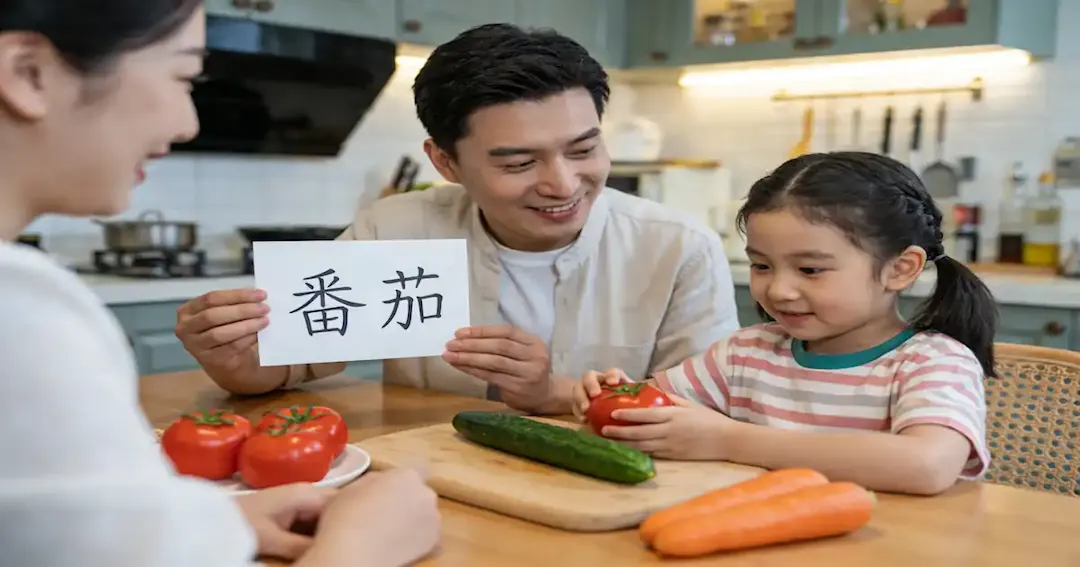
Because each word came with a visual, a place, a mood, the child remembered it as part of a story, not as an isolated term. Families back home can recreate this in simple ways: print small cards with 圣诞节 or 圣诞快乐 and tape them near decorations, or write 平安夜 on a card set on the dinner table during Christmas Eve.
2. Let children’s questions lead the way
Children are quick to spot anything that doesn’t match their mental picture. Those moments of “That’s weird” are often better starting points than any textbook chapter.
In this story, questions sounded like:
“Why are there so many couples out on Christmas Eve?”
“Why is Santa working at the mall?”
“Why apples instead of candy canes?”
Each question gave the parents a chance to explain a small piece of how Christmas in China works, then link it to one or two Mandarin words. The learning stayed short and conversational, more like solving a puzzle than “doing homework.”
For kids already enrolled in online Mandarin lessons, parents can pass these questions to the teacher. Experienced teachers often turn them into stories, short dialogues, or role-plays so that the language connects directly to what the child has noticed in real life.
3. Borrow “Christmas in China” ideas for a North American home
International flights are optional. A family can still bring elements of Christmas in China into December traditions at home:
Set up a small “China corner” near the tree with simple paper cutouts of 圣诞 and 福.
Make a new ritual on Christmas Eve: giving a Peace Apple, explaining 苹果 and 平安, then saying 平安果 together before eating it.
Watch a short kid-friendly video that shows Christmas scenes in Chinese cities and pause occasionally to repeat phrases such as 圣诞快乐 or 圣诞节.
These additions don’t need to replace existing traditions. Mandarin works best here as an extra layer—more color on a picture the child already loves, rather than a new rulebook for how the holiday “should” be done.
4. Use structured courses to turn curiosity into real progress
Spontaneous holiday moments are powerful, but they are also scattered. At some point, many families find it helpful to connect those experiences through a structured Chinese course designed for kids.
When parents in this story looked for support, a few priorities stood out:
Lessons created specifically for children and pre-teens
Teachers who understand both Western and Chinese holidays and can compare them in simple language
A teaching style that uses stories, games, and cultural topics—like Christmas in China—instead of only drills
Platforms such as LingoAce focus on learners aged roughly 3–15 and are built around these ideas. Teachers on such platforms can take a child’s real memories—receiving a Peace Apple, walking past a glowing tree in a shopping street—and fold them into lessons, so curiosity turns into steady Mandarin growth instead of fading after the trip.
What Christmas in China in 2025 Left With Our Family
On the flight back to North America, somewhere above a cloud layer the daughter couldn’t see the end of, she reached into her backpack and pulled out the Peace Apple. By then, the skin was slightly bruised from travel.
Fresh fruit couldn’t go through customs, so there was only one option. She asked for a plastic knife and sliced it slowly, eating piece by piece. Halfway through, she told her parents:
“Christmas in China is kind of strange.”
There was a pause, then she added, “But good strange. It’s still Christmas. They borrowed it and changed some parts. And we took some of their ideas back with us.”
Not long after, she started using 圣诞节 as a sort of family code word. The phrase stuck.
For this family, Christmas in China did more than fill a photo album. It showed their child that traditions can move, bend, and pick up new meanings as they travel. People wrap apples as gifts, crowd shopping streets, play carols with new rhythms—and still wish each other peace. Mandarin became the tool that allowed one child to step into that shifting picture, instead of watching from the edges.
For parents in North America who are thinking about Mandarin for their own children, this story suggests a simple path:
Share stories about how holidays look in different parts of the world
Sprinkle phrases like 圣诞快乐, 平安夜, and 平安果 into December conversations
Treat children’s “That’s weird” comments as openings, not obstacles
When curiosity grows beyond what a family can answer comfortably, that is often the right time to look for a structured kids’ Chinese course. A thoughtful program does not replace family rituals; it stretches them, adding language and cultural context so children can engage more deeply with the world around them.
In the end, that is what this 2025 holiday gave the family: a reminder that joy wears different outfits from place to place, but the wish for light and peace is shared. Mandarin didn’t make Christmas “better,” but it did open another door—one that is now a little easier for other families to find with support from platforms like LingoAce.