
Chinese paintings are known for their emphasis on the harmonious integration of poetry, calligraphy, and painting. It is a concept known as "文人画" (wén rén huà) or literati painting. Unlike Western art traditions prioritizing realism, Chinese painting frequently leans towards symbolic representation and capturing the essence or spirit of the subject rather than meticulous details. This is evident in styles like "写意" (xiě yì), where artists employ expressive and spontaneous brushwork to convey emotion and mood, favoring suggestion over precision.
The role of symbolism is prevalent in Chinese painting, with elements like rocks, water, and flowers carrying deeper cultural and philosophical meanings. The "山水" (shān shuǐ) style, focused on landscapes, often reflects a spiritual connection between humanity and nature, embracing minimalism and inviting viewers to engage their imagination.
What are Chinese paintings?
Chinese painting is an artistic tradition known for its delicate brushwork, rich symbolism, and cultural depth. With just a brush and ink, Chinese paintings have diverse styles, techniques, and themes that depict landscapes, portraits, and narrative scenes from history and mythology. The essence of Chinese painting lies in the final artwork and the artistic process, emphasizing spontaneity, harmony, and the expressive qualities of each brushstroke.
Chinese paintings have a rich tradition dating back thousands of years, and artists use various materials to create these intricate works of art. It starts with Xuan Paper (宣纸, Xuānzhǐ), a type of traditional Chinese paper made from the bark of the wingceltis tree. It is known for its smooth texture and ability to absorb ink and color effectively. There are different grades of Xuan paper, each suitable for specific Chinese painting styles.
The brushes (毛笔, Máobǐ) are typically made from animal hair, such as goat, rabbit, or wolf, and come in a variety of sizes, shapes, and stiffness, allowing artists to achieve different effects. The brush handle is often made from bamboo, and the ferrule (metal part holding the bristles) may be made from materials like copper or brass.
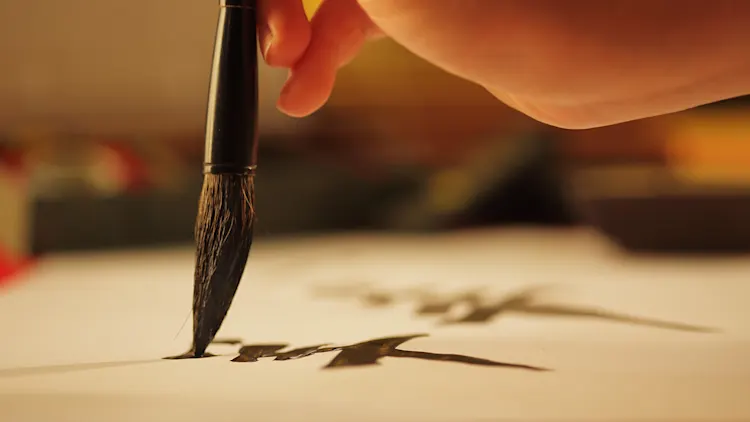
The paintings are made with traditional Chinese ink (墨汁, Mòzhī) that comes in the form of an inkstick. Artists grind the inkstick on an inkstone with a small amount of water to produce liquid ink. High-quality ink is made from pine soot and various other natural materials. Some Chinese paintings incorporate color using pigments derived from minerals, plants, and even some insects. The most common are cinnabar (red), malachite (green), and azurite (blue). Artists use a palette (调色盘, Diàosè Pán) to mix and dilute colors. This may be a separate porcelain dish or a section on the inkstone where the artist grinds the ink. Mixing colors and achieving the right consistency is crucial in Chinese painting.
Instead of a signature, artists use seals (印章, Yìnzhāng) to sign and mark the artwork. They are typically made of stone or wood and engraved with the artist's name in Chinese characters or a symbol (as there is no Chinese alphabet). Seals are an integral part of Chinese painting, adding a distinctive and personal touch to the finished piece. Once the painting is completed, it is often mounted on silk or other fabrics to enhance its durability and visual appeal. Mounting involves attaching the painted Xuan paper to a more substantial backing material.

10 popular Chinese paintings and why they are famous
Dwelling in the Fuchun Mountains (富春山居图 Fùchūn Shān Jū Tú)
Attributed to Huang Gongwang (黄公望) of the Yuan Dynasty, this painting is revered for its sublime depictions of mountains, rivers, and forests. With its profound sense of space, mastery of ink wash techniques, and the artist's introspective connection with nature, this landscape painting showcases the artist's ability to convey the beauty and tranquility of the natural world. The strokes and composition in this Chinese painting reflect the artist's deep contemplation and artistic prowess, making it a timeless masterpiece.
Along the River During the Qingming Festival (清明上河图 Qīngmíng Shànghé Tú)
Considered a Northern Song Dynasty masterpiece, this artwork is often attributed to Zhang Zeduan (张择端) and is hailed as one of the most significant achievements in Chinese painting. This extraordinary panoramic handscroll depicts urban life and festivities along the Bian River. It is celebrated for its intricate details and vibrant portrayal of daily life and historical urban landscapes.
Spring Morning in the Han Palace (汉宫春晓图, Hàn Gōng Chūn Xiǎo Tú) Qiu Ying's (仇英)
Ming Dynasty painting is celebrated for its exquisite depiction of court life during the Han Dynasty. It is known for its vibrant colors, intricate details, and dynamic composition. This Chinese painting captures the essence of a festive spring morning in the imperial palace, showcasing the artist's skill in creating lively and atmospheric scenes.
Court Ladies of the Tang Dynasty (唐宫图, Táng Gōng Tú)
This Tang Dynasty masterpiece is famous for portraying elegant court ladies in the Tang Dynasty. This Chinese painting by Zhou Fang (周昉) is renowned for its graceful and refined depiction of figures, elaborate costumes, and meticulous attention to detail. It provides a glimpse into the sophisticated lifestyle of the Tang court.
Magpies and Hare (喜鹊逢兔图, Xǐ Què Féng Tù Tú) - Xu Beihong
Painted by the 20th-century artist Xu Beihong (徐悲鸿), this piece is famous for its symbolic representation of peace and harmony. The painting features magpies, symbolizing happiness, and a hare, representing longevity. Xu Beihong's fusion of traditional Chinese painting ink techniques with a modern approach contributed to the popularity of this artwork.
The Night Revels of Han Xizai (韩熙载夜宴图, Hán Xīzǎi Yè Yàn Tú) - Gu Hongzhong
Created by Gu Hongzhong (顾闳中) during the Five Dynasties and Ten Kingdoms period, this Chinese painting is famous for depicting a night banquet hosted by a statesman named Han Xizai. The artwork is renowned for its detailed portrayal of figures engaged in various activities, revealing the artist's keen observation and storytelling skills.
Bamboo and Rock (竹石图, Zhú Shí Tú)
This piece is celebrated for its simplicity, highlighting the elegance of bamboo and rocks with minimalistic brushstrokes. It was painted by Zhao Mengfu (赵孟頫), a Yuan Dynasty painter known for his distinctive style combining traditional Chinese painting elements with a taste for individual expression. His innovative approach had a lasting impact on subsequent generations of Chinese painters.
Five Drunken Princes Returning on Horseback (五醉王子图, Wǔ Zuì Wáng Zǐ Tú)
Painted by Ren Renfa (任仁发) during the Yuan Dynasty, this Chinese painting is famous for depicting five princes returning on horseback in intoxication. The artist's skilled rendering of the horses, expressive brushwork, and lively portrayal of the intoxicated princes contribute to the painting's enduring popularity.
Listening to the Qin (聽琴图, Tīng Qín Tú)
Created by Emperor Huizong (宋徽宗) of the Song Dynasty, this painting is renowned for its intimate depiction of court life. The emperor, known for his passion for the arts, portrayed himself as enjoying the music of the qin. This Chinese painting is celebrated for its refined depiction of the emperor's surroundings, reflecting the sophistication of the Song court culture.
One Hundred Horses (百骏图, Bǎi Jùn Tú)
While Giuseppe Castiglione, an Italian Jesuit missionary, may not be traditionally Chinese, his collaboration with the Qing court produced the famous "One Hundred Horses." This piece is celebrated for its fusion of Western and Chinese artistic styles. Castiglione, who adopted the Chinese name Lang Shining (郎世寧), combined his training in European art techniques with a deep understanding of traditional Chinese painting. "One Hundred Horses" is renowned for its dynamic composition, vibrant colors, and meticulous portrayal of horses, symbolizing power, strength, and prosperity. Castiglione's ability to bridge cultural influences contributes to the painting's fame, marking it as a unique and influential piece in Chinese art history.
With their intricate brushwork and profound cultural significance, Chinese paintings offer a window into China's rich artistic heritage. The ten famous Chinese paintings highlighted in this article are timeless masterpieces, each telling a unique story and contributing to the diverse tapestry of Chinese art. From panoramic urban landscapes to serene mountain retreats, these paintings reflect the beauty of nature, the complexities of human life, and the enduring legacy of Chinese artistic expression.
As we explore these masterpieces, we gain an appreciation for the technical skill of the artists but also a deeper understanding of the historical, cultural, and philosophical dimensions that define Chinese painting.
Want your child to learn Chinese? LingoAce is one of the best ways to learn Chinese for kids. Each one-on-one lesson is the product of nearly 200 hours of curriculum development, teacher training, and quality control. Our classes are tailored to meet your child's learning needs.
Experience a redefined Chinese learning experience first-hand and book a free trial class with us today.