
You know the moment: someone offers your kid a snack they don’t want, a classmate grabs a toy, or a relative pushes for “just one more bite.” In English, “no” is quick. In Mandarin, no in Chinese depends on what you’re refusing—an action, an offer, a fact, or a request—and how gentle you need to be.
This list is built for real family life : school, playdates, food, safety, boundaries, and those awkward “we should get together” invitations. You’ll get 40 phrases with pinyin, plus when to use each one, why it matters, and a short example you can steal.
If your child already understands basic Mandarin but freezes when it’s time to speak, that’s normal. “Refusing politely” is one of those skills that needs a little practice—not a lot of grammar.

Is there a direct “no” in Chinese?
Sometimes, yes… but often Chinese answers the type of question instead of saying a standalone “no.”
The 15-second rule: 不 vs 没/没有
不 (bù) = “not / don’t” for now, future, habits, and opinions.
没 (méi) / 没有 (méiyǒu) = “didn’t / haven’t / don’t have” for past or absence (didn’t happen, don’t possess). This “bu vs mei” contrast is a core beginner grammar point.
You don’t need to teach your kid grammar terms. You just want them to pick a phrase that doesn’t sound weird or too harsh.
Quick “No” Cheat Sheet (Compact Tables)
Table A — Fast starters: the 10 you’ll use the most
# | 中文 | Pinyin | 场景 | Tone | Kid |
1 | 不 | bù | quick “no/not” | blunt | △ |
2 | 不是 | bú shì | correct facts | neutral | ✓ |
3 | 不要 | bú yào | don’t / don’t want | firm | ✓ |
4 | 不用 | bú yòng | no need / no thanks | polite | ✓ |
6 | 不行 | bù xíng | can’t / not OK | firm | ✓ |
7 | 不可以 | bù kě yǐ | not allowed | firm | ✓ |
8 | 别… | bié… | stop doing… | firm | ✓ |
11 | 等一下 | děng yí xià | wait a sec | soft | ✓ |
12 | 现在不行 | xiàn zài bù xíng | not now | firm | ✓ |
13 | 下次吧 | xià cì ba | maybe next time | soft | ✓ |
Table B — Polite declines (social + family-friendly)
# | 中文 | Pinyin | 场景 | Tone | Kid |
5 | 不必 | bú bì | not necessary | polite+ | △ |
10 | 先不要 | xiān bú yào | not yet | soft | ✓ |
14 | 改天吧 | gǎi tiān ba | another day | soft | ✓ |
15 | 我不太想… | wǒ bú tài xiǎng… | I’d rather not… | polite | △ |
16 | 我不方便 | wǒ bù fāng biàn | not convenient | polite | △ |
17 | 恐怕不行 | kǒng pà bù xíng | I’m afraid not | very polite | △ |
18 | 不好意思,不用了 | bù hǎo yì si, bú yòng le | sorry, no need | very polite | ✓ |
19 | 不好意思,我不需要 | bù hǎo yì si, wǒ bù xū yào | sorry, don’t need | polite | ✓ |
20 | 谢谢,不用了 | xiè xie, bú yòng le | thanks, no need | polite | ✓ |
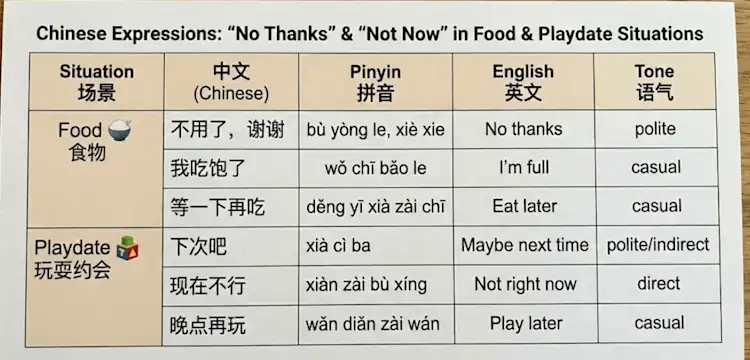
31 | 不用了,谢谢 | bú yòng le, xiè xie | no thanks | polite | ✓ |
Table C — Daily family life (food, preferences, “don’t have”)
# | 中文 | Pinyin | 场景 | Tone | Kid |
21 | 谢谢,我吃饱了 | xiè xie, wǒ chī bǎo le | I’m full | polite | ✓ |
22 | 我不喜欢 | wǒ bù xǐ huan | I don’t like | direct | ✓ |
23 | 我不想要 | wǒ bù xiǎng yào | I don’t want | direct | ✓ |
24 | 我不想去 | wǒ bù xiǎng qù | don’t want to go | direct | ✓ |
25 | 我不能 | wǒ bù néng | I can’t | neutral | ✓ |
26 | 我不会 | wǒ bú huì | I can’t / don’t know how | neutral | ✓ |
27 | 我没有 | wǒ méiyǒu | I don’t have | neutral | ✓ |
28 | 没空 | méi kòng | no time | neutral | △ |
32 | 不吃了 | bù chī le | done eating | direct | ✓ |
33 | 不喝了 | bù hē le | done drinking | direct | ✓ |
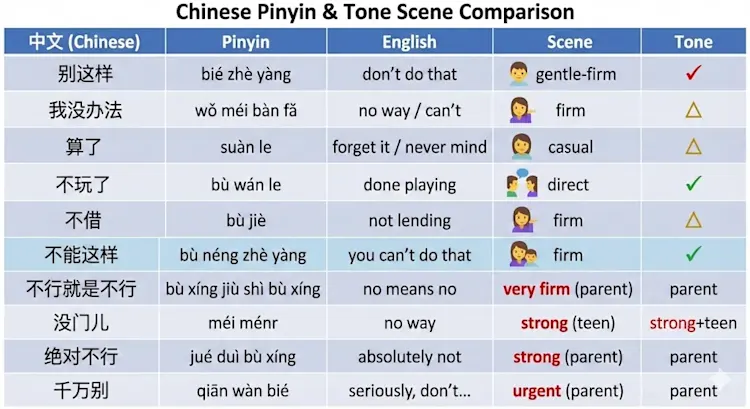
Table D — Boundaries + firm “no” (use with care)
# | 中文 | Pinyin | 场景 | Tone | Kid |
9 | 别这样 | bié zhè yàng | don’t do that | gentle-firm | ✓ |
29 | 我没办法 | wǒ méi bàn fǎ | no way / can’t | firm | △ |
30 | 算了 | suàn le | forget it / never mind | casual | △ |
34 | 不玩了 | bù wán le | done playing | direct | ✓ |
35 | 不借 | bù jiè | not lending | firm | △ |
36 | 不能这样 | bù néng zhè yàng | you can’t do that | firm | ✓ |
37 | 不行就是不行 | bù xíng jiù shì bù xíng | no means no | very firm | parent |
38 | 没门儿 | méi ménr | no way | strong+ | teen |
39 | 绝对不行 | jué duì bù xíng | absolutely not | strong | parent |
40 | 千万别 | qiān wàn bié | seriously, don’t… | urgent | parent |
The 40 phrases (what they mean, why they matter, and how to use them)
Everyday neutral “no” (simple starters)
1) 不 (bù) — quick “no / not” Why it matters: kids overuse it and sound abrupt, so teach it as a “starter,” not the final form. Example:
A: 你要吗?Nǐ yào ma? Want it?
B: 不。Bù. (Short, a bit blunt)
2) 不是 (bú shì) — “no, it isn’t / that’s not it” Why it matters: perfect for correcting facts without sounding dramatic. Example: 不是这个。Bú shì zhè ge. Not this one.
3) 不要 (bú yào) — “don’t / I don’t want (it)” Why it matters: the go-to for refusing an offer or stopping an action. Kid example: 不要,谢谢。Bú yào, xièxie. No thanks.
4) 不用 (bú yòng) — “no need” Why it matters: helps your child refuse help or extras politely. Example: 不用,我自己来。Bú yòng, wǒ zì jǐ lái. No need, I’ll do it.
5) 不必 (bú bì) — “not necessary” Why it matters: a slightly more grown-up version of 不用. Example: 不必麻烦了。Bú bì má fan le. No need to trouble.
6) 不行 (bù xíng) — “can’t / not OK” Why it matters: sets a clear boundary. Great for safety and rules. Example: 这样不行。Zhè yàng bù xíng. That’s not OK.
7) 不可以 (bù kě yǐ) — “not allowed” Why it matters: parent/teacher language that’s firm but clean. Example: 不可以打人。Bù kě yǐ dǎ rén. No hitting.
8) 别… (bié…) — “don’t (do that)” Why it matters: fast intervention phrase. Example: 别跑!Bié pǎo! Don’t run!
9) 别这样 (bié zhè yàng) — “don’t do it like this” Why it matters: stops behavior without shaming. Example: 别这样说。Bié zhè yàng shuō. Don’t say it that way.
10) 先不要 (xiān bú yào) — “not yet / for now, don’t” Why it matters: lets you say “no” while keeping cooperation. Example: 先不要开电视。Xiān bú yào kāi diàn shì. Not TV yet.
Soft “not now” refusals (high success with kids)
11) 等一下 (děng yí xià) — “wait a second” Why it matters: buys time, lowers tension. Example: 等一下,我们先穿鞋。Děng yí xià, wǒ men xiān chuān xié.
12) 现在不行 (xiàn zài bù xíng) — “not right now” Why it matters: clear boundary without argument. Example: 现在不行,等回家。Xiàn zài bù xíng, děng huí jiā.
13) 下次吧 (xià cì ba) — “maybe next time” Why it matters: the classic polite decline. Example: 下次吧,今天有事。Xià cì ba, jīn tiān yǒu shì.
14) 改天吧 (gǎi tiān ba) — “another day” Why it matters: useful when you want to keep the relationship warm. Example: 改天吧,我得接孩子。Gǎi tiān ba, wǒ děi jiē hái zi.
15) 我不太想… (wǒ bú tài xiǎng…) — “I’d rather not…” Why it matters: teaches tone—how to refuse without sounding harsh. Example: 我不太想吃甜的。Wǒ bú tài xiǎng chī tián de.
16) 我不方便 (wǒ bù fāng biàn) — “it’s not convenient” Why it matters: polite adult/teen refusal without explaining everything. Example: 我今天不方便接电话。Wǒ jīn tiān bù fāng biàn jiē diàn huà.
17) 恐怕不行 (kǒng pà bù xíng) — “I’m afraid not” Why it matters: one of the politest “no” options in common guides. Example: 恐怕不行,我已经有安排。Kǒng pà bù xíng, wǒ yǐ jīng yǒu ān pái.
18) 不好意思,不用了 (bù hǎo yì si, bú yòng le) — “sorry, no need” Why it matters: perfect for refusing help or sales-y offers politely. Example: 不好意思,不用了,我看看就好。Bù hǎo yì si, bú yòng le.
19) 不好意思,我不需要 (bù hǎo yì si, wǒ bù xū yào) — “sorry, I don’t need it” Why it matters: still polite, slightly firmer than #18. Example: 不好意思,我不需要这个。Bù hǎo yì si, wǒ bù xū yào zhè ge.
20) 谢谢,不用了 (xiè xie, bú yòng le) — “thanks, no need” Why it matters: the easiest “polite no” to teach a child. Example: 谢谢,不用了。Xiè xie, bú yòng le.
Food, gifts, and “no thanks” situations (parents live here)
21) 谢谢,我吃饱了 (xiè xie, wǒ chī bǎo le) — “thanks, I’m full” Why it matters: helps kids refuse food without sounding rude. Example: 谢谢,我吃饱了。Xiè xie, wǒ chī bǎo le.
22) 我不喜欢 (wǒ bù xǐ huan) — “I don’t like it” Why it matters: honest, but teach kids to add 谢谢 when needed. Example: 我不喜欢这个味道。Wǒ bù xǐ huan zhè ge wèi dào.
23) 我不想要 (wǒ bù xiǎng yào) — “I don’t want it” Why it matters: clean refusal when someone keeps insisting. Example: 我不想要,谢谢。Wǒ bù xiǎng yào, xiè xie.
24) 我不想去 (wǒ bù xiǎng qù) — “I don’t want to go” Why it matters: useful for parties/playdates—then you can negotiate calmly. Example: 我不想去,我想在家。Wǒ bù xiǎng qù, wǒ xiǎng zài jiā.
25) 我不能 (wǒ bù néng) — “I can’t” Why it matters: lets kids refuse based on rules (“I can’t have candy”). Example: 我不能吃糖。Wǒ bù néng chī táng.
26) 我不会 (wǒ bú huì) — “I don’t know how / I can’t (do it)” Why it matters: turns frustration into a clear sentence. Example: 我不会写这个字。Wǒ bú huì xiě zhè ge zì.
27) 我没有 (wǒ méiyǒu) — “I don’t have (it)” Why it matters: the classic “no” for possession—this is where 没/没有 shines. Example: 我没有带作业。Wǒ méiyǒu dài zuò yè.
28) 没空 (méi kòng) — “no time” Why it matters: simple decline without overexplaining. Example: 我今天没空。Wǒ jīn tiān méi kòng.
29) 我没办法 (wǒ méi bàn fǎ) — “I can’t (there’s no way)” Why it matters: firmer than 我不能; useful when something is impossible. Example: 我没办法现在过去。Wǒ méi bàn fǎ xiàn zài guò qù.
30) 算了 (suàn le) — “forget it / never mind” Why it matters: ends a negotiation. Use carefully—can sound dismissive. Example: 算了,我们走吧。Suàn le, wǒ men zǒu ba.
School + playdate boundaries (where kids really need “no in Chinese”)
31) 不用了,谢谢 (bú yòng le, xiè xie) — “no thanks” Why it matters: the safest default refusal for kids. Example: 不用了,谢谢。我带了。Bú yòng le, xiè xie. Wǒ dài le.
32) 不吃了 (bù chī le) — “I’m done eating” Why it matters: helps with portion pressure without arguing. Example: 我不吃了,谢谢。Wǒ bù chī le, xiè xie.
33) 不喝了 (bù hē le) — “I’m done drinking” Why it matters: same pattern—easy for children to memorize. Example: 我不喝了。Wǒ bù hē le.
34) 不玩了 (bù wán le) — “I’m done playing” Why it matters: clean exit line at the park or a friend’s house. Example: 我不玩了,我要回家。Wǒ bù wán le, wǒ yào huí jiā.
35) 不借 (bù jiè) — “not lending (it)” Why it matters: toy boundaries. For younger kids, soften it. Kid-friendly upgrade: 现在不借。Xiàn zài bù jiè. Not right now.
36) 不能这样 (bù néng zhè yàng) — “you can’t do that” Why it matters: a strong but appropriate correction. Example: 不能这样抢。Bù néng zhè yàng qiǎng. Don’t snatch like that.
37) 不行就是不行 (bù xíng jiù shì bù xíng) — “no means no” Why it matters: for repeated pushing. Use as parent language, not a first move. Example: 不行就是不行,结束。Bù xíng jiù shì bù xíng, jié shù.
38) 没门儿 (méi ménr) — “no way” (colloquial) Why it matters: playful/strong refusal among friends; not for teacher situations. Example: 你要我现在写十页?没门儿。Nǐ yào wǒ xiàn zài xiě shí yè? Méi ménr.
39) 绝对不行 (jué duì bù xíng) — “absolutely not” Why it matters: reserved for safety and hard rules. Example: 绝对不行,太危险。Jué duì bù xíng, tài wēi xiǎn.
40) 千万别 (qiān wàn bié) — “don’t (seriously)” Why it matters: urgent prevention phrase. Example: 千万别碰!Qiān wàn bié pèng! Don’t touch!
A natural way to practice (so your child actually uses these)
Here’s what usually happens: kids can recognize phrases, maybe even repeat them… then real life hits, and their brain blanks. If you want your child to use no in Chinese comfortably, keep practice tiny and consistent.
A 3-minute-a-day routine (works for busy families)
Pick 3 phrases for the week (one polite, one “not now,” one boundary).
One role-play at breakfast: you offer something; your child refuses politely.
One role-play at night: toy sharing, screen time, “don’t touch,” “not allowed.”
Swap the setting (“at school,” “at grandma’s,” “at a friend’s house”) so the phrase sticks.
If your child needs a bit more structure—especially to get tone right—role-play lessons can help. Some families like trying a short online trial class where a teacher uses kid-friendly scenarios (school, playdates, food offers) and guides the exact wording. LingoAce is one option parents use for that kind of speaking practice, particularly when they want 1-on-1 attention and a clear path from phrases to real conversation.
If you want to see whether guided role-play helps your child speak up politely, you can book a LingoAce trial lesson and ask the teacher to focus on “refusing and setting boundaries” scenarios.

Key takeaways: best options by age
Ages 3–6 (keep it short and clean)
Default polite refusal: 不用了,谢谢 / 谢谢,不用了 (#20/#31)
“Not now”: 现在不行 / 等一下 (#12/#11)
Safety: 别… / 不可以 (#8/#7)
Ages 7–10 (add one reason)
我不能… (#25) + a simple reason: 因为… (because…)
下次吧 / 改天吧 (#13/#14) for social situations
Ages 11–15 (tone control matters)
Polite but firm: 恐怕不行 / 我不方便 (#17/#16)
Slang with friends only: 没门儿 (#38)
The goal isn’t “perfect Mandarin.” It’s confidence: your child can refuse, stay polite, and avoid misunderstandings.
FAQ about no in Chinese
1) What’s the most common way to say “no in Chinese”? Many guides say 不 (bù) is the simplest “no,” but it can sound blunt alone. A kid-friendly upgrade is 不用了,谢谢 or 谢谢,不用了 for offers.
2) How do you politely say “no thanks” in Chinese? Try 不用了,谢谢 or 谢谢,不用了. If you need extra politeness, add 不好意思: 不好意思,不用了.
3) What’s the difference between 不 and 没/没有? (bu vs mei) A simple parent rule: 不 for “don’t / not (now or in general),” 没/没有 for “didn’t / don’t have.” For example, 我不吃 (I don’t eat it) vs 我没吃 (I didn’t eat it).
4) How can kids say “no” in Mandarin without sounding rude? Teach a “polite wrapper” first: 谢谢 + 不用了. Then add “not now” phrases like 等一下 to avoid sounding sharp.
5) Is there a cultural reason Chinese people sometimes avoid a direct “no”? Yes—refusals can be softened to protect feelings or keep the relationship smooth, especially with acquaintances. That’s why phrases like 下次吧 and 改天吧 work so well.
Conclusion
There isn’t just one “no in Chinese.” There are useful no’s: polite ones for offers, calm ones for “not now,” and firm ones for safety and boundaries. Pick five phrases your family will actually use this week, practice them in tiny role-plays, and your child will start reaching for the right words without freezing.
If you’d like help turning these phrases into real speaking confidence, consider trying a LingoAce trial lesson and ask for role-plays around school, playdates, and polite refusal—those are the exact moments kids need “no” the most.