
For most kids, Chinese characters look like someone dropped a box of matchsticks on the page and called it a language.But there’s a secret that changes everything:Almost every character your child meets has a story behind it.
The Chinese writing system goes back over 3,000 years. Some of the oldest examples are carved on oracle bones—animal bones and turtle shells used for fortune-telling during the Shang dynasty. Many early characters were little pictures of real things: a tree, the sun, a river. Over time, those pictures turned into the stylized characters we see today.In this guide, you’ll get:
A quick, parent-friendly primer on where Chinese characters come from
Simple tips on how to use stories, games, and LingoAce live classes to make Chinese less about drilling and more about curiosity.
Let’s start with a tiny bit of history, then dive straight into story-based learning.

1. A quick, kid-friendly tour of Chinese character origins
You don’t need a linguistics degree to explain this part. A short, clear story is enough.
1.1 How did Chinese characters begin?
Researchers and museums describe a few major stages:
Earliest known form (around 1250–1050 BCE).
Characters scratched on animal bones and turtle shells for divination.
Many look like tiny drawings: a tree, a person, the sun, a hand.
Bronze and seal scripts (金文 / 篆书)
Characters move from bones to bronze vessels, then to more formal “seal” shapes.
The pictures start to stretch and curl, but you can still see the original idea in many characters.
Clerical and regular scripts (隶书 / 楷书)
Characters become more block-shaped, easier to write with a brush.
This is where modern forms really take shape.
Kids don’t need all the details, but they love bits like:
“People used to carve questions into turtle shells to ask the future. That’s where some of your characters began.”
“The character for ‘tree’ really did look like a little tree thousands of years ago.”
1.2 How are characters built today?
Most modern characters fit into a few patterns:
Type | What it means in kid language | Simple examples |
Pictograph 象形 | Little pictures of things | 山 (mountain), 木 (tree), 口 (mouth) |
Compound idea 会意 | Two or more pictures combined to show a concept | 林 (two trees = woods), 明 (sun + moon = bright) |
Sound-meaning 形声 | One part hints at meaning, one part hints at sound | 河 (water radical + “can” sound), 妈 (female radical + “ma” sound) |
When kids learn these patterns, characters stop being random. They start to feel like Lego pieces.Now let’s turn that into something practical: origin stories you can share at the breakfast table.
2. Nature & world: 10 Chinese characters your child can “see”
These are some of the easiest to start with because the pictures are so clear in early forms.
# | Character | Pinyin | Basic meaning | Kid-friendly origin story |
1 | 山 | shān | mountain | Originally drawn as three peaks in a row—imagine a little mountain range. |
2 | 川 | chuān | river | Early forms show three flowing lines, like water running between banks. |
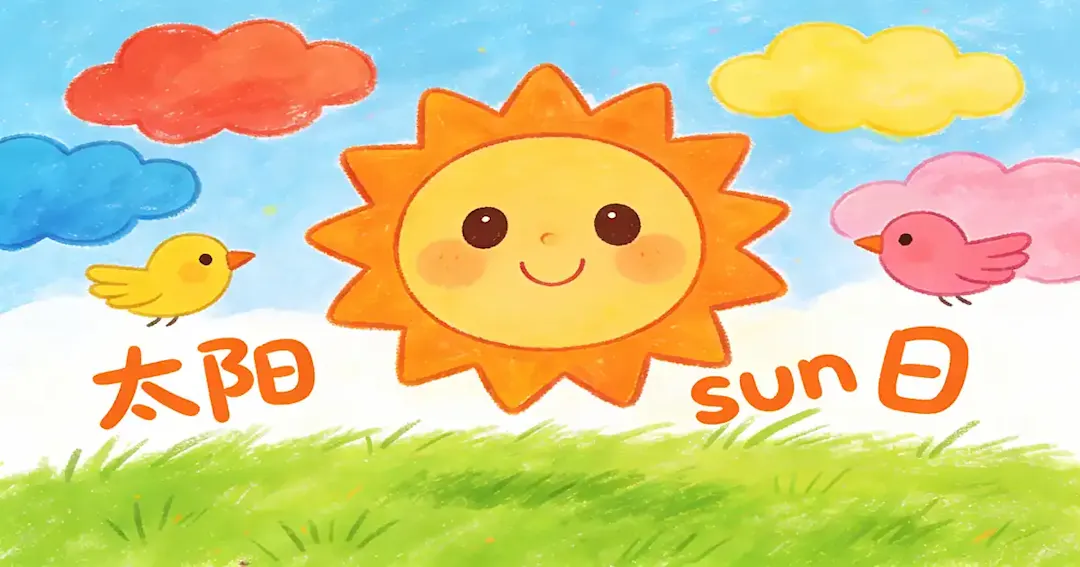
3 | 日 | rì | sun / day | Began as a circle with a dot inside, like the sun in the sky. |
4 | 月 | yuè | moon / month | Started as a crescent moon shape; later, strokes made it more square. |
5 | 水 | shuǐ | water | Drawn as wavy lines showing a stream with splashes. |
6 | 火 | huǒ | fire | Looks like flames shooting upward, with sparks on the sides. |
7 | 木 | mù | tree | A trunk in the middle, branches on top, roots at the bottom. |
8 | 林 | lín | woods | Two trees side by side—when you see more trees, you’re in the woods. |
9 | 森 | sēn | forest | Three trees together, like a thick forest you can get lost in. |
10 | 田 | tián | field | A square divided into sections, like a farmer’s field seen from above. |
How to use these at home
Have your child draw the “ancient picture” next to the modern character.
Ask: “If you didn’t know Chinese, what do you think this looks like?” Let them guess first.
Once they hear the real story, connect it to a real object: a tree outside, water in the sink, the sun going down.
3. People & body: 10 characters that start with us
Kids love anything related to themselves: eyes, hands, family, friends. Many such characters started as stylized body shapes.
# | Character | Pinyin | Meaning | Origin story for kids |
11 | 人 | rén | person | A simple stick figure—head on top, two legs below. |
12 | 大 | dà | big | Like a person standing tall with arms stretched wide. |
13 | 小 | xiǎo | small | Originally three little dots, like tiny pieces. |
14 | 口 | kǒu | mouth | Drawn as a square opening—think of an open mouth. |
15 | 目 | mù | eye | A vertical oval with lines, like an eye with eyelids. |
16 | 手 | shǒu | hand | Early forms show a hand with five fingers. |
17 | 心 | xīn | heart | First a shape like a real heart; later simplified, but still looks like one if you tilt your head. |
18 | 女 | nǚ | woman | Ancient form showed a person sitting with arms folded, a common pose in early art. |
19 | 子 | zǐ | child / son | A big head and body wrapped like a baby bundle. |
20 | 友 | yǒu | friend | Two hands reaching to each other—friendship is about helping. |
Parent–child routine idea
Pick one “people” character per week. For that week:
Draw it,
Find it in simple books or labels,
Use it to build compound words (for example, 人 in 男人, 女人, 朋友的人).
You’re gently connecting character, sound, meaning, and real life.
4. Home, family & daily objects: 10 cozy characters
Now move into your child’s everyday world: house, doors, tools, home life.
# | Character | Pinyin | Meaning | Story they can picture |
21 | 家 | jiā | home / family | A roof on top (宀) and a pig (豕) underneath—long ago, a family with animals under one roof meant a real home. |
22 | 门 | mén | door | Two panels with a gap in the middle, like an old wooden door. |
23 | 户 | hù | household / door | A side view of a single swinging door panel. |
24 | 车 | chē | cart / vehicle | Early forms show a cart with two wheels and a platform. |
25 | 舟 | zhōu | boat | A simple boat from the side, floating on water. |
26 | 刀 | dāo | knife | A blade with a handle; you can almost see the sharp edge. |
27 | 火 (again) | huǒ | fire, cooking | In the kitchen example, explain it as the flame under the pot. |
28 | 米 | mǐ | rice | Grains of rice spread out; originally looked more like a bunch of tiny seeds. |
29 | 食 / 饣 | shí | eat / food | A picture of a person with food; modern left-side form 饣 hints at “something to eat.” |
30 | 灯 | dēng | lamp / light | Fire radical 火 on the left + 丁 on the right; think of a controlled little fire giving light. |
For many modern characters like 灯, the origin is partly phonetic (丁 for sound) and partly semantic (火 for meaning). With kids, you don’t need the full academic explanation—“part shows meaning, part shows sound” is enough.
5. Animals & nature friends: 10 characters kids instantly like
Animal characters are some of the easiest to turn into stories kids remember.
# | Character | Pinyin | Meaning | Kid story hook |
31 | 马 | mǎ | horse | Like a horse’s head and flowing mane in early forms. |
32 | 牛 | niú | cow | Horns on top, head below—like a cow facing you. |
33 | 羊 | yáng | sheep | Curved horns and a face; imagine a sheep looking over a fence. |
34 | 鱼 | yú | fish | A fish with tail and fins; the extra lines show scales. |
35 | 鸟 | niǎo | bird | A small bird with beak and tail; early forms even show claws. |
36 | 虫 | chóng | insect / bug | A simple wriggly shape; now often used as “creature” radical. |
37 | 狗 | gǒu | dog | 犭 is the animal/dog side radical, 句 gives the sound; think of a dog next to its owner’s words. |
38 | 猫 | māo | cat | 犭 again means “animal,” 苗 gives sound; nice chance to talk about radicals. |
39 | 龙 / 龙 | lóng | dragon | Ancient forms show a long, twisting creature with horns. |
40 | 虎 | hǔ | tiger | A striped body and tail; many kids see a tiger face if you outline it. |
Memory trick
Draw the animal in pencil, then trace the modern character on top in a darker pen.
Show how the picture “shrinks” into the square box.
Kids start seeing characters as cartoons that got tidied up.

6. Feelings, learning & action: turning abstract ideas into pictures
Now we move past concrete objects into things you can’t see: thinking, love, learning, walking. Many of these combine a “body” part (hand, heart, foot) with another clue.
6.1 Emotions and mind
# | Character | Pinyin | Meaning | Origin story for kids |
41 | 忙 | máng | busy | Heart radical 心 on the left + “forget” part on the right—when you’re busy, your heart forgets to rest. |
42 | 想 | xiǎng | think / miss | Tree 木 on top, eye 目 in the middle, heart 心 below—thinking ties together what you see, remember, and feel. |
43 | 爱 / 愛 | ài | love | Old form 愛 shows a hand, a heart, and a friend; modern 爱 dropped 心 but you can tell kids “love uses hands and heart for others.” |
44 | 怕 | pà | scared | Heart radical + phonetic part; easy way to say, “Your heart feels shaken.” |
45 | 乐 / 樂 | lè | joy | Early forms look like drums and music—joy linked to music and celebration. |
Double-check: some of these are more folk explanations than strict academic ones, so you can phrase it as “One common way teachers explain this is…” rather than “This is the only true origin.”
6.2 Learning, reading and writing
Here we mix characters your child will see in school, in textbooks, and in LingoAce class descriptions.
# | Character | Pinyin | Meaning | Story kids can use |
46 | 文 | wén | writing / culture | Looks like lines on cloth or patterns on something—marks that carry meaning. |
47 | 字 | zì | character / word | A child 子 under a roof 宀—children learning words inside a home or school. |
48 | 学 | xué | study / learn | Hands (small child) under a roof with decorations—learning under a protective roof. |
49 | 校 | xiào | school | Tree 木 + a checking/correcting part 交—an early idea of a place to correct and cultivate. |
50 | 书 / 書 | shū | book / to write | Old form shows a hand holding a brush over bamboo strips; modern 书 is a tidy simplification. |
At this point, you’ve already got 50 characters with origin hooks. It’s very realistic for a family to build from here to 100 by repeating the same pattern with other words your child meets in class.
7.Character Origin / Memory Stories(51–100)
A. Numbers & Time (51–60)
# | Character | Pinyin | Meaning | Kid-friendly origin / memory story |
51 | 一 | yī | one | A single horizontal line, like the ground or a starting line – everything begins here. |
52 | 二 | èr | two | Two lines, one above the other, like “one” with a friend. |
53 | 三 | sān | three | Three stacked lines – top, middle, and bottom, like a three-layer cake. |
54 | 十 | shí | ten | One line up, one line across, like a crossroads where many paths meet. |
55 | 百 | bǎi | hundred | Think of it as “a lot more than ten” – a covered “white” 白, like a pile of things under a lid. |
56 | 千 | qiān | thousand | A line and “ten” below – imagine a number that’s much bigger than ten. |
57 | 年 | nián | year | A person carrying a bundle of grain – one full cycle of growing crops is a year. |
58 | 月 | yuè | month / moon | The moon changes shape; each full cycle of the moon is a month. |
59 | 日 | rì | day / sun | The sun rises and sets; one trip across the sky is a day. |
60 | 时 | shí | time / hour | The sun 日 on the left and a building on the right – long ago people watched the sun to tell time. |
B. Weather & Seasons (61–70)
# | Character | Pinyin | Meaning | Kid-friendly origin / memory story |
61 | 雨 | yǔ | rain | A cloud on top with four dots falling down like raindrops. |
62 | 云 | yún | cloud | Curved lines under a sky line – imagine fluffy clouds drifting by. |
63 | 风 | fēng | wind | Like a flag or cloth being blown around by the wind. |
64 | 雪 | xuě | snow | Rain at the top, little shapes below like hands catching snowflakes. |
65 | 雷 | léi | thunder | Rain over a “field” 田, as if lightning is striking the ground. |
66 | 电 | diàn | lightning / electricity | A cloud above and a streak below – picture lightning slicing through the sky. |
67 | 多云* | duō yún | cloudy | Not a single character, but you can say: more “cloud” 云 means more clouds in the sky. |
68 | 春 | chūn | spring | New plants pushing up, warmed by the sun – everything starts to grow. |
69 | 夏 | xià | summer | A person under a “hat” in the hot sun, sweating in summer heat. |
70 | 冬 | dōng | winter | Arms wrapped around little dots – like hugging yourself to stay warm. |
you can keep 云 as the base character and explain how adding 多 (many) makes “many clouds / cloudy.”
C. Directions & Places (71–80)
# | Character | Pinyin | Meaning | Kid-friendly origin / memory story |
71 | 上 | shàng | up / above | A short line sitting above a mark – it literally shows “on top.” |
72 | 下 | xià | down / below | A line sitting below a mark – it literally shows “underneath.” |
73 | 左 | zuǒ | left | A “tool” 工 on the left – imagine holding tools in your left hand. |
74 | 右 | yòu | right | A “mouth” 口 on the right – imagine someone speaking on your right side. |
75 | 东 | dōng | east | Think of the sun caught in a tree at sunrise in the east. |
76 | 西 | xī | west | Like a basket catching the setting sun as it falls in the west. |
77 | 南 | nán | south | An old-style direction symbol – you can call it a sign pointing south on a map. |
78 | 北 | běi | north | Two people back-to-back, standing against cold northern wind. |
79 | 中 | zhōng | middle / center | A line going right through a box – that’s the exact center. |
80 | 国 | guó | country | A big box like city walls around a precious thing – treasure inside walls is a whole country. |
D. School & Study Life (81–90)
# | Character | Pinyin | Meaning | Kid-friendly origin / memory story |
81 | 语 | yǔ | language | “Speaking” radical on the left + “me” on the right – the words I speak are my language. |
82 | 言 | yán | speech/words | Looks like a person with lines above their mouth – words coming out. |
83 | 课 | kè | class / lesson | “Speaking” radical + “fruit” 果 – a class is where you “harvest” the fruit of learning. |
84 | 本 | běn | root / notebook | A line at the base of a tree 木 – the bottom, the root; also think of a book resting on a tree. |
85 | 本 (book) | běn | book | Same character; tell kids “a book is the ‘root’ of knowledge.” |
86 | 笔 | bǐ | pen | Bamboo ⺮ on top, tool below – early pens were made from bamboo. |
87 | 问 | wèn | to ask | A mouth 口 inside a door 门 – a voice calling from inside the door is asking a question. |
88 | 听 | tīng | to listen | Ear 耳 plus extra parts – listen so carefully that even a king would be impressed. |
89 | 看 | kàn | to look | A hand above an eye – shading your eyes with your hand so you can see clearly. |
90 | 写 | xiě | to write | A roof 宀 over a hand-like part – someone sitting inside a house, writing. |
E. Character & Everyday Values (91–100)
# | Character | Pinyin | Meaning | Kid-friendly origin / memory story |
91 | 好 | hǎo | good / fine | A girl 女 and a child 子 together – family togetherness feels good. |
92 | 和 | hé | harmony / peace | Grain 禾 on the left, mouth 口 on the right – when everyone has food and can speak calmly, there is peace. |
93 | 同 | tóng | same / together | Many people inside one “mouth” or space – everyone in the same place, doing things together. |
94 | 新 | xīn | new | An axe 斤 cutting wood 木 – old wood turned into something new. |
95 | 乐 / 樂 | lè | joy / happy | Like drums and hands making music – people celebrate and feel joyful. |
96 | 安 | ān | safe / peaceful | A roof 宀 over a woman 女 – when family is safely under one roof, there is peace. |
97 | 朋 | péng | friend | Two moons 月月 side by side – like two friends walking together night after night. |
98 | 信 | xìn | trust / letter | A person 亻 next to words 言 – when a person’s words can be trusted, that is “xìn.” |
99 | 明 | míng | bright | Sun 日 plus moon 月 – both lights together make things very bright. |
100 | 家 | jiā | home / family | A roof 宀 and an animal underneath – in the past, animals under your roof meant a real home; today, we can say “love under one roof is home.” |
8. Everyday routines that make character stories stick
Origin stories are powerful, but they work best when woven into normal life. Here are a few simple parent–child routines you can choose from.
8.1 A simple weekly rhythm
You don’t need a complicated schedule. Something like this can work:
Day | Mini habit |
Monday | Choose 2 new characters and tell their origin stories together. |
Tuesday | Draw the “ancient picture” and the modern character side by side. |
Wednesday | Find each character in 2–3 words or a short sentence. |
Thursday | Play a quick guessing game: “Which picture goes with which character?” |
Friday | Review all 4–6 characters from the week with a tiny quiz or game. |
Weekend | Use one or two characters in a craft, label, or story you make together. |

8.2 Tiny “life hacks” that require almost no prep
Sticky labels around the house
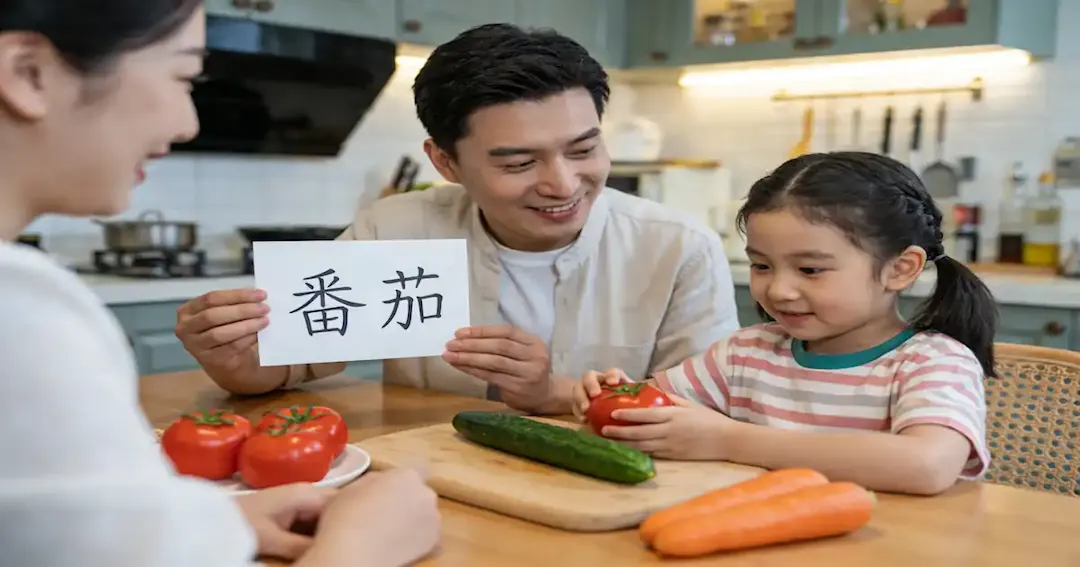
Put 手 on a glove box, 门 on the door, 木 on a plant pot.
Don’t label everything at once. Add a few each week.
Story-before-sleep, not drill-before-sleep
At bedtime, pick one character and ask your child to retell its origin in their own words. One minute is enough.
Origin vs “looks like” game
Show a character and ask, “What did scholars say this came from? And what does your brain think it looks like?”
Both answers are allowed. This gives space for creativity while anchoring them to the real etymology.
Link to culture and history
When you talk about festivals or legends, point out characters that match:
龙 for dragon boat races,
月 for Mid-Autumn,
心 and 爱 when you talk about family relationships.
These little habits make characters part of your child’s story, not just part of a workbook.
9. Where LingoAce fits in your “100 stories” journey
You can absolutely do a lot at home with stories and simple drawings. But at some point, most families want:
A teacher who can spot gaps and explain tricky characters clearly.
A structured path through characters, pinyin, tones, and sentences.
A fun environment where kids see other children learning Chinese with them.
That’s exactly the piece LingoAce tries to solve:
Online Chinese lessons designed specifically for kids aged 3–15, not adults.
Different programs by age and level, from preschool to advanced, with interactive visuals and story-based lessons.
Teachers who can connect characters to culture, myths, and modern life so kids see the “why,” not just the “how.”
You can treat your 100-character origin project like this:
Home is where you and your child collect and enjoy the stories.
LingoAce class time is where a teacher ties those stories into real listening, speaking, reading, and writing.
If you’d like to see how your child responds to a live, interactive Chinese lesson—without committing to a long contract—you can book a free LingoAce trial class.
Bring a few of the characters you’ve already explored together. Let your child show off what they know. Then let the teacher suggest which next characters and topics to tackle so that “Learn Chinese Characters: 100 Origin Stories for Kids” becomes not just a nice title, but something your child actually lives through.