

Simple formulas, leap-year logic, real-life examples, and kid-ready practice you can use tonight.
How many hours in a year? Start with the 10-second answer
If your child just asked “how many hours in a year?” (or you’re staring at a homework sheet that expects one neat number), here’s the clean answer:
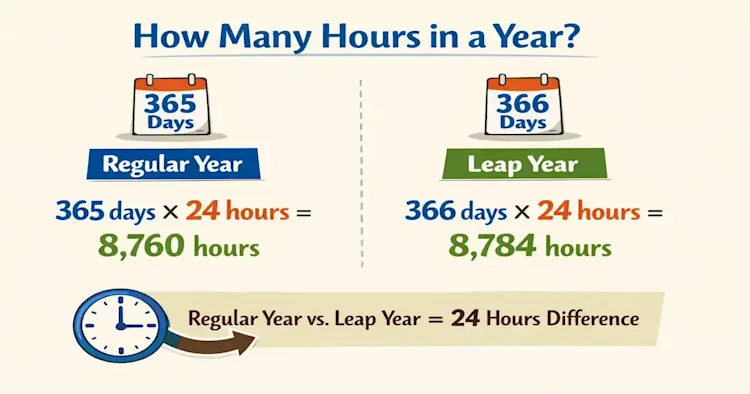
Regular year: 365 days × 24 hours = 8,760 hours
Leap year: 366 days × 24 hours = 8,784 hours
That’s the part most people want. But if you’re helping a 7-year-old who’s still learning what a “year” really means, or a 12-year-old who’s starting to get tripped up by word problems, the real challenge is usually not the multiplication—it’s knowing which year the question is talking about, and whether the worksheet wants an exact number or a reasonable estimate.
Time conversions look harmless, but they pop up everywhere—fractions, decimals, rates, and word problems. Getting comfortable with this one question often makes a whole unit feel less intimidating.
What it actually means and what it does not
Before we calculate again, it helps to pin down what “how many hours in a year” usually means in math class.
What it means most of the time
In school math, the question “how many hours in a year” almost always means:
A calendar year (a year on the calendar), and
Total hours, not “awake hours,” “school hours,” or “work hours.”
So we treat a year as 365 days unless the question says “leap year.”
What it does not mean
Parents and older students often mix this up with:
Work hours in a year (often 2,080 for a full-time schedule)
School hours in a year (varies by district and grade)
Hours in a “typical month” (months don’t all have the same number of days)
If a worksheet is vague, your child can still answer correctly by showing the setup: 365 × 24 (and optionally mentioning the leap-year case). Teachers love seeing the reasoning.
If time conversions are a repeating pain point in word problems, a short burst of structured practice can help your child stop guessing and start setting up problems confidently. If you’d like support, you can try a LingoAce trial class as one optional way to get guided practice and feedback on math reasoning and word-problem setup (especially helpful when kids know the facts but rush the steps).
The step-by-step calculation kids can copy
Here’s a kid-friendly way to show the work. (It’s also what you can remind them to do when they rush.)
Step 1: Decide the kind of year
If it says regular year or doesn’t specify: use 365 days
If it says leap year: use 366 days
Step 2: Multiply by hours per day
There are 24 hours in a day.So:
Regular year: 365 × 24
Leap year: 366 × 24
Step 3: Do the multiplication in a “less scary” way
Some kids freeze when they see 365 × 24. Break it into chunks:
365 × 24 = 365 × (20 + 4) = (365 × 20) + (365 × 4) = 7,300 + 1,460 = 8,760
And for a leap year:
366 × 24 = 366 × (20 + 4) = 7,320 + 1,464 = 8,784
Parent tip: If your child makes repeated multiplication mistakes, this is a perfect moment to practice the distributive property in a way that feels useful, not abstract.
Why leap years add 24 extra hours
Kids usually accept “because the calendar says so” for about five minutes—then they ask, “But why?”
The simplest explanation is:
Earth doesn’t orbit the Sun in exactly 365 days.
It takes about 365.2422 days.
That extra 0.2422 of a day is close to 6 hours.
Over four years, those extra hours add up to about 24 hours.
So we add one extra day (leap day) to keep the calendar lined up with seasons.

The “average year” number you might see
Sometimes you’ll see a number like 8,765.82 hours for “average hours in a year.” Here’s the parent version:
The true length of a year (in a scientific sense) is not an exact whole number of days.
Over long time periods, calendars use leap years to keep things aligned.
When people average out that fractional extra time across years, you can get a non-integer “average.”
When that average matters
Science contexts (astronomy, long-term timekeeping)
Some finance/engineering calculations that use standard year-length conventions
When it does not matter
Most elementary and middle-school math
Everyday planning
Standard conversion problems that clearly expect 8,760 or 8,784
If the homework prompt just says “how many hours in a year,” the safe move is:
answer 8,760, and
add a note: “If it’s a leap year, it would be 8,784.”
Quick comparisons to days, weeks, and months
Once your child understands how many hours in a year, teachers often follow up with other conversions. Here are the ones that show up most:
1 day = 24 hours
1 week = 7 days = 168 hours
1 regular year = 365 days = 8,760 hours
1 leap year = 366 days = 8,784 hours
The month trap
Months vary:
28 or 29 days (February)
30 days (some months)
31 days (some months)
So “hours in a month” depends on which month. For quick estimates, many worksheets use 30 days as a “typical month”:
30 × 24 = 720 hours
Parent tip: Teach your child to look for clue words:
“about,” “estimate,” “roughly” → 30-day month is usually okay
“exactly,” “in February,” “in April” → use that month’s day count
Practice problems (with answers)
Use these as a quick “do we actually get it?” check. Keep it light—one or two per night is enough.
Practice Set A: Direct conversions
How many hours are in 5 days?
How many hours are in 3 weeks?
How many hours are in a regular year?
Practice Set B: Leap-year thinking
How many hours in a leap year?
A student says “leap year adds 1 hour.” What’s the correct difference in hours, and why?
Practice Set C: Estimation
About how many hours are in a “typical” 30-day month?
About how many hours are in half a year (estimate using 365 days)?
Practice Set D: Real-life schedule word problems
If your child sleeps 9 hours each night, about how many hours do they sleep in a regular year?
If a club meets 2 hours every week, about how many hours do they meet in a year?
Your child practices piano 20 minutes per day. About how many hours is that in a regular year? (Estimate.)
Answer key
5 × 24 = 120 hours
3 × 168 = 504 hours
8,760 hours
8,784 hours
Leap year adds 1 day, which adds 24 hours (not 1 hour)
30 × 24 = 720 hours (estimate)
Half of 365 days is 182.5 days; 182.5 × 24 = 4,380 hours (estimate)
9 × 365 = 3,285 hours
2 × 52 = 104 hours
20 minutes/day = 1/3 hour/day; (1/3) × 365 ≈ 121.7 hours (about 122)
A 90-second mini quiz
Try these quickly—no calculator first, then check.
True or false: A leap year has 8,760 hours.
Fill in the blank: A regular year has ____ days, so it has ____ hours.
If something happens 10 hours per week, about how many hours is that in a year?
Which is the better answer for “hours in a month”: exact or estimate? (Explain in one sentence.)
What’s the difference in hours between a regular year and a leap year?
Quick answers:
False (leap year is 8,784)
365 days; 8,760 hours
10 × 52 = 520 hours
It depends on the month; estimate is okay only if the problem allows it
24 hours
Motivation nudge: If any of these felt oddly tricky, you’re not alone. Time units combine reading and math, and kids need practice with both at once.
How to explain it by age
Different ages need different explanations. Here are parent-tested approaches.
Ages 5–7: Make it concrete
Goal: understand what “a day” and “a year” feel like.
Use a calendar: “One square is one day.”
Tie it to routines: bedtime, school, weekends.
Keep “how many hours in a year” as a quick fact: “A regular year is 8,760 hours.”
Try saying: “A year is 365 bedtimes. Each day has 24 hours. That’s why we multiply.”
Ages 8–10: Teach the setup as a habit
Goal: convert units without skipping steps.
Write: days → hours (× 24)
Practice: 365 × (20 + 4) to avoid messy multiplication
Add one leap-year example so they don’t assume 365 always
Ages 11–15: Add nuance
Goal: handle word problems, averages, and estimation.
Discuss when to estimate (months, half-years)
Introduce why leap years exist (the 0.2422 day idea)
Mention “work hours” vs “calendar hours” so they stop mixing contexts
If your teen is confident with math but still loses points, it’s often because they rush the reading. A little guided feedback on setup can make a bigger difference than more worksheets.
FAQs:parents actually ask in 2026
Is it always 8,760?
No. That’s for a regular 365-day year. In a leap year, “how many hours in a year” becomes 8,784.
What about leap seconds—do they change the answer?
In everyday math, no. Leap seconds are occasional one-second adjustments added to keep clocks aligned with Earth’s rotation. They’re real, but they don’t change the classroom answer.
Why do some sources mention 365.2422 days?
That’s a more precise average for Earth’s orbit length, which explains why calendars need leap days. For homework, use 365 (or 366 for leap year).
What’s the fastest way for my child to remember it?
Two anchors:
Regular year: 365 × 24 = 8,760
Leap year: “one extra day” → add 24 hours → 8,784
How do I help without turning it into a fight?
Keep it short. Ask for the setup first (“Which number of days?”), then let them do the multiplication. Praise the process: choosing 365 or 366 correctly is half the battle.
conclusion
If you only remember three things from this guide, make them these:
Regular year: 365 × 24 = 8,760 hours
Leap year: 366 × 24 = 8,784 hours (exactly 24 more hours)
When problems get messy, your child can usually win by writing the setup clearly and deciding whether the question wants an exact answer or an estimate
And if you’d like a more guided path, LingoAce is one option parents use for structured learning and steady confidence-building. On Trustpilot, many parents describe their kids enjoying classes and teachers being patient and engaging Book a LingoAce trial class to see whether guided practice can make time-conversion word problems feel calmer and more predictable for your child.