When it comes to math skills, Singaporean students are second to none. Singapore has consistently topped the scores on the PISA test, including the most recent evaluation conducted in 2022. This international study of the different education systems evaluates the knowledge of 15-year-old students in participating countries. No wonder many parents want to know what makes Singapore Math so effective at teaching mathematics to children.
What is Singapore Math?
Singapore Math is an approach to teaching mathematics that develops a deep understanding of mathematical principles and problem-solving skills rather than rote memorization. Developed in Singapore in the 1980s, this teaching method emphasizes developing problem-solving skills, logical reasoning, and a strong foundation in basic math concepts. It has proven highly effective and has been adopted by many countries worldwide, including the United States, where elements have been incorporated into the Common Core Math curriculum.
For reference, Common Core Math, sometimes called "new math," refers to the mathematics standards outlined in the Common Core State Standards (CCSS) initiative, which was launched in the United States in 2010. The Common Core aims to provide a consistent, clear understanding of what students are expected to learn, ensuring they are prepared for college and careers. It emphasizes critical thinking, problem-solving, and analytical skills required in the modern world. Singapore Math and Common Core Math share similarities in their goals to improve mathematical understanding and problem-solving skills. However, there is some variation in their approaches and implementation.

By comparison, traditional math education, often called "old math," focuses heavily on rote memorization and procedural learning. While this method has been used for decades, it has several drawbacks that can hinder students' mathematical understanding and problem-solving abilities. For instance, focusing on memorizing procedures and formulas requires understanding the underlying concepts to allow students to apply their knowledge to new and unfamiliar problems. Likewise, there needs to be more emphasis on finding the correct answer over the process of finding the solution. As a result, students may need help to solve complex or multi-step problems that require creative thinking and a deep understanding of math concepts.
How is Singapore Math Different?
Singapore Math stands out from traditional math teaching methods in several ways:
Concrete-Pictorial-Abstract Approach (CPA): This teaching method focuses on introducing students to new concepts using physical objects, also known as manipulatives, to model problems. This is the "concrete" approach. Next, students transition to visual representations, such as drawings or diagrams, known as the "pictorial" approach. Finally, students move to the abstract approach using mathematical symbols and numbers to represent problems.
Here's an example of how addition is taught using the CPA method. Let's say we want to prepare students to understand and solve the addition problem 4+3.
In the concrete stage, students use physical objects, such as counters, blocks, or buttons, to count 4 objects and 3 objects into two groups. Afterward, they will be asked to combine the groups and count the total. This teaches them that 3 objects plus 4 objects equals 7 objects.
In the pictorial stage, students move from concrete objects to visual representations. For example, they will be asked to draw a picture, like circles, to represent 3 objects and 4 objects. Through this exercise, students should see that 3 circles plus 4 circles equals 7 circles.
In the abstract stage, students represent the problem and solution using mathematical symbols. Students would be introduced to the addition equation 4 + 3; each number represents the quantities of objects they worked with in the concrete and pictorial stages. From there, students could solve the equation using their understanding of the previous stages.
Bar Modeling Technique: This visual representation method helps students solve word problems for addition and subtraction by breaking them down into simpler, more manageable parts. Like the pictorial approach described above, students draw a horizontal bar and divide it into different parts based on the clues in a word problem. It's a powerful tool for visualizing relationships between numbers and concepts. Bar modeling helps students better comprehend mathematical concepts and enhances their problem-solving skills.
Focus on Problem Solving: Emphasis is placed on solving complex problems and understanding the underlying concepts rather than just performing operations. This approach helps students develop critical thinking and analytical skills.
Depth Over Breadth: Singapore Math prioritizes a deep understanding of a smaller number of topics, ensuring that students have a solid grasp of fundamental concepts before moving on to more advanced topics.
The Singapore Math Curriculums
There are several versions of the Singapore Math curriculum, each tailored to different educational needs and settings:
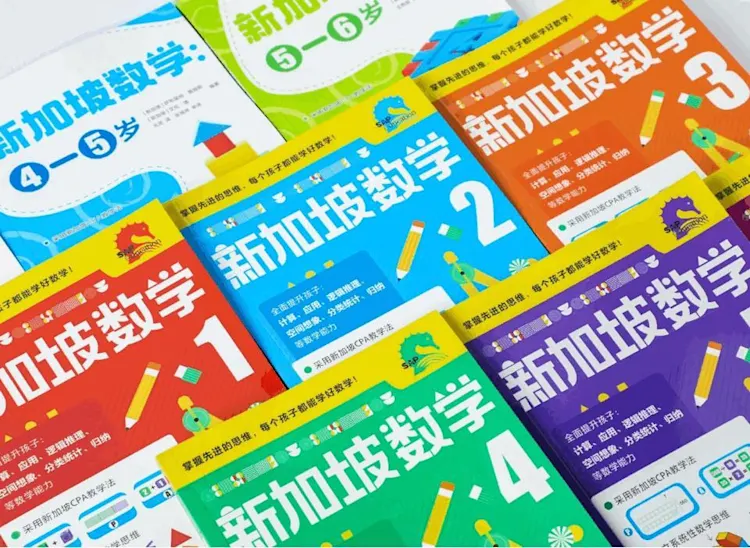
Primary Mathematics: This is the original curriculum used in Singaporean schools. It is divided into several levels, typically covering grades 1 through 6. The curriculum includes textbooks, workbooks, and teacher's guides.
Math in Focus: Developed for the U.S. market, this curriculum aligns with the Common Core State Standards. It retains the core principles of Singapore Math while adapting to the American educational context.
Dimensions Math: This more recent curriculum builds on the strengths of Primary Mathematics, offering a more comprehensive approach with enhanced visuals and explanations. It is suitable for both school and home use.
Discovering Mathematics: A curriculum designed for middle school students, focusing on deepening their understanding of mathematical concepts and preparing them for higher-level math.
Why is Singapore Math So Popular?
Several factors contribute to the popularity of Singapore Math. First, Singapore consistently ranks top in international math assessments, such as the Trends in International Mathematics and Science Study (TIMSS) and the Programme for International Student Assessment (PISA). This success is often attributed to the effectiveness of the Singapore Math curriculum. Second, numerous studies have demonstrated the efficacy of Singapore Math in improving students' math performance.
Schools and educators report significant improvements in students' understanding and application of mathematical concepts. Moreover, Singapore Math can be adapted to diverse educational settings, from traditional classrooms to homeschooling environments. Its flexible approach makes it accessible to a wide range of students. Does Singapore Math Work for Your Kids? Determining whether Singapore Math is the right fit for your children depends on several factors:
Learning Style: Singapore Math is particularly effective for students who benefit from a structured, logical approach to learning. The CPA method caters to visual and hands-on learners, making abstract concepts more accessible.
Foundational Skills: A strong foundation in basic math skills is essential for success with Singapore Math. If your child struggles with basic arithmetic, additional support may be needed initially to build these skills.
Problem-Solving Focus: If your child enjoys solving puzzles and tackling challenging problems, they will likely thrive with Singapore Math. The curriculum encourages a deep understanding of concepts and creative problem-solving.
Parental Involvement: Singapore Math requires active involvement from parents, especially for younger children. Parents should be prepared to spend time reinforcing concepts and assisting with homework.
Teacher Support: The success of Singapore Math also depends on the teacher's familiarity and comfort with the curriculum. Schools should provide adequate training and resources to ensure effective implementation.
Find Singapore Math Courses on LingoAce 在线数学课 Looking for more fun ways to help your kid improve their math skills? LingoAce now offers small group classes for children ages 5-13 to learn math online. Our courses are taught by professional math teachers with experience teaching in American and Canadian classrooms. Give us a try for free.