
April Fool’s Day is one of those dates kids look forward to—classmates whispering plans, social media full of silly “gotcha” moments, even brands joining in with fake announcements. It’s light, it’s playful, and honestly, it can be a great memory.
But as parents, we naturally worry a little more than kids do—and that’s not being overly serious. April Fool’s Day isn’t the problem. The problem is when a joke slides past a reasonable line: someone feels embarrassed, something gets broken, or a harmless prank turns into a long apology.
So the goal isn’t to ban pranks. It’s to keep April Fool’s Day within a healthy limit—funny, reversible, and respectful. And if your family moves between cultures (or you simply want your child to understand different norms), that “reasonable limit” can look slightly different in China vs. the West.
This 2026 guide breaks down what’s similar, what’s different, and why it matters for families—plus practical Chinese phrases (with pinyin) kids can use to clarify intent, set boundaries, and repair quickly when a joke doesn’t land.
The quick comparison: China vs. the West at a glance
(Save this table. It’s the “why” behind a lot of misunderstandings.)
Dimension | China (typical day-to-day reality) | West (North America/UK/AU common patterns) | What families should do |
Popularity (how widespread) | Not uniformly “big”; more informal, more peer-to-peer | More visible, more expected in schools/media/brands | Treat it as culture + context, not a universal rule |
Typical pranks | Smaller, friend-to-friend jokes; less “public spectacle” | Wider range: classroom jokes, social media stunts, brand campaigns | Keep pranks low-stakes and reversible |
Where it happens | Mostly among friends, online humor, casual settings | Schools, workplaces, social media, marketing, family homes | Decide where your child can prank (and where not) |
Red lines (what backfires) | Rumor-like “fake news,” public embarrassment, loss of face | Harm, property damage, humiliation, safety issues | Make “no harm/no shame/no lies that spread” the family rule |
Kid-friendly level | Depends on family/school; not always emphasized as a kids’ event | More kids’ content and kid-safe lists exist | Use age filters; aim for “everyone laughs” |
What to say (scripts) | “Just kidding” needs tact; explain intent clearly | “April Fools!” is widely recognized | Teach kids the language of repair: apologize, clarify, reset |
Three-sentence takeaway: Kids can play in both contexts, but the meaning of “a joke” can shift fast depending on where you are and who’s watching. The biggest risk isn’t the prank itself—it’s public embarrassment and misinformation-style jokes. A simple family script (“I meant it as a joke—are you okay?”) prevents most drama.
Do people “celebrate” April Fool’s Day in China?
If you’re looking for a single yes/no, it won’t help much. A better question is: How does joking show up in everyday life, and what kind of joking feels acceptable?
In many Chinese contexts, humor exists everywhere—teasing, wordplay, playful nicknames, funny internet trends. But a designated “prank day” isn’t always treated as a big, official thing the way it can feel in some Western schools or social media spaces.
What you may notice instead:
More emphasis on not making someone lose face (being publicly embarrassed can sting more than the prank itself).
More caution around spreading false info, especially in public channels. “It’s just a joke” lands differently if it looks like a rumor.
A preference for humor that stays inside the group: friends who understand each other’s boundaries.
Motivation moment #1 (for parents): If your child is growing up between cultures, this is one of those “small” topics that teaches a big skill: how to read the room, explain intent, and repair quickly. That’s confidence, not just vocabulary.
Why April Fool’s Day often feels more “official” in the West
In North America and some other Western contexts, April Fool’s Day tends to have more built-in visibility:
Schools sometimes acknowledge it (even if they discourage pranks).
Brands and media run joke announcements.
Kids swap prank ideas online.
That visibility can make kids feel like participation is “required.” The problem is they often copy what they see (internet pranks skew extreme) without understanding the social cost.
Here’s the quick rule that works across cultures:
If it’s funny only for the prankster, it’s not kid-safe. If someone might cry, feel stupid, or be singled out, it’s a no.
Motivation moment #2: Many parents aren’t worried about fun—they’re worried about their child becoming “that kid” at school. Setting a clear prank policy at home is usually enough to prevent the call from the teacher.
Three scenes where misunderstandings happen (and how to coach kids)
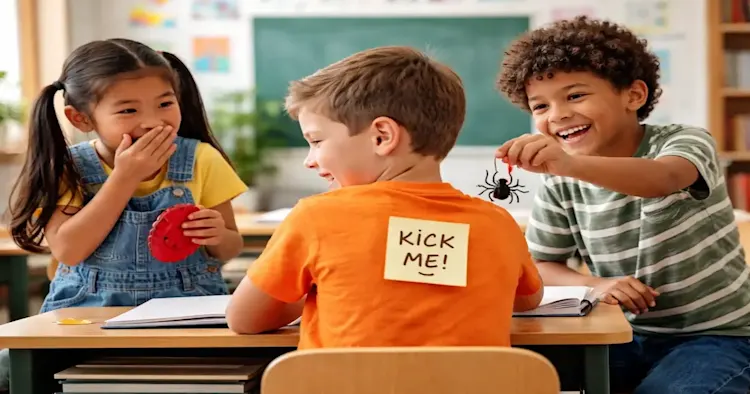
Scene 1: The classroom prank
What kids want: attention + laughter. What schools want: safety + respect + minimal disruption.
Common fail: “I swapped your stuff” / “I tricked you into saying something” / “I made you look wrong in front of people.” That crosses into humiliation, even if the kid didn’t intend it.
Parent coaching line (English): “Pranks at school must be teacher-approved, reversible, and not about making someone look bad.”
Parent coaching line (Chinese + pinyin):
在学校不要整蛊别人。 Zài xuéxiào bú yào zhěng gǔ bié rén. (Don’t prank people at school.)
要先问老师。 Yào xiān wèn lǎoshī. (Ask the teacher first.)
Scene 2: The family prank
Family jokes can be the safest—if they’re about surprise, not fear.
Better than: “I told you we’re moving tomorrow.” Try instead: harmless visual jokes (googly eyes on fruit, upside-down snack labels) that you can undo in 10 seconds.
Repair script kids can practice (Chinese + pinyin):
我开玩笑的,你还好吗? Wǒ kāi wán xiào de, nǐ hái hǎo ma? (I’m joking—are you okay?)
对不起,我不想让你难过。 Duì bu qǐ, wǒ bù xiǎng ràng nǐ nán guò. (Sorry—I didn’t want to upset you.)
Scene 3: The social media “joke”
This is where culture, trust, and risk collide.
A fake “announcement” can travel fast. Even if it starts as a joke, it can be reshared without context. In many places—including China—this can feel less like a prank and more like rumor-spreading.
Family rule: No “fake news” jokes. Period.
Simple line kids can use:
这个不是真的,是愚人节玩笑。 Zhè ge bú shì zhēn de, shì yú rén jié wán xiào. (This isn’t real; it’s an April Fool’s joke.)
不要转发。 Bú yào zhuǎn fā. (Don’t repost.)
Motivation moment #3: This is secretly a critical thinking lesson. Helping kids decide what should stay private vs. public is a life skill—and it makes “bilingual identity” feel practical instead of academic.
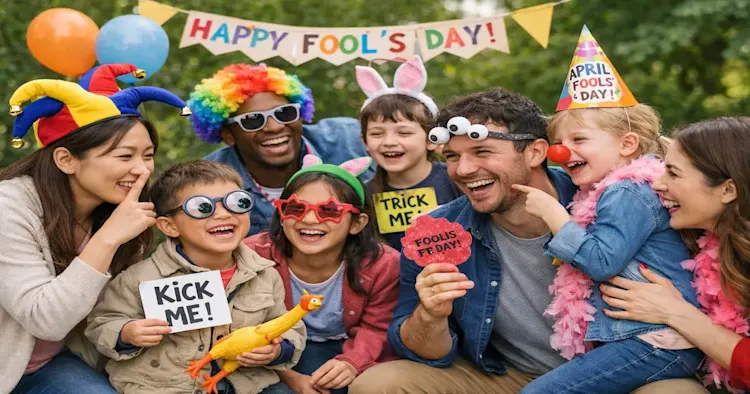
Make it fun (and cross-subject): turn April Fool’s Day into a mini Chinese + thinking lesson
You said “all-subject but Chinese-forward.” Here’s a light, playful way to do it without turning your living room into a classroom.
1) Chinese vocabulary you can actually use (with pinyin)
Keep it small and real—kids remember what they can say today.
愚人节 yú rén jié — April Fool’s Day
开玩笑 kāi wán xiào — to joke
整蛊 zhěng gǔ — to prank
上当了 shàng dàng le — got tricked
被骗了 bèi piàn le — got fooled (stronger, use carefully)
别生气 bié shēng qì — don’t be mad
我不是故意的 wǒ bú shì gù yì de — I didn’t mean to
你觉得好笑吗? nǐ jué de hǎo xiào ma? — do you think it’s funny?
2) ELA (reading) in 5 minutes: “Spot the clue”
Write 6 sentences. One is obviously silly. Kids underline the clue that proves it’s fake.
Example (you can adjust):“Today our school announced all homework is replaced by ice cream.”
Then ask, in Chinese or English:
“What’s the clue?”
哪里不对? Nǎ lǐ bú duì? (What’s off?)
3) Math in disguise: “Prank budget challenge”
Give your child a $5 “prank budget.” They choose one harmless prank material (tape, googly eyes, sticky notes). Add prices. Do quick addition and comparison.
Chinese mini-lines:
这个多少钱? Zhè ge duō shǎo qián? (How much is this?)
太贵了。 Tài guì le. (Too expensive.)
我们选便宜一点的。 Wǒ men xuǎn pián yi yì diǎn de. (Let’s pick a cheaper one.)
4) Social studies / character: “Funny vs. hurtful”
Ask the simplest question that changes everything:
“Who is laughing at the end?”
Chinese versions:
最后谁在笑? Zuì hòu shéi zài xiào? (Who’s laughing at the end?)
如果他不笑,就不要做。 Rú guǒ tā bú xiào, jiù bú yào zuò. (If they’re not laughing, don’t do it.)
Motivation moment #4: Kids who can explain boundaries in two languages aren’t just “smart.” They’re safer socially. They can exit awkward moments without panicking.
A “China-friendly” prank rulebook parents can reuse anywhere
If you want one rule set that works across cultures, here it is:
No fear (no scary surprises).
No shame (no public embarrassment).
No damage (nothing that breaks, stains, wastes food).
No rumors (no fake announcements that can spread).
Fast reset (can be undone in under 30 seconds).
Repair ready (child can say sorry + clarify intent).
Teach one “repair line” and you’ve prevented half the problems:
我开玩笑的,对不起。 Wǒ kāi wán xiào de, duì bu qǐ. (I was joking—sorry.)
If your child wants to joke in Chinese—or explain cultural differences without freezing up—what helps most is guided speaking practice: role-playing the situation, getting feedback, and learning the “repair lines” that make communication smooth. If you want a structured path, a LingoAce Chinese trial lesson can be a practical option: teachers can run a short scenario (school prank, family joke, online “fake news”) and help your child practice what to say—clearly and politely—so the language actually sticks.

FAQ (quick answers families search for)
Is April Fool’s Day “banned” in China?
It’s more accurate to say it isn’t treated as an official celebration everywhere, and people may be cautious about certain kinds of pranks—especially public rumor-like jokes. Family and friend humor still exists; it just often shows up differently.
What is April Fool’s Day called in Chinese?
愚人节 (yú rén jié). A common line is 愚人节快乐 (yú rén jié kuài lè), but with kids, the most useful lines are the “joke + repair” ones.
How do I keep April Fool’s Day kid-friendly?
Use the “No fear / No shame / No damage / No rumors / Fast reset” rule. Then stick to it like a seatbelt rule.
What should my child say if someone is upset?
Start with intent + care:
我开玩笑的,你还好吗? Wǒ kāi wán xiào de, nǐ hái hǎo ma?
对不起,我不是故意的。 Duì bu qǐ, wǒ bú shì gù yì de.
How can this help Chinese learning (not just culture)?
Because it teaches real-life speaking: clarifying intent, setting boundaries, apologizing, and explaining differences—these are the moments kids actually remember.
Closing: The real lesson isn’t “pranks”—it’s social fluency
April Fool’s Day is a perfect test-run for a bigger skill: reading context. China vs. the West isn’t about “who’s right.” It’s about different expectations—privacy, face, rumor sensitivity, and what counts as playful.
If your child learns to be funny and kind, and can explain what they mean in Chinese (even in short lines), they’ll do better socially—at school, at family gatherings, anywhere.
If you’d like your child to practice these bilingual “real-life scripts” with feedback—so they can joke, clarify, and recover politely—consider trying a LingoAce Chinese trial lesson. It’s an easy way to turn a cultural moment into confident speaking, without making it feel like homework.