When the school email about the CogAT test in 2nd grade lands in your inbox, it can feel a bit like being handed a race date without any training plan. You’re happy your child was selected. You’re also thinking, “Okay… now what?”
On paper, the CogAT (Cognitive Abilities Test) is an ability test schools use to understand how students think and to help with gifted and talented placement. In real life, for a 7- or 8-year-old and their parents, it can easily turn into a source of pressure if you let it.
And if you’d like someone to help with the “training plan” – especially on the language and reasoning side – an online program like LingoAce can quietly sit in the background, building the skills CogAT measures while your home stays a normal home, not a test center.
Let’s go step by step.
1. What Is the CogAT Test for 2nd Grade, Really?
The CogAT is a group test that measures a child’s reasoning ability in three areas, not how many facts they can memorize:
Verbal reasoning
Quantitative (number) reasoning
Nonverbal (visual-spatial) reasoning
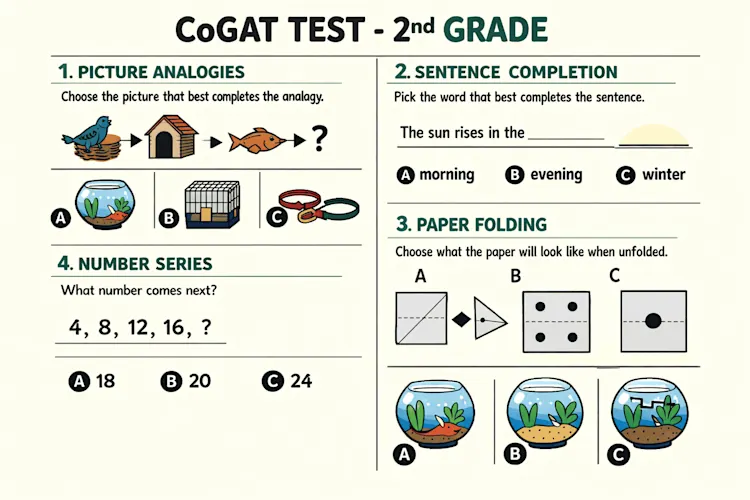
Students in 2nd grade usually take CogAT Level 8, which is designed for children around eight years old. According to practice providers and school guides, the Level 8 test is divided into three batteries, each with several short subtests.
Here’s the structure in simple form:
Battery | Typical 2nd Grade Subtests (Level 8) | What It Measures |
Verbal | Picture analogies, sentence completion, picture classification | Understanding relationships between words/ideas |
Quantitative | Number analogies, number puzzles, number series | Number sense, patterns, logic with quantities |
Nonverbal | Figure matrices, paper folding, figure classification | Visual/spatial reasoning and pattern recognition |
The whole CogAT 2nd grade test has roughly 120–150 questions (often cited around 154 for Level 8) and takes about 90 minutes to 2–3 hours total, depending on the school and pacing.
Schools often combine CogAT scores with grades, teacher recommendations, and sometimes other tests to decide on gifted program placement or to better understand how each child learns.
So your job at home is not to “hack” the test. It’s to:
Make the format familiar
Strengthen the thinking skills behind the questions
Keep stress low enough that your child’s real ability shows up on test day
2. Step One: Explain the Test in Kid Language
Before you touch a single practice question, give your child a simple, honest explanation.Something like:
“This is a thinking test. You’ll see three kinds of puzzles: word puzzles, number puzzles, and picture puzzles.
The teacher will tell you when each part starts and ends.
You don’t need to get everything right – you just use your best thinking.”
Kids worry a lot less when they know what is coming, even if they don’t know every detail.You can also:
Show them a quick picture of a CogAT-style question from a school handout or online sample.
Emphasize that CogAT is not about being “good” or “bad,” it’s about how their brain likes to solve problems.
Ten minutes of calm explanation now prevents hours of anxiety later.
3. Step Two: Show, Don’t Just Tell – Use a Few Sample Questions
Next, let your 2nd grader see what CogAT questions look like. You don’t need to buy a big workbook immediately. Start with a very small handful of free CogAT 2nd grade sample questions from trusted sites like:
eTutorWorld – CogAT Grade 2 practice tests and free sample questions
GiftedReady – CogAT 2nd Grade Free Practice Test (Level 8)
TestPrep-Online – Free CogAT 2nd grade sample questions
School or district pages that share Grade 2 CogAT examples
Sit together and go through:
2–3 verbal questions
2–3 quantitative questions
2–3 nonverbal questions
Focus on the style, not the score. Ask things like:
“What do you notice about this question?”
“What do you think they’re really asking here?”
Once your child has seen each type at least once, you’ve already removed most of the “mystery factor” that makes test days scary.
4. Step Three: Build a Low-Stress Weekly CogAT Prep Plan
Now you know what you’re dealing with. Time to gently train the “thinking muscles.”
You don’t need a 7-day boot camp. A realistic home plan for most families:
3 days per week
15–25 minutes per session
A mix of CogAT-style questions and playful reasoning games
Here’s a sample weekly rhythm you can adapt:
Day | Focus | What You Might Do (15–25 min) |
Mon | Verbal reasoning | 5–8 CogAT-style verbal items + a quick “odd-one-out” word or picture game |
Wed | Quantitative | 5–8 number analogies/series + mental math or number pattern game |
Fri | Nonverbal reasoning | 5–8 figure/pattern questions + tangram/LEGO/puzzle activity |
A few rules of thumb:
Quit while it still feels okay. Don’t wait for the meltdown point.
Talk through strategies. “Show me how you figured that out” is more valuable than “Right or wrong?”
Keep it predictable. Kids relax when they know Tuesdays and Thursdays are “no CogAT days.”
If this still feels like a lot to juggle on your own, this is exactly where a structured class helps. In a program like LingoAce, teachers can deliberately build verbal, math, and reasoning skills inside live lessons, and you just maintain short practice blocks at home instead of carrying everything yourself.

5. Step Four: Train Each CogAT Battery with Everyday Activities
5.1 Verbal Battery: Word and Idea Connections
Verbal questions check how your child sees relationships between ideas, not spelling lists.
Fun ways to build verbal reasoning:
Odd-one-out games
Say “cat, dog, banana” and ask which doesn’t belong – and why.
Let your child make sets for you and explain their answers.
Classification games
Put several items on the table (or pictures on paper): shoes, hat, apple, book.
Ask: “How could we group these?” (things you wear / things you read / things you eat).
Sentence finishers
“When it started to rain, we grabbed our ____.”
Give three options and ask which one makes the best sense – and why.
These are exactly the kinds of skills CogAT verbal subtests rely on, and they also help with reading comprehension in school.
5.2 Quantitative Battery: Number Sense and Patterns
Quantitative questions are about relationships between numbers more than big calculations.
Easy ways to practice:
Number patterns at the table
Count forks in twos, count steps in threes, make short sequences like 2, 4, 6, __ and ask what comes next.
Number analogies in story form
“2 cookies become 4 cookies when I double them. If you double 3 cookies, how many?”
Later you can show this in analogy form: 2 → 4 as 3 → ?.
Board games with dice
Simple games (Snakes and Ladders, for example) help with counting, adding small numbers, and understanding more/less without feeling like a lesson.
A solid math foundation here doesn’t just help with CogAT – it’s good for every test your child will see later.
5.3 Nonverbal Battery: Visual and Spatial Puzzles
Nonverbal questions test how your child understands shapes, patterns, and visual changes.
Play-based practice ideas:
Tangrams or pattern blocks
Copy a simple design from a picture.
Then swap roles: your child creates a pattern, you try to copy it.
Spot-the-difference pictures
These build attention to detail and noticing small changes.
LEGO or block models
Show a built model and ask your child to rebuild it from a different angle.
For many children, this is the most enjoyable part of CogAT prep. It feels like problem-solving play time, not “test prep.”
6. Step Five: Use CogAT 2nd Grade Practice Tests Wisely
Practice tests are helpful, but only if you use them thoughtfully.
Good uses:
To introduce question types in a realistic layout
To practice sitting and focusing for a set amount of time
To help your child learn to move on from a tricky question
Not-so-great uses:
Doing full tests every day
Using scores to compare siblings or classmates
Turning every mistake into a lecture
You can try this sequence:
Start with small sets – 5–10 questions at a time from free sample pages.
After a few weeks, try a timed mini-section (for example, 10–12 minutes of one subtest).
In the last 1–2 weeks, do one fuller practice session that covers a big chunk of all three batteries.
When you review, ask:
“Where did you feel stuck?”
“What could you try first if you see a similar question again?”
This helps your child build strategies, not just memorize answers.
Reliable sources for practice tests and questions include eTutorWorld, GiftedReady, TestPrep-Online, and others that clearly label Grade 2 / Level 8 and show verbal, quantitative, and nonverbal questions.
7. Step Six: Understanding CogAT 2nd Grade Scores (Without Obsessing)
When results come back, you’ll likely see:
A Standard Age Score (SAS) – scaled around 100 as “average”
Percentile ranks – how your child compares to a national group
Stanines – a 1–9 banded score
Possibly an Ability Profile describing strengths across the three batteries
Some gifted programs look for higher percentiles (for example, 95th percentile or above) or SAS scores in the 120s or 130s, but the exact cutoff varies by district and year.
Instead of locking onto one number, ask bigger questions:
Is my child ahead in verbal, but average in quantitative?
Do they seem to fly through nonverbal puzzles but slow down on sentence questions?
Does this match what we see at home and in school?
Scores are data points, not a final label. They can help you and teachers decide:
Where to challenge your child
Where to give extra support
Whether advanced programs might be a good fit
8. Test Week and Test Day: Small Things That Make a Big Difference
You’ve done the practice. Now it’s time to protect your child’s energy and calm.
The week before the CogAT test
Keep bedtime steady. This is not the week for extra-late nights.
Light review only. A couple of small practice sets, then stop.
Dial down the talk about the test. One clear reminder is enough: “You’ve practiced; just do your best thinking.”
The night before
Lay out clothes, glasses, and anything else they need.
Avoid brand-new worksheets or tests. Let their brain wind down.
Do something easy and familiar: a board game, story time, or a walk.
Test morning
Aim for a steady breakfast with some protein (eggs, yogurt, peanut butter toast) and not just sugary cereal.
Remind them of three simple rules:
Listen carefully to directions.
If you’re stuck, take your best guess and move on.
Take a slow breath if your brain feels “stuck.”
After the test
Instead of “How do you think you did?”, try:
“Was there any part you felt proud of?”
“Was there a part that felt tricky?”
Then go back to normal life. The test is over; your child is still your child.

9. FAQ: Common Questions About the CogAT Test 2nd Grade
Here are some of the questions parents type into search bars at 11 p.m., answered in one place.
1. How long is the CogAT test for 2nd graders?
The CogAT test for 2nd graders (usually CogAT Level 8) is split into three batteries: Verbal, Quantitative, and Nonverbal. Each battery has several short subtests and typically takes around 30–45 minutes, with quick breaks in between. Altogether, schools often schedule about 90 minutes to 2–3 hours to finish the entire CogAT 2nd grade test, depending on their pacing.
2. How many questions are on the CogAT test 2nd grade?
The CogAT 2nd grade test usually includes around 120–150 questions, depending on the exact form. Many guides cite about 154 questions for Level 8, divided across the three batteries and nine subtests.
3. Is the CogAT test for 2nd grade hard?
Whether the CogAT test for 2nd grade feels “hard” depends a lot on the child’s experience with puzzles, patterns, and word or number games. Many children find some questions easy and some quite challenging. That’s normal. Light practice with CogAT 2nd grade sample questions and everyday thinking games can make the test feel more familiar and much less intimidating.
4. What is a good CogAT score for 2nd grade?
Schools use CogAT scores in different ways, but many gifted programs pay special attention to higher percentiles and higher Standard Age Scores (SAS). A “good CogAT score for 2nd grade” is one that accurately reflects your child’s ability without test-day panic. Rather than chasing a specific number, use the score report to see your child’s strengths in verbal, quantitative, and nonverbal reasoning and to guide long-term support.
5. How do schools use CogAT test 2nd grade scores for gifted programs?
Many districts use CogAT test 2nd grade scores as part of their gifted and talented screening process. They may combine CogAT results with classroom grades, teacher recommendations, and achievement tests to decide who qualifies for advanced programs. If you’re unsure how your school uses CogAT Level 8 scores, ask the counselor or gifted coordinator for their current criteria.
6. How can I prepare my child for the CogAT 2nd grade test at home?
You can prepare for the CogAT 2nd grade test at home by mixing short practice sessions with fun, low-pressure games. Aim for 10–20 minutes, 2–3 times a week. Combine CogAT 2nd grade practice test questions with everyday activities such as classification games, number patterns, and picture puzzles. The goal is to build flexible reasoning skills, not just memorize one kind of question.
7. Where can I find free CogAT 2nd grade practice test questions online?
Several education sites publish free CogAT 2nd grade practice test questions and sample problems. Look for pages that specifically mention “CogAT Grade 2” or “CogAT Level 8” and include verbal, quantitative, and nonverbal examples. Start with a few questions at a time rather than full tests so your child can get used to the style gradually.
8. What’s the best CogAT test prep for 2nd graders who are easily stressed?
For 2nd graders who get anxious easily, the best CogAT test prep is gentle and predictable. Use short, consistent practice blocks, give lots of encouragement, and focus on effort rather than scores. Many families also like using an online class such as LingoAce, where a teacher can guide reasoning and language skills in a calm, engaging way so parents don’t have to carry all the coaching alone.
10. Where LingoAce Fits In – And How to Take the Next Step
At the end of the day, the CogAT test 2nd grade is just one snapshot of how your child thinks. The real work – and the real growth – happens slowly, through:
Daily reading and listening
Conversations that stretch their vocabulary and ideas
Little math puzzles at the kitchen table
Visual games with blocks, shapes, and pictures
That’s exactly the world LingoAce lives in.In a LingoAce class, your child doesn’t just check answers. They:
Practice verbal reasoning by hearing, speaking, and reading in rich language environments (English and/or Chinese).
Strengthen quantitative thinking as teachers weave logic and number sense into age-appropriate lessons.
Build nonverbal skills by following visual cues, patterns, and tasks on screen.
So when CogAT day comes around, your child isn’t just “prepped for a test” – they’ve been training their thinking muscles all along.
If you’d like structured support that fits into family life and quietly builds the skills CogAT measures, you can try it out first:
Book a free trial class with LingoAce and see how guided, engaging lessons can help your 2nd grader prepare for the CogAT test without the stress.