
If you’re reading this, there’s a good chance you’ve heard the phrase NWEA MAP practice test tossed around at school meetings, in parent chats, or on a letter that showed up in your child’s backpack. And if you’re honest, your first reaction might not have been calm curiosity. It was probably closer to:“Another test? What does this even measure? And what happens if my child doesn’t do well?”
Many parents quietly panic when they see a score report full of numbers, percentiles, and acronyms. It’s easy to imagine this one test deciding everything about your child’s future. Kids feel that tension too. You say “It’s just practice,” but your voice is a little tight, and they notice.
Here’s the thing: the MAP Growth test is more like a growth thermometer than a final exam. It’s there to show where your child is now, and what kind of help they might need next. But without the right NWEA MAP practice test resources, the whole thing can feel like a black box.
That’s why this guide exists. In this article, we’ll break down:
What the test really does (in plain language).
Which NWEA MAP practice test resources are actually worth your time.
How to build a simple two-week plan that lowers anxiety instead of raising it.
Along the way, we’ll also talk about how ongoing learning tools—like structured online classes from platforms such as LingoAce—can quietly build the reading and math skills that MAP is trying to measure in the first place.You don’t have to turn your home into a test-prep factory. You just need a small, steady routine that fits into real family life.
1.Why the NWEA MAP Feels So Stressful (and What’s Really Going On)
Before we talk about any NWEA MAP practice test tools, it helps to name the stress out loud.For many families, the tension comes from three places:
Unclear purpose You’re not totally sure what the test measures, how often it’s given, or how much it “counts.” For example, tend to focus heavily on definitions and academic explanations of NWEA MAP as a computer-adaptive test that tracks student growth over time. Useful, yes—but still a bit abstract when your child is nervous the night before.
Confusing score reports RIT scores, percentiles, growth norms…it can feel like reading a lab report.Some guides explain that MAP scores are used to understand growth and plan instruction, not to label kids for life.But that nuance doesn’t magically make a worried parent feel calm.
Fear of labels Many parents quietly worry: “If this score is low, will the teacher think my child is behind forever?” Kids pick up that fear, even if no one says it out loud.
Here’s the reality: schools often give MAP up to three times a year (fall, winter, spring) to see how students are growing, not to punish them. And yes, a bit of preparation can help. Not because your child needs to “game the system,” but because familiarity lowers anxiety.A thoughtful NWEA MAP practice test routine is really about helping your child say, “I know what this looks like. I know how to click through. I’ve seen questions like this before. I can do this.”

2.What the NWEA MAP Test Is (Without the Jargon)
Most deep-dive articles to the NWEA MAP practice test—start with long explanations of computer-adaptive algorithms and normed data.That’s helpful for teachers. For parents, we can keep it simpler.In plain English:
Who takes it? Students from kindergarten through middle school (and sometimes beyond), usually in reading, math, and sometimes language usage or science.
How does it work? It’s computer-adaptive. When your child answers correctly, the next question gets harder. If they miss, the next one gets a bit easier. The test is trying to “zero in” on the level where your child is challenged but not overwhelmed.
What does it measure? Not just grade-level standards, but broader skill development over time. A MAP score can show growth from year to year—even if your child isn’t on a typical grade-level pathway yet.
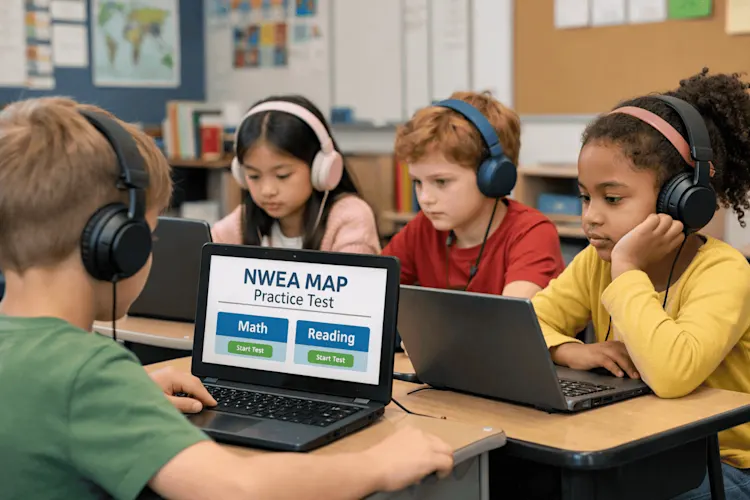
What about the NWEA MAP practice test part? Practice is less about memorizing content and more about getting comfortable with:
The on-screen tools (highlighter, calculator, etc.).
The pacing and types of questions.
The idea that questions will sometimes feel too hard—and that’s okay.
A good NWEA MAP practice test routine should support those goals without turning your child’s entire week into test prep.
3. 8 Trusted NWEA MAP Practice Test Resources for 2026
Now let’s get practical. Below is a curated list of NWEA MAP practice test resources that show up again and again in high-quality guides—plus how to actually use them at home without burning everyone out.
1. Official NWEA Student Resources & Practice Tests
If you use only one thing, let it be this.NWEA hosts an official Student Resources page and MAP Growth warm-up tests where students can log in and try out the tools and sample questions before the real thing.
What it offers:
Short practice tests (“warm-ups”) that mirror the real interface.
Built-in tools like the highlighter, eraser, calculator, and text-to-speech, so kids can explore them in advance.
Videos that explain what the test is like.
How to use it at home:
Schedule 10–15 minutes, twice a week, where your child simply explores the practice area.
Make it low-pressure: “We’re just clicking around to see how it works.”
Sit beside them the first time to show you’re curious too, not just checking up on them.
This is the most direct form of NWEA MAP practice test exposure—and it’s free.
2. NWEA Family Toolkit (For Parents Who Want the Big Picture)
The NWEA Family Toolkit is designed specifically for families, with explainers on what MAP Growth is, what scores mean, and how you can support learning at home.
Why it matters:
It turns mystery into understanding. Instead of guessing what the test does, you can see how teachers use scores to guide instruction.
It can calm some of that background anxiety: you realise this is a tool, not a verdict.
How to use it:
Read one short article from the toolkit on your own.
Then, pick one idea—like asking the teacher what skill areas the next MAP will focus on—and follow up.
Use what you learn to shape the rest of your NWEA MAP practice test plan (e.g., focusing more on reading comprehension or math problem-solving).
3. TestPrep-Online: Sample Questions and Full Practice Packs
Sites like TestPrep-Online offer free MAP-style sample questions plus paid practice packs by grade level, along with detailed explanations and strategy tips.
What you get:
Free sample questions to get a feel for difficulty and format.
Optional paid packs with full practice tests and skills-based drills.
Explanations that show not just the correct answer, but why.
How a parent might use it:
Start with free sample questions to see how your child reacts.
If your child is very anxious, limit it to 5–8 questions at a time. Talk about strategies (reading carefully, eliminating answers) rather than just scores.
If you go for a paid pack, treat it like a tool to target specific gaps you’ve already noticed.
This can be one layer of your NWEA MAP practice test routine—great for slightly older children who are ready for more structured practice.
4. TestingMom: Practice by Grade and Score-Level Context
TestingMom offers MAP practice questions organized by grade and provides information about typical scores and growth.
Why it’s useful:
It gives you a sense of what’s “normal” across grades, which can take some emotional heat out of the conversation.
Sample questions let your child see “Oh, so this is what a grade 3 MAP question might feel like.”
How to use it:
Pick a small set of questions in your child’s grade band.
Work through them together at first. Let your child talk through their thinking; don’t jump in with corrections.
Use what you see to decide whether your NWEA MAP practice test focus should be more on reading or math in the next week.
5. Khan Academy’s MAP-Linked Practice (Math)
Khan Academy offers a MAP-linked “Mappers” tool that suggests math exercises based on a student’s MAP scores.Even if you don’t have the exact score mapping handy, Khan’s MAP-aligned content is still valuable:
Short, focused math practice that feels more like learning than like taking another NWEA MAP practice test.
Video explanations for when your child says, “I just don’t get this.”
How to use it:
Aim for 15–20 minutes of math practice, 3–4 times a week.
Choose topics you know your child struggles with: fractions, word problems, multi-step equations, etc.
Remind your child: “These skills show up on MAP, but they matter way beyond any test.”
6. YouTube Warm-Ups and Explainers
There are surprisingly good MAP-related videos on YouTube—especially for kids who learn better with someone talking to them on-screen.
Examples include:
NWEA’s own warm-up videos that explain the test in kid-friendly language.
Channels like TestPrep-Online’s YouTube, which share MAP practice tips and sample questions.
How to use YouTube without falling into a rabbit hole:
Choose a single 5–10 minute video as a “warm-up” before trying a short set of NWEA MAP practice test questions.
Watch with your child the first time. Pause and ask, “What part of that sounded helpful to you?”
Add good videos to a playlist so you don’t have to search every time.
7. School-Provided Practice and Teacher-Recommended Tools
Sometimes the best NWEA MAP practice test resources are the ones your child’s teacher already uses:
Some schools have internal practice systems or license third-party platforms for MAP-style questions.
Teachers may already be assigning warm-up activities in class or recommending specific websites.
Why this matters:
It aligns home practice with what’s happening in class.
It respects the fact that MAP is part of a larger plan to support student growth, not a stand-alone hurdle.
Don’t be afraid to send a quick email like:“We’re trying to support [Child’s Name] at home before the next MAP test. Are there any short practice tools or question types you recommend we focus on?”That one question can shape a much more efficient practice routine.
8. LingoAce: Building the Underlying Skills MAP Is Trying to Measure
Finally, let’s zoom out for a moment.Even the best NWEA MAP practice test cannot replace daily reading, reasoning, and math exposure. In the long run, your child’s confidence on MAP comes from feeling solid in core skills—especially in reading comprehension and problem-solving.
That’s where structured, interactive programs like LingoAce can play a quiet but important role:
Live, teacher-led classes that focus on language skills, reading, and logical thinking.
Lessons designed for kids in international or bilingual settings, where school tests might be in English but home languages vary.
A safe space to practice asking questions, making mistakes, and trying again.
Think of LingoAce as the “engine” that builds skills week after week, while the NWEA MAP practice test resources are the “dashboard” that shows how those skills are translating into scores.
4.A Simple 2-Week Confidence-Building Plan (That Still Respects Real Life)
You don’t need a 6-month boot camp. For many families, a focused two-week routine before the test is enough to lower anxiety and build familiarity with the NWEA MAP practice test format.
This isn’t a rigid schedule. Think of it more like a menu you can adapt.
Week 1: Get Comfortable with the Test and Tools
Goal: Turn “I have no idea what this is” into “I’ve seen this before.”
Day 1–2: Gentle introduction
Visit the official student practice site and warm-up tests together.
Let your child click around, try tools, and even intentionally get a few questions wrong just to see what happens.
Keep the tone light: “We’re just getting to know how this thing works.”
Day 3–4: Light question exposure
Use free sample questions from TestPrep-Online or TestingMom.
Do 5–8 questions in reading or math, not both.
Talk through thinking out loud: “Why do you think this answer makes sense?”
Day 5–7: Notice patterns, not just scores
Ask your child which types of questions feel hardest: long reading passages, multi-step math, unfamiliar vocabulary.
Choose one of those areas to target next week with a mix of NWEA MAP practice test items and skill-building tools like Khan Academy or LingoAce-style lessons.
The point of Week 1 is not improvement—it’s familiarity.
Week 2: Target Weak Spots and Keep Nerves Low
Goal: Give your child a few “small wins” before the real test, so they go in thinking, “I can handle this.”
Day 8–9: Focused skill practice
If reading was tough, spend 15–20 minutes on short reading passages with questions.
If math word problems were the issue, work on a small set of problems using Khan Academy’s MAP-related practice.
You’re mixing core skills and the feel of an NWEA MAP practice test, not drilling endlessly.
Day 10–11: One mini “mock session”
Set a simple timer for 20–25 minutes.
Use a collection of mixed practice questions (from official warm-ups, TestPrep-Online samples, or school resources).
The rule: no pausing every minute to discuss. Let your child work through it, then review a few key questions afterward.
Day 12–14: Dial things down, not up
The last few days are about calming, not cramming.
Revisit the practice site once, watch one short YouTube explainer, and do a handful of questions—then stop.
Focus conversation on effort and strategies, not on being “above average.”
Throughout the whole two weeks, keep reminding your child:“This test is here to help your teacher see what you’re ready to learn next. It doesn’t measure how kind you are, how creative you are, or how loved you are.”That message is as important as any NWEA MAP practice test you’ll ever open.
5.FAQ: Parents’ Most Common Questions About the NWEA MAP Practice Test
Q1: How often do kids take the MAP test? Many schools give MAP up to three times a year—fall, winter, and spring—so they can track growth over time, not just one snapshot. That means a single low score isn’t the end of the story.
Q2: Will the MAP score go on my child’s report card? MAP Growth scores are usually reported separately from letter grades. They help teachers identify strengths and gaps, group students for instruction, and adjust teaching plans.
Q3: Can you actually prepare for a test that’s adaptive? Yes—but not by memorizing questions. Good preparation for an NWEA MAP practice test focuses on familiarity with the format, comfort using on-screen tools, and stronger reading and math skills.
Q4: My child already feels “bad at tests.” Won’t extra practice make it worse? It can, if practice is framed as punishment or endless drilling. But short, supportive sessions that mix skills with encouragement often have the opposite effect: kids feel more in control, less surprised, and more confident.
Q5: Do we need paid practice packs or is free practice enough? Free tools—official warm-ups, sample questions, Khan Academy, school resources—cover a lot. Paid resources can help if your child needs more structure or you want extra full-length NWEA MAP practice test options. They’re optional, not mandatory.
6.Key Takeaways and Next Steps (Without the Panic)
Let’s be very clear: your child is more than a score on a screen.The NWEA MAP test is one tool among many. When used well—with the right NWEA MAP practice test resources and a sane routine—it can:
Help teachers see where to stretch and where to support.
Give your child small wins that build confidence.
Guide you toward skills that need extra attention this year.
You don’t have to perfect everything by next week.What you can do, starting today, is:
Pick one official resource (like the NWEA student practice site).
Pick one skill-building resource (like Khan Academy or a structured program such as LingoAce for ongoing language and reasoning practice).
Set up a short, doable routine—20 minutes a few times a week—for the next two weeks.
If you’d like more guided support, especially in reading and language skills that impact MAP performance, you can explore a free trial class with LingoAce. Treat it not as “test prep,” but as a way to strengthen the foundation that every assessment, MAP included, is trying to measure.Your child doesn’t need perfection. They need calm adults, clear information, and a plan that fits the real life of your family.