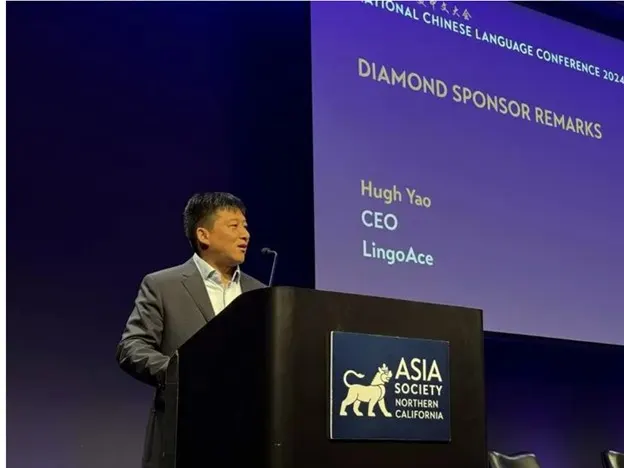
Asia Society hosted the 2024 National Chinese Language Conference (NCLC) from May 2-3 in at the Computer History Museum in Mountain View, California. Since its inception in 2008, the NCLC provides a high-profile platform for sharing new ideas and best practices in the fields of Chinese language teaching and learning, arts and culture, and international exchange. Over the years, this premier education conference has attracted nearly 18,000 attendees from across the United States and around the globe.

Hugh Yao, Founder and CEO of LingoAce, along with his team, was invited to attend and participate in discussions about teaching Chinese language as well as Chinese art and culture. Throughout the conference, they engaged in in-depth exchanges with global education experts, Chinese language teachers from across the country, and school administrators, and other industry leaders.
NCLC 2024: Mandarin Education in a Transformative Era
The 2024 NCLC was opened by Kyung-wha Kang, the President and CEO of Asia Society. In addition to the remarks by LingoAce Founder and CEO Hugh Yao, other conference speakers included Sal Khan, founder and CEO of Khan Academy; Jonathan McKay, Growth Product Manager at OpenAI; and Emily Reed, CEO of AI4ALL, among other industry experts.
As the world's largest Chinese language education conference, many industry leaders, and innovators in education and edtech gathered to discuss the key topics in Chinese language learning and teaching, the movement for Asian American studies, and how AI is transforming language learning today. They contemplated various opportunities for the development of international Chinese education. The aim is build stronger bridges through language learning and cultural exchanges between teachers and students around the world.

LingoAce Founder: AI in language learning
In his remarks, Founder and CEO Hugh Yao shared insights from LingoAce’s experience teaching Chinese as a second language to students from more than 100 countries and regions, along with recent language learning research, and his own personal observations:
"One of the most common questions I get asked is: will AI replace teachers and online tutoring? As one of the world's leading online language learning platforms for children, LingoAce must consider whether artificial intelligence will replace teachers and online tutors. My take on that question is “no,” and this is not my own bias talking.”

More real-time practice, anytime, from anywhere
The advancement in AI technology has made it possible to have context-based conversations. This allows language learners to practice what they have learned from their teachers. It will also make it easier for parents who do not speak the language themselves. Instead of planning playdates or looking for local immersive activities and events, AI will make it possible to help their kids practice in between lessons.
Accelerate content production for creating curriculum, books, and learning games
Language learners need constant stimulation in the language they are learning. However, a common challenge is finding enough textbooks, story books, movies, and TV shows that are age- and level-appropriate for students learning another language. What AI can do is make it easier and faster to produce graphics and write text to create those materials.
Make adaptive learning real
The future of education is personalization. Until now, technologies have not been advanced enough to truly serve every learner and cater to how they learn best. How this plays out is to be developed, but I believe AI will be essential to making adaptive learning a reality at an even lower cost, making learning affordable to all.
Excerpts from Other NCLC Speeches
Sal Khan, CEO and Co-founder of Khan Academy delivered the keynote speech. Khan Academy is an education non-profit that collaborates with over 500 public school districts and schools in the United States, with over 150 million registered users in more than 190 countries/regions globally. It offers free courses in over 50 languages, including mathematics, science, and humanities, and is currently attempting to launch an AI guide called "Khanmigo." At the conference, Sal Khan shared how to use artificial intelligence for education, leveraging AI to unlock the potential of all students. He asked attendees to image an entire generation actively engaged, exploring new ideas, and creating greater changes than any of us could have imagined.

LingoAce Exhibition Booth
LingoAce’s exhibition booth at the 2024 NCLC attracted many attendees from educators and industry experts to connect and exchange ideas.

Conference Roundtable Discussion
At the 2024 NCLC, LingoAce led a roundtable discussion about making Chinese language learning more effective with online learning tools and platforms. The conversation was led by Dr. Xiaoqiu Xu, LingoAce’s Senior Director of Curriculum and Assessment, who leads LingoAce’s research and teaching teams and is responsible for the online education platform’s Chinese language program.

Closing Thoughts from LingoAce Founder and CEO

“I was delighted to have been invited to attend the 2024 National Chinese Language Conference (NCLC). After exchanging many ideas with experts from the entire industry, I left feeling inspired, and my mind filled with many new ideas for LingoAce’s future.
We, as a global online education leader, will continue to use cutting-edge technology and the latest education research, combined with our team’s global perspective on the actual needs of young learners around the world. For example, we plan to utilize artificial intelligence more extensively to change education on multiple levels. This will help make language learning for children and teaching for educators more streamlined and effective, while contributing to the longer-term cultural understanding and greater fluency in world languages.