Maybe your child came home with a note about some “NGAT test” happening next month. The teacher mentioned gifted screening, you nodded, and then later that night you realized: you’re not entirely sure what that actually is. If your child is bilingual or learning Chinese on top of regular schoolwork, the whole thing can feel twice as confusing.
This guide is meant to be that “parent conversation over coffee” you wish you’d already had. We’ll walk through what the NGAT test is, how the format works, and why schools care about it.
Along the way, we’ll also talk about how this all fits with raising a child who uses more than one language, including Chinese.
1. What is the NGAT test?
The term NGAT refers to the Naglieri General Ability Tests, a family of standardized assessments used by many US school districts. Instead of testing whether a child remembers last week’s math lesson or spelling list, these tests try to understand how a child thinks—their ability to reason with patterns, pictures, and simple relationships.
A key design idea behind the NGAT is that it leans more on visual information and less on heavy reading and writing. Children usually see pictures, shapes, or very short prompts and are asked to choose the option that best completes a pattern or solves a visual puzzle. Because of that, it’s often used as part of a more “language-fair” approach to identifying students who might do well in gifted or advanced programs.

Instead of just a few “top” students being nominated, some districts give it to entire grade levels as a universal screener. The goal (at least on paper) is to spot students who might be overlooked if schools only relied on report cards or teacher recommendations.
Who tends to take the NGAT?
Group of students | What usually happens in practice |
Early elementary (e.g., grades 1–3) | Often tested as a full grade for initial gifted/advanced screening |
Upper elementary / middle school | Sometimes tested for additional screening or re-evaluation |
Bilingual / English-learner students | May be included to provide a more language-fair data point |
If your child is learning Chinese in an after-school program or at an online school, they’re using their brain in ways that don’t always show up in English-only classwork.
A test that leans more on patterns and reasoning can help teachers see some of that hidden potential, even if the child’s English writing is still catching up.
2. NGAT test structure and format
Exact details vary by version and district, and schools don’t always explain them clearly. Still, most NGAT setups share three big strands of reasoning:
Verbal reasoning
Nonverbal reasoning
Quantitative reasoning
You can think of these as three slightly different “gym areas” for the brain.
Core sections at a glance
Section | What the child does | Feels like… |
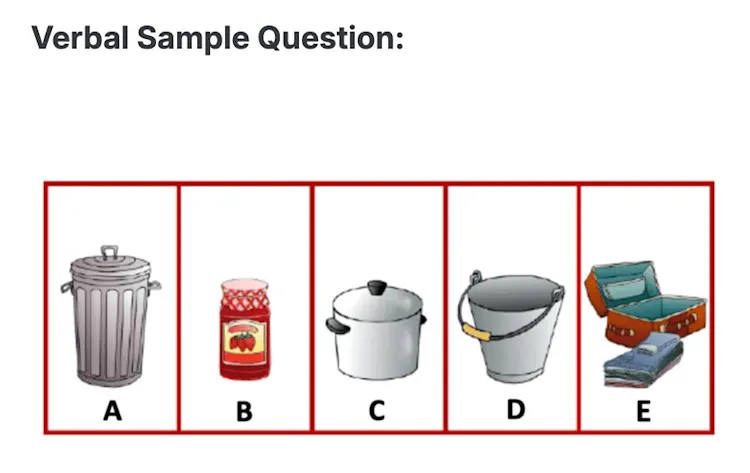
Verbal reasoning | Works with words, categories, and simple relationships | Light word puzzles and matching tasks |
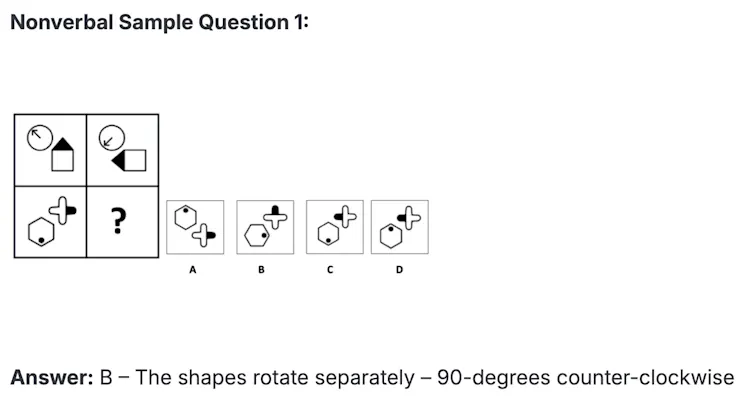
Nonverbal reasoning | Looks at shapes, visual analogies, and pattern completion | Picture-based logic or “spot the pattern” |
Quantitative | Handles basic number relationships and pattern-based math questions | Simple number puzzles, not big calculations |
Even in the “verbal” part, the language load is usually lighter than in a reading test. The emphasis is still on relationships and logic rather than long passages.
What do the questions look like?
You’ll typically see:
Multiple-choice questions with 4–5 options
Pattern completion: “Which picture comes next?”
Visual analogies: “A is to B as C is to…?” using shapes or symbols
Simple number sequences: “2, 4, 6, ?” type questions, sometimes drawn as dots or bars
Kids don’t always realize this is “serious testing”—to them, it can feel like a long set of puzzles, assuming the pacing and pressure are handled gently.
How is the test given and timed?
In most schools, the NGAT is administered to a whole class or grade at once. The rough flow is often something like:
The teacher reads instructions and walks through a few practice examples.
Students complete several timed sections, each with its own batch of questions.
Everything is done with simple materials (paper-and-pencil or on a computer), usually within a single morning or spread over a couple of shorter sessions.
Timing is tight enough that many children won’t finish every single question. That’s normal. The design assumes that.
Decoding NGAT scores in everyday language
Parents often feel intimidated by the numbers on the report. A typical summary might include:
A standard or scaled score
A percentile rank (for example, 84th percentile)
Sometimes a phrase like “Meets criteria for additional gifted evaluation”
It helps to treat the score as one snapshot, not a verdict on your child’s entire future. You can gently ask the school:
How much weight do you give this test compared to classroom work?
Is this score a starting point for further evaluation, or the main gatekeeper?
For bilingual kids or English learners, do you interpret results differently or look for extra evidence?
Those questions are especially important if your child is switching between languages at home or in Chinese lessons.
3. Why the NGAT test matters for your child
So, why all the fuss about a pile of pattern puzzles? In many US districts, NGAT results are part of the decision-making process for advanced learning opportunities.
Connection to gifted and advanced programs
Districts might use NGAT scores to:
Flag students for gifted program eligibility
Help decide placement in advanced math or reading groups
Identify students who might benefit from enrichment projects or pull-out classes
If your child often finishes work quickly, asks deep questions, or seems under-challenged, the right placement can make school feel less like endless review and more like something that actually matches their curiosity.
Why it’s especially relevant for bilingual and Chinese-learning kids
Consider a child who:
Speaks one language at home and another at school
Attends Chinese class online twice a week
Reads simple books in both English and Chinese
In daily school life, that child may still be working on spelling, grammar, or writing organization in English. A teacher who sees inconsistent writing might hesitate to nominate them for gifted testing. A more language-fair test like NGAT can give a second angle on the child’s abilities and help balance that picture.
The skills that NGAT taps—pattern recognition, flexible thinking, problem-solving—are constantly exercised when kids:
Switch between two languages
Learn a different writing system (like Chinese characters)
Juggle tones, meanings, and sentence structures across languages
In other words, the same brain “muscles” that help in a Chinese class can also support strong performance on ability tests and, later on, in advanced academic work.
A milestone, not a life label
It’s easy to over-focus on the test. But for most children, the NGAT is:
A checkpoint that might open or confirm opportunities
One piece of data among many (teacher input, classwork, other tests)
Not a final word on who they are or what they’ll achieve
For bilingual kids especially, a lot of their strengths show up gradually—over months and years of reading, speaking, and thinking in two languages—not in a single testing session on a random Tuesday morning.
4. NGAT test preparation strategies and home study plan
You don’t need a color-coded binder and a whistle. A quiet, realistic plan is usually enough. Think in terms of three intertwined threads: puzzle exposure, gentle familiarity with test styles, and day-to-day habits that help both NGAT performance and Chinese learning.
4.1 Build “puzzle muscles” in ordinary life
Instead of announcing “We’re doing NGAT prep now,” you can simply bring more reasoning activities into the week:
Examples of low-stress puzzle practice
Activity type | Simple ideas you can try |
Visual puzzles & games | Jigsaw puzzles, tangrams, mazes, simple strategy board games |
Everyday pattern spotting | “What pattern do you see in these tiles / cars / shelves?” |
Quick analogy moments | “Dog is to puppy as cat is to…?” on the way to school |
When your child suggests their own “rule” or pattern, resist the urge to correct immediately. Ask, “Tell me how you saw it that way,” and let them explain. That explanation step is gold for building thinking skills.
4.2 Light exposure to test-style questions
A bit of familiarity goes a long way in reducing anxiety:
Show a few example questions: a simple pattern, a picture analogy, a small number sequence.
Talk through one or two together, then let your child try a couple alone.
Emphasize strategies like:
Look for how shapes change (size, direction, number of pieces).
Eliminate obviously wrong answers first.
If stuck, make a thoughtful guess and move on.
Keep these sessions short—10 to 15 minutes is fine—and occasional, not daily “drills.”
4.3 Daily habits that help both NGAT and Chinese
Reading routine in two languages
English: short chapter books, comics, or nonfiction snippets
Chinese: picture books, graded readers, simple dialogues
Talk about “how you solved it”
While building LEGO or cooking, ask: “What made you decide to do it that way?”
If your own Chinese allows, encourage your child to re-tell a simple version in Chinese. It doesn’t have to be perfect.
Math and reasoning in real life
Let them estimate totals at the grocery store.
Ask them to guess how many minutes something will take and then check.
Over time, these small habits build the mental flexibility that helps on reasoning tests and on future Chinese exams like YCT or HSK, without feeling like a separate project.
4.4 Emotional preparation (often underestimated)
Some children have the thinking skills but get tangled in worry the moment they hear “test.”
You can:
Normalize it: “Your teachers just want another way to see how you think.”
Avoid pressure sentences like “This decides if you’re gifted.”
Teach a tiny pre-test routine: three deep breaths, relax shoulders, wiggle fingers, then focus on the first question only.
If they walk into the room feeling reasonably calm and not blindsided by the format, you’ve already done something important.
5. Resources and tools for the NGAT test and Chinese learning
You don’t need a giant shopping list of materials. A few well-chosen resources, plus some clarity from the school, are usually enough.
5.1 Information: how your district uses NGAT
First stop: ask the school or district to share in writing:
A parent-friendly explanation of why they use NGAT
A sample report with fake data so you know what all the numbers mean
How they consider bilingual and English-learner students in the identification process
If the district has a dedicated gifted education or advanced learning page, that’s usually where they hide the rules about retesting, qualification thresholds, and timelines.
5.2 Practice and “brain warm-ups”
For gentle exposure, you can look for:
Puzzle books or printable sheets focused on visual patterns and logic
Kid-friendly strategy or pattern games (board or digital)
Occasional small sets of test-style questions to build familiarity
You don’t need to turn it into a big countdown. Think of these as brain warm-ups, mixed into life in the same way you might mix in sports or music practice.
5.3 Long-term growth through Chinese learning
The third pillar is long-term and often underappreciated: structured language learning, especially in a language quite different from English, like Chinese.
A good children’s Chinese program will:
Build listening, speaking, reading, and writing step by step
Introduce characters and tones in a way that’s achievable for kids
Offer clear milestones (sometimes aligned with tests like YCT or HSK)
Understand that many kids already have heavy homework from regular school
The same cognitive skills that help a child reason through NGAT questions—memory, attention, pattern recognition, flexible thinking—are constantly used in a serious Chinese course. You’re not choosing between “test prep” and Chinese; in many ways, long-term Chinese learning is part of the deeper, slower preparation for advanced academic work in general.
6. NGAT test FAQs for parents
Q1. Is the NGAT test basically an IQ test? Not exactly. It does measure reasoning ability in a similar spirit to parts of an IQ test, but schools typically treat NGAT as one component in a bigger picture.
They usually combine it with teacher observations, classroom performance, and sometimes additional assessments when deciding on gifted or advanced placements.
Q2. Is it possible to prepare, or is everything fixed? You can’t rewrite your child’s innate ability in a month, and that’s not the goal anyway. What you can do is help them show what they can already do: reduce fear of the unknown, make the format feel familiar, and build habits like staying with a tricky puzzle instead of giving up at the first sign of difficulty.
Q3. My child is still learning English. Will that affect their NGAT score? The NGAT is designed to reduce language demands, so many bilingual or English-learner students actually get a fairer chance to display their thinking.
That said, directions are still given in English, and any confusion there can affect performance. It’s reasonable to ask how the school supports English learners during testing and how they interpret results for those students.
Q4. What if the score is lower than we expected? A single test can be thrown off by a bad night’s sleep, a headache, nerves, or simply the child misreading instructions. Instead of jumping straight to worst-case scenarios, it usually helps to talk with the teacher about how your child is doing day to day.
Some districts allow retesting or the use of additional evidence (work samples, other tests). Meanwhile, you can keep building the skills that matter: reading, reasoning, curiosity, and bilingual competence.
Q5. How does any of this relate to my child’s Chinese learning? Quite a lot, actually. Learning Chinese requires pattern spotting (characters, tones), strong memory, and the courage to make mistakes and correct them—all of which support academic growth in general. Good reasoning skills help your child organize vocabulary, understand grammar, and solve reading tasks in Chinese.
In the long run, pursuing both Chinese and advanced academic work creates a reinforcing loop rather than a conflict.
7. Next steps after the NGAT test: supporting your advanced, bilingual learner
Once the NGAT test is over and those numbers appear on a report, it’s tempting to stare at them as if they’re the whole story. They’re not.
Use the results as a starting point for conversations:
Ask the teacher what the score actually changes in terms of your child’s school day.
If your child is bilingual or learning Chinese, ask how the school plans to support both their thinking and language growth.
Stay curious about how your child behaves in class: are they engaged, bored, anxious, energized by challenges?
If you feel your child would benefit from more structured support, consider booking a Lingo Ace trial Chinese class with an online program that understands both bilingual families and the pressure around tests.
That way, your child isn’t just preparing for one assessment; they’re building a strong, flexible mind that will carry them through many school years to come.