If your child is learning Mandarin, seasons are a surprisingly useful place to start. They show up in school stories, weather talk, clothing choices, and holiday conversations—so kids get lots of natural repetition.
You can use this post in one quick sitting: learn the four seasons, copy a few ready-to-say phrases, and practice with mini word lists by season. For a more accurate seasonal/climate breakdown in Chinese culture, many families also learn the 24 Solar Terms (二十四节气)—we’ve(Lingoace) covered them in another blog post if you’d like to go deeper.
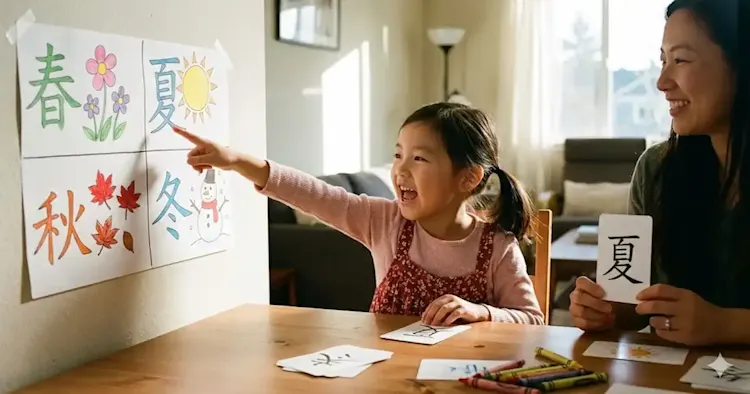
The 4 Seasons in Chinese
Tip: Kids will hear both 天 (tiān) and 季 (jì) forms. The 天 form is extremely common in everyday speech.
Chinese | Pinyin | English |
春天 | chūntiān | spring |
夏天 | xiàtiān | summer |
秋天 | qiūtiān | fall / autumn |
冬天 | dōngtiān | winter |
Copy-and-say (super easy):
我喜欢___。Wǒ xǐhuān ___. (I like ___.)
的时候,我会。___ de shíhou, wǒ huì ___. (In ___, I will ___.)
Examples:
我喜欢春天。Wǒ xǐhuān chūntiān.
夏天的时候,我会游泳。Xiàtiān de shíhou, wǒ huì yóuyǒng.
“Season” in Chinese: 季节 and 四季
Parents often see “season” written in two common ways:
季节 (jìjié) = season (general word)
四季 (sìjì) = the four seasons (literally “four seasons”)
Chinese | Pinyin | Meaning | Copy-and-say example |
季节 | jìjié | season | 你最喜欢哪个季节?(Which season do you like best?) |
四季 | sìjì | the four seasons | 一年有四季。(A year has four seasons.) |
Kid-friendly question to use at dinner:
你最喜欢哪个季节?Nǐ zuì xǐhuān nǎge jìjié?
The 5-Minute Phrases Kids Use Most
Tip: To say “in (a season),” kids can use …的时候 (when it’s…) or just say the season and add a simple sentence.
Phrase | Chinese | Pinyin | Meaning |
in spring | 春天的时候 | chūntiān de shíhou | in spring / when it’s spring |
this summer | 这个夏天 | zhège xiàtiān | this summer |
in fall | 秋天的时候 | qiūtiān de shíhou | in fall |
this winter | 这个冬天 | zhège dōngtiān | this winter |
it’s warm | 很暖和 | hěn nuǎnhuo | it’s warm |
it’s hot | 很热 | hěn rè | it’s hot |
it’s cool | 很凉快 | hěn liángkuai | it’s cool (pleasant) |
it’s cold | 很冷 | hěn lěng | it’s cold |
it’s windy | 有风 | yǒu fēng | it’s windy |
it’s rainy | 下雨 | xiàyǔ | it’s raining |
Quick sentence frames:
春天的时候,天气___。Chūntiān de shíhou, tiānqì ___.
这个冬天很___。Zhège dōngtiān hěn ___.

Spring Words in Chinese
Tip: Spring talk for kids is usually weather + nature + activities.
Word | Chinese | Pinyin | Example |
warm | 暖和 | nuǎnhuo | 春天很暖和。 |
flowers | 花 | huā | 春天有花。 |
green | 绿 | lǜ | 草很绿。 |
rainy | 下雨 | xiàyǔ | 今天下雨。 |
windy | 有风 | yǒu fēng | 外面有风。 |
umbrella | 雨伞 | yǔsǎn | 我带雨伞。 |
park | 公园 | gōngyuán | 我去公园。 |
Copy-and-say:
春天的时候,我去___。Chūntiān de shíhou, wǒ qù ___. (In spring, I go to ___.)
Summer Words in Chinese
Tip: Summer is perfect for “I like / I want / I can” sentences—kids feel motivated.
Word | Chinese | Pinyin | Example |
hot | 热 | rè | 夏天很热。 |
sunny day | 晴天 | qíngtiān | 今天是晴天。 |
ice cream | 冰淇淋 | bīngqílín | 我想吃冰淇淋。 |
swim | 游泳 | yóuyǒng | 我会游泳。 |
beach | 海边 | hǎibiān | 我去海边。 |
hat | 帽子 | màozi | 我戴帽子。 |
shorts | 短裤 | duǎnkù | 我穿短裤。 |
Copy-and-say:
夏天的时候,我会___。Xiàtiān de shíhou, wǒ huì ___. (In summer, I will ___.)
Fall/Autumn Words in Chinese
Tip: Fall sentences often sound great with “I see…” and “I wear…”
Word | Chinese | Pinyin | Example |
cool (pleasant) | 凉快 | liángkuai | 秋天很凉快。 |
leaves | 叶子 | yèzi | 我看到叶子。 |
yellow | 黄 | huáng | 叶子是黄的。 |
pretty | 漂亮 | piàoliang | 秋天很漂亮。 |
sweater | 毛衣 | máoyī | 我穿毛衣。 |
school | 学校 | xuéxiào | 我去学校。 |
busy | 忙 | máng | 我很忙。 |
Copy-and-say:
秋天的时候,我穿___。Qiūtiān de shíhou, wǒ chuān ___. (In fall, I wear ___.)
Winter Words in Chinese
Tip: Winter is great for practicing simple “it’s cold / I want warm…” lines.
Word | Chinese | Pinyin | Example |
cold | 冷 | lěng | 冬天很冷。 |
snow | 雪 | xuě | 我看到雪。 |
jacket/coat | 外套 | wàitào | 我穿外套。 |
scarf | 围巾 | wéijīn | 我戴围巾。 |
gloves | 手套 | shǒutào | 我戴手套。 |
hot chocolate | 热巧克力 | rè qiǎokèlì | 我想喝热巧克力。 |
warm | 暖和 | nuǎnhuo | 这里很暖和。 |
Copy-and-say:
冬天的时候,我想___。Dōngtiān de shíhou, wǒ xiǎng ___. (In winter, I want to ___.)
Seasons vocabulary is one of those topics kids can use constantly—weather, school stories, weekend plans, even what they’re wearing. But a very common “stuck point” is this: children recognize the words, yet their sentences still don’t come out smoothly. That’s where a more systematic, professional learning path can save families a lot of trial and error.
You can consider LingoAce as one option: teachers guide kids step by step in turning vocabulary into real spoken sentences, and parents can sit in to observe lessons—so it’s easier to judge fit in a real-life context. If you’re still comparing choices, starting with a free trial class is a low-pressure way to decide your next step after one real lesson.

Bonus Culture Box: 24 Solar Terms in One Minute
Beyond the four seasons, Chinese culture also uses the idea of 二十四节气 (èrshísì jiéqì)—the “24 solar terms”—to describe seasonal changes more precisely across the year. You don’t need to memorize them for everyday conversation, but it’s fun context for curious kids.
Two examples you might hear:
立春 (lìchūn): “Start of Spring”
冬至 (dōngzhì): “Winter Solstice”
FAQ
How do you say “season” in Chinese?
The most common word is 季节 (jìjié). If you mean “the four seasons,” people often say 四季 (sìjì).
What are spring, summer, fall, winter in Chinese?
They are 春天 (chūntiān), 夏天 (xiàtiān), 秋天 (qiūtiān), and 冬天 (dōngtiān).
Is it 秋天 or 秋季?
Both exist. 秋天 is very common in daily speech. 秋季 can sound slightly more formal or “written/official.” Kids can safely start with 秋天.
How do you say “in spring / this winter” in Chinese?
A simple beginner-friendly pattern is:
“in spring” = 春天的时候 (chūntiān de shíhou)
“this winter” = 这个冬天 (zhège dōngtiān)
What are the 24 solar terms?
They’re a traditional set of 24 markers used to describe seasonal change through the year (二十四节气). You can treat them as a cultural bonus rather than core vocabulary.
Conclusion
You don’t need a huge vocabulary list to make real progress. If your child can say the four seasons and a few simple weather/activity lines, they can start using Mandarin in daily life right away. For the next week, try this tiny plan: pick one season per day, use two sentence frames, and repeat them at breakfast or on the drive to school.
If you’d like a more guided path to help your child move from “knowing words” to “speaking naturally,” the free trial option mentioned above can be a practical next step—especially if you want to observe a lesson and see what kind of feedback your child gets.