If your child has ever tried to say “I have a sister” in Mandarin and then froze—yep, that moment is normal. English gives kids one neat word: siblings. Mandarin doesn’t do “neat” here. It cares about older vs younger, and that single detail changes which word your child should use.
This guide is written for parents in North America who want language that works in real life: playground chats, Zoom calls with grandparents, and those daily “Stop touching your brother’s stuff!” moments. We’ll cover the core words for siblings in Chinese, easy pronunciation tips, polite vs casual options, and a short practice plan you can actually stick to. And because kids don’t learn vocabulary in a vacuum, you’ll also get mini-dialogues and “parent scripts” you can borrow.
What Is “Siblings in Chinese” Actually Referring To?
The umbrella term
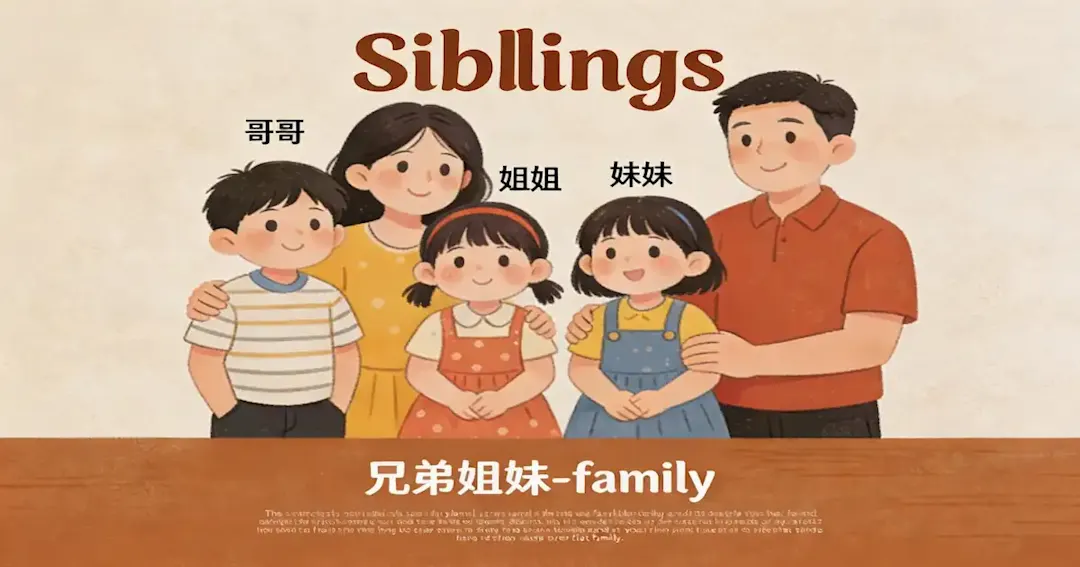
兄弟姐妹 (xiōngdì jiěmèi)= siblings (brothers and sisters as a group)
The four core words
哥哥 (gēge)=older brother
弟弟 (dìdi)=younger brother
姐姐 (jiějie)=older sister
妹妹 (mèimei)=younger sister
In English, your kid can say “my brother” without thinking. With siblings in Chinese, your kid has to make a tiny decision first: older or younger? That’s the whole game.
Why “Older vs Younger” Is Non-Negotiable for Siblings in Chinese
This is where kids get tripped up—and honestly, adults do too.
1) The fast decision rule
When your child wants to say a sibling word in Chinese, ask one question: Is that sibling older than you?
If yes → 哥哥 / 姐姐
If no → 弟弟 / 妹妹
That’s it. No need for long explanations.
2) What if they’re twins?
Parents ask this a lot. For siblings in Chinese, twins are usually handled by who is older by birth order. If you don’t want to get into it, many families just stick with names at home. It’s fine. Language is supposed to help you communicate, not start arguments before breakfast.
4) The cultural “why”
Mandarin puts a spotlight on relationships. Age isn’t just a number; it’s a shortcut to how you speak and how you show respect. When kids learn family words, they’re also learning a social habit: notice who is older, notice who is younger, adjust your language.
3) A tiny “spot check” quiz
Your sister is 2 years older. → (姐姐)
Your brother is 3 years younger. → (弟弟)
Your sibling is older and a boy. → (哥哥)
Your sibling is younger and a girl. → (妹妹)
Kids love “getting it right” fast, and this turns siblings in Chinese into a game instead of a rule.
The Most Useful “Siblings in Chinese” Phrases Parents Teach First
Vocabulary sticks better when it’s attached to a situation. Here are phrases that show up constantly.
1) “Do you have siblings?” in Chinese
你有兄弟姐妹吗?
(Nǐ yǒu xiōngdì jiěmèi ma?) = Do you have siblings?
Kid-friendly answers:
我有一个哥哥。
(Wǒ yǒu yí ge gēge.) = I have an older brother.
我有一个妹妹。
(Wǒ yǒu yí ge mèimei.) = I have a younger sister.
我没有兄弟姐妹。
(Wǒ méi yǒu xiōngdì jiěmèi.) = I don’t have siblings.
If your child is shy, give them a shorter “starter”:
有-- (Yǒu) = Yes.
没有--(Méi yǒu) = No.
2) “This is my …” introductions
这是我哥哥。
(Zhè shì wǒ gēge.) = This is my older brother.
这是我姐姐。
(Zhè shì wǒ jiějie.) = This is my older sister.
这是我弟弟。
(Zhè shì wǒ dìdi.) = This is my younger brother.
这是我妹妹。
(Zhè shì wǒ mèimei.) = This is my younger sister.
This section is a big reading-time keeper because it’s instantly usable. Parents searching siblings in Chinese usually want sentences, not just vocabulary lists.
If you’d like a more consistent routine—especially for pronunciation and real conversation—one option is to book a LingoAce trial class. A good teacher can coach the tiny “older vs younger” decisions in live speaking, and your child gets used to using siblings in Chinese in actual dialogue, not just drills.

3) The phrase you’ll use on family video calls
If your child talks to grandparents in Mandarin (or you want them to), these lines are gold:
我跟我哥哥一起玩。
(Wǒ gēn wǒ gēge yìqǐ wán.) = I play with my older brother.
我妹妹今天很开心。
(Wǒ mèimei jīntiān hěn kāixīn.) = My younger sister is very happy today.
You’ll notice something: siblings in Chinese becomes easier when kids talk about what they do with siblings, not just what siblings “are.”
Polite Forms and Respectful Options for Siblings in Chinese
At home, kids talk casually. In public or to elders, you might want a slightly more respectful tone. Siblings in Chinese has a few flexible options.
1) Referring to someone else’s siblings
When speaking about another child’s siblings, kids can still use the same words, but the sentence structure matters.
你哥哥几岁?
(Nǐ gēge jǐ suì?) = How old is your older brother?
你有姐姐吗?
(Nǐ yǒu jiějie ma?) = Do you have an older sister?
2) Using names + role (a polite “safe mode”)
In some families, especially with mixed-language homes, kids use:
name+哥哥 or name +姐姐
Example: 安娜姐姐-(Older sister Anna)
It’s clear, respectful, and avoids the awkward “Wait… is she older?” moment when kids aren’t sure.
3) When in doubt, keep it simple
If your child struggles to pick the right siblings in Chinese word quickly, it’s okay to use names sometimes. Language should reduce friction, not create it.
Can Kids Call Someone 哥哥 or 姐姐 If They Aren’t Family?
This is a high-curiosity section for “siblings in Chinese” searches, because parents hear kids use these words outside the home and wonder if it’s “wrong.”
1) What’s common in everyday life
Kids (and sometimes adults) use 哥哥/姐姐 as friendly address terms for someone slightly older—like a neighbor teen, a family friend, or a babysitter. It can sound warm and polite.
2) What can feel strange
Big age gaps (calling a grown adult 哥哥 can sound flirtatious or joking depending on context)
Formal settings (school staff, official situations)
When the person clearly prefers their name/title
Pronunciation Tips That Make Siblings in Chinese Stick
Pronunciation is where motivation can dip. Kids say a tone “wrong,” get corrected, feel embarrassed, and then avoid speaking. It’s not dramatic… but it’s real.
1) The three “hot spots”
jiějie (姐姐): English speakers sometimes swallow the “ie” sound.
dìdi (弟弟): the “di” needs a clean “d,” not “dee” with a long vowel.
mèimei (妹妹): kids often flatten the tones when excited.
If you’re thinking, “I’m not confident correcting tones,” you’re not alone. Many parents aren’t. That’s one reason families look for structured speaking practice—someone else can handle the micro-corrections, and you can stay in “supportive parent” mode.
2) The two-minute daily drill
Pick one pair per day:
哥哥 / 弟弟
姐姐 / 妹妹
Do a quick call-and-response: You: “Older brother?” Child: “哥哥!” You: “Younger sister?” Child: “妹妹!”
It’s low pressure. It builds speed. And it makes siblings in Chinese automatic.
FAQ
1) What’s the single word for “siblings in Chinese”? The umbrella phrase is 兄弟姐妹 (xiōngdì jiěmèi). It’s used when you mean “brothers and sisters as a group,” especially in questions like “Do you have siblings?”
2) How do you say “older sister” and “younger sister” in siblings in Chinese vocabulary? Older sister is 姐姐 (jiějie) and younger sister is 妹妹 (mèimei). The difference is purely the age relationship.
3) How do you say “older brother” and “younger brother” in siblings in Chinese vocabulary? Older brother is 哥哥 (gēge) and younger brother is 弟弟 (dìdi).
4) How do you ask “Do you have siblings?” in Chinese? Say 你有兄弟姐妹吗? (Nǐ yǒu xiōngdì jiěmèi ma?). Kids can answer with 有 (yes) or 没有 (no) if they’re just starting.
5) Can my child call a non-sibling 哥哥/姐姐? Often yes, as a friendly way to address someone a bit older—especially for kids. In formal settings or with big age gaps, use a name or an appropriate title instead.
Conclusion
The biggest win with siblings in Chinese isn’t memorizing four words. It’s your child using them naturally: “这是我姐姐,” “我弟弟五岁,” “你有兄弟姐妹吗?” Those tiny sentences stack up into real confidence.If you want one simple focus for the next two weeks, make it this: older vs younger first, pronunciation second, speed last. Your child doesn’t need to speak perfectly—they need to speak often.
And if your family would benefit from a steadier structure (plus live feedback on tones and conversation flow), you can try a LingoAce trial class. It’s an easy way to turn siblings in Chinese from “something we know” into “something we use.”