If you’ve searched simplified vs traditional mandarin, you’re probably trying to make a smart, low-regret choice for your child—especially if your family balancing school, community, relatives, and long-term goals.
Here’s the quick truth that clears up 80% of the confusion: Mandarin is a spoken language. “Simplified” and “Traditional” describe how Chinese is written. Your child can speak Mandarin perfectly well regardless of which character set they learn first. What you’re really choosing is a literacy path—and the best path depends on your family’s “where will we use it?” reality.
This guide is built for parents, not linguists. You’ll get:
a clear decision rule,
a side-by-side comparison table you can screenshot,
and a low-stress plan if you want your child to recognize both scripts later.
Simplified vs Traditional Mandarin:
When people say “Simplified Mandarin” or “Traditional Mandarin,” they’re usually mixing two separate things:
Mandarin (spoken): what your child says and hears.
Simplified/Traditional characters (written): what your child reads and writes.
Think of it like this: English can be spoken in many accents, but it’s still written with the same alphabet. Chinese is different: one spoken variety (Mandarin) can be written in two major character forms—Simplified or Traditional.
So when you ask simplified vs traditional mandarin, you’re not choosing a spoken language. You’re choosing which written system will make reading and writing easier in your child’s day-to-day life.
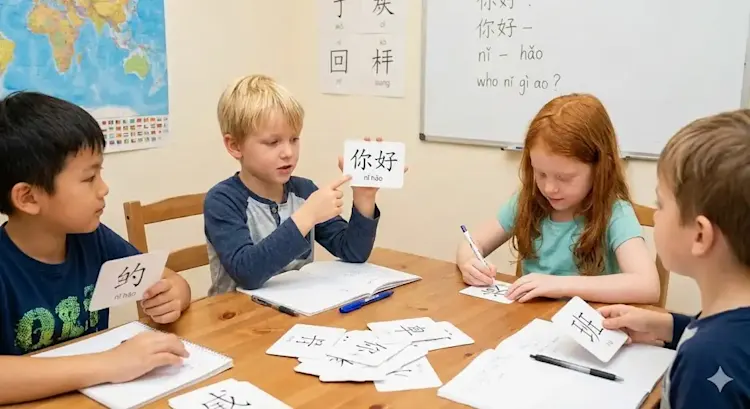
Simplified vs Traditional Mandarin: where each script shows up (and why your kid will care)
A simple default rule helps most families:
Simplified characters are most commonly used in Mainland China and Singapore, and in many modern learning resources.
Traditional characters are most commonly used in Taiwan, Hong Kong, and Macau, and in many heritage contexts tied to those regions.
But what matters more than geography is exposure. Kids learn faster when the script they’re studying matches what they see in real life—books at home, weekend school worksheets, relatives’ messages, subtitles, signage when traveling, and even the character set used by their teacher or program.
A good answer to simplified vs traditional mandarin starts with one question:Where will my child actually read Chinese most often in the next 12–24 months?
If your family texts grandparents who read Traditional, or your child attends a community school that prints Traditional handouts, that’s a strong pull. If your child’s Mandarin immersion program uses Simplified books and readers, that’s another strong pull. The “best” choice is often the one that reduces friction and increases consistency.
Simplified vs Traditional Mandarin: a 5-minute parent checklist
If you want to pick confidently, don’t start with “which is better.” Start with which is easier to sustain.
Answer these five questions:
School or program: Which script does your child’s school/class use (if any)?
Family & community: Which script do the relatives your child reads with use most?
Travel & future plans: Where do you expect to spend time (or study) in the next few years?
Child temperament: Is your child likely to tolerate handwriting drills, or do they thrive with quick wins and reading first?
Your main goal in 2026: Speaking confidence, basic reading, or real writing?
If you have strong answers to #1 and #2, your simplified vs traditional mandarin decision usually becomes obvious. If you don’t, default to the option with better resource availability and lower daily resistance for your child.
If you’re wondering what to do after you choose a script, our guide on Chinese characters for kids breaks down a low-stress learning path (recognition first, then writing—plus simple routines you can actually stick with).
Simplified vs Traditional Mandarin: side-by-side comparison (the screenshot table)
This table is designed for real family tradeoffs—not academic debates.
Category | Simplified Characters | Traditional Characters | Parent takeaway |
Where it’s commonly used | Mainland China, Singapore, many mainstream resources | Taiwan, Hong Kong, Macau, many traditional/heritage contexts | Match what your child will see most |
Visual complexity (early handwriting) | Often fewer strokes for many characters | Often more strokes for many characters | For handwriting-heavy kids, Simplified can feel lighter early |
Reading/recognition | Fast once kids know common components | Also fast with strong component awareness | Reading speed depends more on practice than script |
Materials & apps | Very widely available | Also widely available, but varies by region/provider | Choose what your school/community uses |
Family fit | Best when your texts/books/environment are Simplified | Best when your family texts/books/environment are Traditional | “Home input” matters more than online opinions |
Switching later | Usually manageable (add recognition) | Usually manageable (add recognition) | Switching is easier than parents fear—if you do it the right way |
Best for | Families connected to Mainland/Singapore or Simplified-based schools | Families connected to Taiwan/HK or Traditional-based community programs | The “best” is the one your child will keep using |
If you want a one-line conclusion: in simplified vs traditional mandarin, your “winning” script is the one that makes it easier for your child to practice consistently without battles.
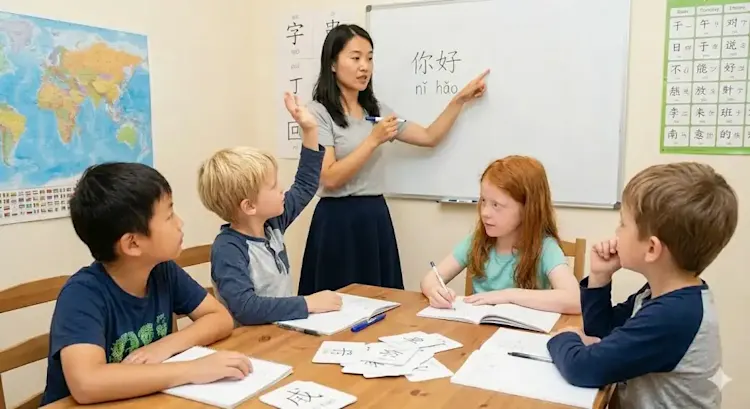
Simplified vs Traditional Mandarin: the Simplified path
Why Simplified works well for many North America kids
Pros
Lower handwriting load at the beginning (for many characters), which can reduce frustration for younger kids.
Easy alignment with a lot of mainstream learning materials (readers, graded content, many programs).
Often a smoother start for families who want early reading wins and don’t want handwriting to become the “reason we quit.”
Cons
If your child’s closest reading relationships are with Traditional readers (some grandparents/community schools), you may feel a mismatch early.
Some families worry it’s “less authentic.” In practice, authenticity comes from real usage—speaking, reading, and connecting—not from stroke count.
Best for
Your child’s school/program uses Simplified.
Your family expects more exposure to Mainland/Singapore media or travel.
Your child is young, easily discouraged by handwriting, or needs quick wins to stay motivated.
A parent note: if you’re mostly focused on speaking confidence, the script choice matters less than how often your child speaks and is corrected gently. The biggest risk in simplified vs traditional mandarin isn’t “choosing wrong.” It’s “starting and stopping.”
Simplified vs Traditional Mandarin: the Traditional path (pros, cons, best-for)
Why Traditional is a strong choice in the right family context
Pros
Strong fit for families with Taiwan/Hong Kong ties and communities where Traditional is the default.
If grandparents send messages or read with your child in Traditional, alignment makes learning feel more natural.
Some kids (especially older ones) enjoy the “structure” of Traditional characters and the visual logic once they learn components.
Cons
Handwriting can feel heavier early for certain kids, especially if the program pushes writing before the child is ready.
If your child’s school materials are Simplified, you may spend extra time translating resources.
Best for
Your child will read with Traditional-script relatives frequently.
Your community school or chosen program uses Traditional.
Your child is older (often 9+) and can handle more deliberate practice, or is genuinely motivated by literacy depth.
A practical way to think about simplified vs traditional mandarin here: if Traditional makes reading at home easier and more frequent, it can beat “theoretically easier” Simplified every time.
Simplified vs Traditional Mandarin: a “speak-first” reality check for bilingual families
Here’s what many parents don’t realize until later: for bilingual kids, speaking momentum often decides whether literacy sticks.
If the learning plan becomes “write characters for 20 minutes a day,” many families burn out. A sustainable plan often looks more like:
short speaking routines (2–5 minutes, frequent),
reading recognition (short and consistent),
and optional handwriting as your child is ready.
So if your child is:
3–6: prioritize speaking, listening, and recognition; keep writing light.
7–10: add structured reading and gentle writing practice, but don’t let handwriting dominate.
11–15: increase writing if your goals require it (school credit, exams, formal literacy), but keep speaking active so the language stays alive.
This isn’t a “skip writing” argument. It’s a “don’t let writing kill the habit” argument—especially when families are stuck on simplified vs traditional mandarin and forget the bigger goal: a child who can actually use Chinese.
If you’re still torn on simplified vs traditional mandarin, your best next step is often not more reading—it’s a trial lesson that gives you:
a real sense of your child’s level,
a clear plan for speaking + literacy,
and feedback on whether your child is ready for handwriting or should start with recognition.
If you’re exploring options, LingoAce can be one practical choice: teachers can help you place your child, build a consistent speaking routine, and align reading/writing goals with whichever script you choose. A trial lesson is an easy way to test fit before committing.

Simplified vs Traditional Mandarin: do kids need to learn both?
Most families don’t need “full mastery” of both. What they often want is:
Write one, and
Recognize the other.
That’s a smart, realistic goal.
Why? Because in real life, being able to recognize the other script helps with:
reading signs or menus when traveling,
understanding relatives’ messages,
consuming a wider range of books and media.
But writing both from the beginning can double workload and reduce consistency—especially for younger kids.
So a good bilingual-family answer to simplified vs traditional mandarin is often:Start with the script you’ll use most, then add recognition of the other once your child has momentum.
Simplified vs Traditional Mandarin: can kids switch later? (Yes—here’s the low-stress plan)
Switching works best when you treat it as pattern recognition, not “start over.”
A simple transition plan (2–4 weeks)
Week 1: Recognize pairs
Pick 20–30 high-frequency characters your child already knows.
Show the Traditional/Simplified pair together (side by side).
Goal: “I can recognize it,” not “I can write it.”
Week 2: Learn the most common component changes
Many differences follow repeatable patterns.
Focus on noticing, not memorizing lists.
Week 3: Read short texts in the new script
Keep it light: captions, short paragraphs, easy readers.
Week 4: Optional writing (only if needed)
If your child must write the new script, start with the most useful characters, not everything.
A key parent mindset shift: in simplified vs traditional mandarin, switching later is usually more about confidence and consistency than intelligence. Kids who read regularly adapt quickly.
Simplified vs Traditional Mandarin: Mandarin vs Cantonese vs scripts (the confusion that keeps coming back)
Many search queries mix all four terms—so let’s clarify cleanly:
Mandarin and Cantonese are spoken varieties. (Different pronunciation, vocabulary, and sometimes grammar in everyday speech.)
Traditional and Simplified are written scripts.
Either Mandarin or Cantonese can be written in either script.
So when people say “Traditional is Cantonese,” that’s not accurate. Traditional characters are simply the standard writing system in certain regions—not a separate spoken language.
This is why simplified vs traditional mandarin is a writing decision, while “Mandarin vs Cantonese” is a spoken-language decision.
FAQ
chinese simplified vs traditional mandarin
Chinese simplified vs traditional mandarin is really asking: which character set should my child learn first while speaking Mandarin. A practical default is: choose the script used by your child’s school/community and the relatives they read with most. If both are neutral, Simplified often has broader beginner materials, while Traditional can be a better fit for Taiwan/HK family contexts.
chinese simplified vs traditional vs mandarin vs cantonese
When people search chinese simplified vs traditional vs mandarin vs cantonese, they’re mixing spoken and written categories. Mandarin vs Cantonese = spoken varieties. Traditional vs Simplified = writing systems. Your child can speak Mandarin and read either script; the “right” choice depends on where your child will read Chinese most often.
cantonese vs mandarin vs traditional vs simplified
Cantonese vs Mandarin vs Traditional vs Simplified breaks into two separate choices:
Which spoken variety do we focus on (Mandarin or Cantonese)?
Which script do we read/write (Traditional or Simplified)? Many families do Mandarin for broader school/resource support, then pick the script that matches relatives and community. But the best plan is the one your family will actually practice consistently.
chinese simplified vs traditional which one is mandarin
If you’re asking chinese simplified vs traditional which one is mandarin, the answer is: neither. Mandarin isn’t a script; it’s speech. Mandarin can be written in Simplified or Traditional characters.
mandarin simplified vs traditional spoken
For mandarin simplified vs traditional spoken: spoken Mandarin is the same regardless of script choice. Script impacts reading and writing, not speaking. If your child’s main goal is conversation, prioritize speaking routines and choose the script that reduces friction for reading practice.
Conclusion:
If you want a clean decision for simplified vs traditional mandarin, use this:
Choose Simplified first if your child’s school/program uses it, your resources skew Simplified, or your child needs lower handwriting friction to stay motivated.
Choose Traditional first if your family/community reads it most, or Taiwan/HK ties make Traditional the script your child will see daily.
Choose one to write + learn recognition of the other later if your family spans regions or you want flexibility without doubling workload.
And if you’d rather not guess: a well-structured trial lesson can quickly show you what your child is ready for (speaking only, reading recognition, or writing), and help you commit to a plan you can sustain. If you’re exploring options, you can try a LingoAce trial lesson to get level placement, a practical learning path, and the kind of consistent speaking practice that keeps bilingual learning from fading out.