A scroll that doesn’t feel ancient
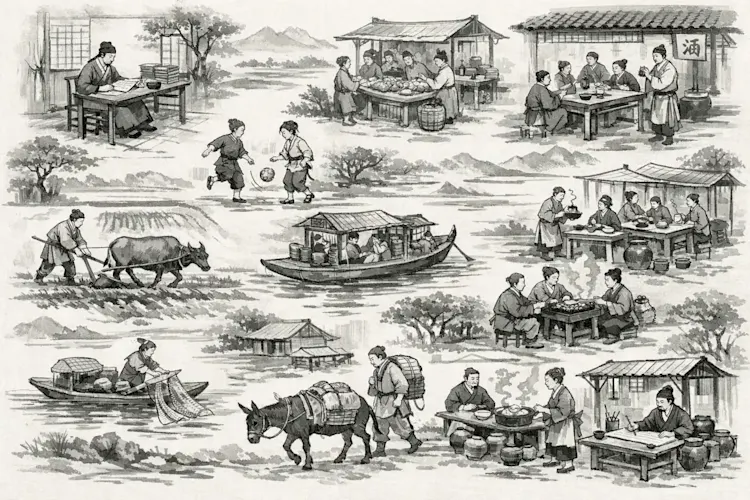
If you stare at Along the River During Qingming Festival for more than ten seconds, you’ll realize it doesn’t feel like an “ancient painting” at all.It feels like a paused city video: a bridge packed with people, a boat squeezing through river traffic, vendors calling out prices, pedestrians sidestepping a donkey cart, and someone sitting quietly inside a teahouse as if they have all the time in the world.
That’s the magic of this scroll.It doesn’t introduce the Song Dynasty with dates—it drops you right into the street.
And that’s exactly why Chinese learners love it.
Because once you can see the world, the Chinese stops feeling like random vocabulary lists. Words like 桥 (bridge), 船 (boat), 市场 (market), and 热闹 (lively) suddenly have a place to live. You’re not memorizing them anymore—you’re recognizing them.
In this guide, we’ll “walk” through the scroll scene by scene, meet the people hidden inside it, and collect practical Chinese words and short phrases you can actually use—especially if you’re learning as a family.
One-minute context: What is the Qingming Scroll?
Along the River During the Qingming Festival (清明上河图) is a famous handscroll painting attributed to Zhang Zeduan (张择端) from the Northern Song dynasty. It portrays life in Bianjing (汴京)—the Northern Song capital, in today’s Kaifeng.
It’s also famously detailed: the scroll stretches over five meters, and it includes hundreds of figures and dozens of boats captured in motion. So when people say it feels “alive,” they’re not exaggerating. It truly is a whole city, paused mid-step.
Now—let’s step inside.

Scene 1: The quiet edge of the city
The scroll doesn’t start with noise. It starts with space.You see the outskirts first—fields, paths, travelers moving toward the city. It’s calm enough that your brain has time to settle. Then the road pulls you forward, little by little, until the city begins to appear.
That pacing matters for Chinese learners too.You don’t “rush into” Chinese. You arrive in it—one scene at a time.
Useful Chinese words (easy, high-frequency):
路 (lù) — road
人 (rén) — person
走 (zǒu) — to walk
进城 (jìn chéng) — enter the city
慢慢来 (màn man lái) — take it slow / no rush
One line you can actually say today:
慢慢来,不着急。 (Màn man lái, bú zhāojí.) — Take it slow. No need to rush.
Scene 2: City gates and “Song Dynasty energy”
Then the scroll gets busy.You reach the city gate area, and suddenly everything is in motion—goods coming in, people moving out, animals passing through, and small businesses forming their own little ecosystems around the traffic.
Smarthistory describes the world inside the scroll as full of shops and teahouses, with everyday life moving through the city gate like water through a river channel.The Song Dynasty starts to feel strangely familiar here.
Not because the clothes are modern—they aren’t.But because the rhythm is: people commuting, merchants selling, workers hauling goods, and that constant sense that a city is always “mid-task.”
Chinese words to learn from this scene:
城门 (chéngmén) — city gate
进 (jìn) — enter
出 (chū) — exit
商人 (shāngrén) — merchant
店 (diàn) — shop
热闹 (rènào) — lively, bustling
Mini speaking practice:
这里好热闹! (Zhèlǐ hǎo rènào!) — It’s so lively here!
我们进去看看。 (Wǒmen jìnqù kànkan.) — Let’s go in and take a look.
Scene 3: The bridge—where the scroll becomes a story
Every great city has a choke point.In the Qingming Scroll, it’s the bridge.This is the part people remember because it has tension: a boat trying to pass, the space too tight, the crowd too dense, everything happening at once. It feels like the exact second before something goes wrong.
And that’s why it’s so useful for language learning.Because when a moment has pressure, the Chinese becomes instinctive. You don’t say long sentences. You say quick ones. Real ones.
Bridge scene Chinese (super usable):
桥 (qiáo) — bridge
船 (chuán) — boat
河 (hé) — river
小心 (xiǎoxīn) — careful
别挤 (bié jǐ) — don’t push / don’t squeeze
What you might actually shout in real life:
小心一点! (Xiǎoxīn yìdiǎn!) — Be careful!
慢一点! (Màn yìdiǎn!) — Slow down!
Small note for learners: this is the kind of “street Chinese” many textbooks don’t really teach—short, emotional phrases that people actually say out loud.If you’d like more “behind-the-book” moments like this (and want a teacher to help your child turn them into natural speaking), LingoAce uses stories and real-life scenes to make vocabulary stick—without forcing memorization.

Scene 4: Markets, street jobs, and the Song “business brain”
After the bridge, the city opens up.And this is where the scroll becomes almost overwhelming—in a good way. You stop seeing “pretty details” and start noticing systems: transport, commerce, street jobs, and the way a city keeps itself alive.
Scholarly summaries of the scroll often mention visible economic activity: people loading cargo, shops doing business, and even signs of official management connected to trade.
Here’s a detail most people miss the first time: in some discussions of the original version, only around twenty women appear outdoors, and most are shown in limited ways compared to men. It’s not the whole story of Song society—but it’s an honest reminder that “daily life” looks different depending on who you are.
Market Chinese vocabulary (instant wins):
市场 (shìchǎng) — market
摊位 (tānwèi) — stall
买 (mǎi) — buy
卖 (mài) — sell
便宜 (piányi) — cheap / good deal
太贵了 (tài guì le) — too expensive
Useful shopping phrases:
这个多少钱? (Zhège duōshǎo qián?) — How much is this?
可以便宜一点吗? (Kěyǐ piányi yìdiǎn ma?) — Can it be a bit cheaper?
我再看看。 (Wǒ zài kànkan.) — I’ll keep looking.
That last line is pure real-life Chinese. Polite, smooth, and it saves you from awkward goodbyes.
Scene 5: Teahouses, snacks, and the soft side of the Song
One reason the Song Dynasty stays in people’s imaginations is that it wasn’t only ambitious—it was refined in everyday ways.Tea culture is a perfect example.
The scroll includes scenes connected to shops and leisure spaces, and modern explainers often highlight how teahouses and commercial streets were part of daily Song urban life.
And honestly? For learners, tea vocabulary is a cheat code. Because it’s cultural and practical—words you can use immediately.
Tea words you’ll reuse forever:
茶 (chá) — tea
茶馆 (cháguǎn) — teahouse
喝茶 (hē chá) — drink tea
香 (xiāng) — fragrant
好喝 (hǎohē) — tasty (for drinks)
Natural lines (not stiff):
我想喝点茶。 (Wǒ xiǎng hē diǎn chá.) — I want to drink a little tea.
这个茶很香。 (Zhège chá hěn xiāng.) — This tea smells amazing.
太好喝了! (Tài hǎohē le!) — So good!
Does it really show the Qingming Festival? A small mystery
People often assume the scroll is literally about “Qingming Day” itself.But the truth is a little more interesting: scholars debate what exactly the title refers to and what “Qingming” means in this context.
For learners, that’s actually the best part.Because it means you don’t need one “correct answer.”You can use the scroll as a speaking prompt:
What season does it feel like?
Why is everyone moving?
What would you buy in this market?
If you can describe what you see, you’re already using Chinese the right way.
A simple way to learn Chinese through the scroll (10 minutes, no burnout)
If you’re learning as a family, try this routine:
The 3-Zoom Rule
Zoom out: choose one section (gate, bridge, market)
Zoom in: pick one person and describe what they’re doing
Zoom language: learn 5 words + speak 2 sentences
Example (bridge scene):
Words: 桥 / 船 / 河 / 小心 / 热闹
Sentences: 这里好热闹!小心一点!
That’s enough to build consistency.
And if you want more “book-doesn’t-teach-this” cultural details while your child practices speaking in full sentences, you can explore story-based Chinese learning with LingoAce—it’s a simple way to turn curiosity into real conversation skills, step by step.