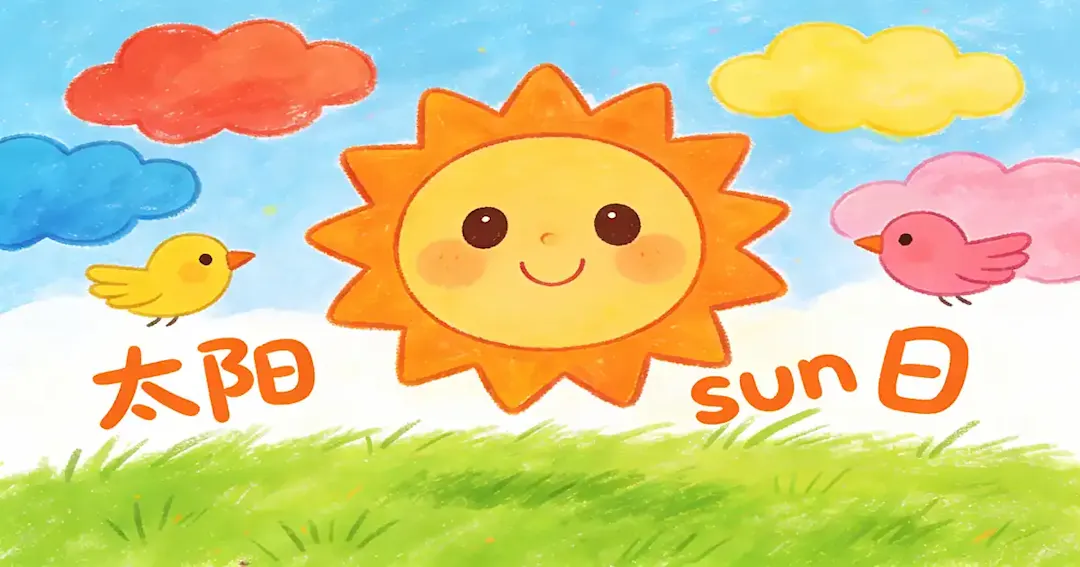
If you’ve ever heard your child say “rì” when they meant “the sun,” or write 日 on a drawing of a bright yellow circle… yep. Totally normal. This guide gives you the quick answer first, then the “why”.
Quick Answer Box: “sun in Chinese” in one glance
Most common everyday word:
太阳—tàiyáng—“the sun” (the one in the sky)
Common character you’ll see a lot (books, calendars, compounds):
日—rì —“sun/day/date”depending on context
When to use which (plain-English rules):
Talking about the actual sun outside → use 太阳 (tàiyáng)
Talking about days, dates, daily routines, or seeing it inside another word → you’ll often see 日 (rì)
When in doubt for speaking, default to 太阳 (it sounds natural and kids hear it everywhere)
6 useful mini-phrases:
太阳出来了。 Tàiyáng chūlái le. — The sun is out.
今天有太阳。 Jīntiān yǒu tàiyáng. — It’s sunny today (literally “today has sun”).
太阳很大。 Tàiyáng hěn dà. — The sun is big/strong.
太阳光很刺眼。 Tàiyáng guāng hěn cìyǎn. — Sunlight is glaring.
日光 rìguāng — sunlight (more “wordy,” shows up in writing)
太阳能 tàiyángnéng — solar energy
Save this box. Honestly, most families only need this for day-to-day life. The rest is for the moments your child asks, “But why are there two?”

What “sun in Chinese” usually means
When parents search sun in Chinese, they’re usually trying to solve one of these situations:
My kid wants to say “the sun is bright” in Mandarin.
Homework or a book shows 日, and my kid thinks it’s always “sun.”
I’m not sure if 太阳 is the only “right” word.
The short version: 太阳 is the everyday thing in the sky. 日 is a character that can mean sun, but very often drifts into day/date/daily in real usage.
太阳 = the sun you can point at
If your child is describing weather, a picture, a morning walk, a hot playground… 太阳 is the natural choice.
太阳 feels concrete: you can draw it, feel it, squint at it.
Kids hear it in cartoons, teachers say it in class, grandparents use it casually.
So for speech, especially beginner speech, 太阳 is your friend.
日 = “sun/day/date,” and it shows up everywhere
The character 日 is older, shorter, and sneaks into lots of “grown-up” or “written” words:
日期 rìqī — date
生日 shēngrì — birthday
每日 měirì — every day
日记 rìjì — diary
日常 rìcháng — daily life
Notice what those words have in common: they’re about time, not the glowing ball in the sky.
This is why kids get confused. They learn “日 = sun,” then suddenly it’s “birthday” and “date” and “daily.” It feels like a trick. It’s not a trick, it’s just… language doing language things.
Sun in Chinese pinyin & pronunciation: stop tone mistakes early
A surprising number of kids learn sun in Chinese “correctly” at first, then fossilize a slightly-off pronunciation because no one catches it in natural conversation.
Pinyin you actually need
If your child is mixing tones, they’re not alone. Mandarin tones are like musical notes—kids can learn them, but they need short, frequent exposure.
A quick tone memory trick for tàiyáng
This is not scientific, but it works in real kitchens:
tài (4th tone) feels like a quick “drop” (firm, decisive)
yáng (2nd tone) feels like it rises (lighter)
So you can tell your child: “Drop then rise: tài–yáng.”
And then move on. Don’t over-explain it. The goal is a tiny hook they can grab.
If your child still mixes up 太阳 and 日, it’s usually not a “memory” issue—it’s a real-time feedback issue. You can keep home practice simple (a few short sentences + “chunk” words like 生日/日期), but if you’re stuck, a LingoAce trial class can help. Ask the teacher to check tàiyáng tones, a few “sun in Chinese” sentences, and whether your child understands 日 as day/date in common words. You’ll leave with a clear practice plan.

When to use 太阳 vs 日: the rules families actually need
Let’s make this painfully practical. If you’re deciding which word to teach or correct, this simple table handles 95% of life.
What you mean | What to use | Why |
The sun in the sky (weather, pictures, outdoors) | 太阳 (tàiyáng) | Most natural spoken word |
Dates, days, “daily,” “every day” concepts | 日 (rì) inside compounds | 日 is strongly linked to time |
Set words you memorize (sunlight, solar, diary, birthday) | Learn the whole word | The compound decides usage |
Everyday conversation → pick 太阳
These are the moments parents actually face:
“The sun is out.” → 太阳出来了。
“It’s sunny.” → 今天有太阳。
“The sun is so strong.” → 太阳很晒 / 太阳很大。 (both heard; kids can start simple)
If your child is speaking, and you want one correct default for sun in Chinese, choose 太阳.
Dates and formal-ish words → you’ll see 日
If your child is reading, writing, or doing schoolwork, 日 shows up a lot. Not because it’s “fancier,” but because Chinese packs meaning into characters inside compounds.
A few high-frequency examples:
生日 shēngrì — birthday
日期 rìqī — date
周日 zhōurì — Sunday (you’ll also see 星期日)
每日 měirì — every day
Kids don’t need to memorize all of these at once. But it helps to teach the pattern: 日 often signals “day/date.”
The “sun radical” 日: why it shows up in so many useful words
Parents often ask: “So is 日 a radical or a word?” The honest answer is: both, depending on what you’re looking at.
As a standalone character, 日 can mean sun/day.
As a component in other characters, it often hints at light, time, daily cycle.
What the radical tends to hint at
Not every word follows a perfect rule, but you’ll often see 日 in words connected to:
time (early, morning, day)
light/brightness (bright, clear)
daily routine (usual, everyday)
A curated set of 日-words kids actually meet
1) Daily routine + time words
早 zǎo — early / morning
晚 wǎn — evening / late
时 shí — time (as in 时间)
昨 zuó — yesterday (as in 昨天)
These are gold because they attach to daily life. Kids can use them immediately.
2) Light / brightness words
明 míng — bright / clear (also “tomorrow” in 明天)
晴 qíng — sunny / clear weather (晴天)
星 xīng — star (kids love this one)
You can see how this helps: if your child knows 日 is “sun-ish,” then 晴 being related to weather suddenly makes more sense.
3) Calendar / school words
期 qī — period/term (学期, 日期)
日 rì inside 星期日 — Sunday
暑 shǔ — heat (暑假 summer vacation)
A note before anyone turns this into a “radical lecture”: you don’t need to teach radicals like a textbook. Use them like clues. Little hints. Not a test.
FAQ
1) What is the most common way to say sun in Chinese?
For everyday speaking, it’s 太阳 (tàiyáng). That’s the safest, most natural choice when you mean the actual sun in the sky.
2) Sun in Chinese pinyin — what’s the correct pinyin for 太阳?
太阳 = tàiyáng (4th tone + 2nd tone). If tones are tough, practice it inside a sentence like 今天有太阳 so it feels less like a drill.
3) Is 日 “sun” or “day” in Chinese?
Both can be true, but in modern daily usage 日 very often appears in words meaning day/date/daily, like 生日, 日期, 每日. That’s why kids see it everywhere.
4) For kids learning Mandarin, should I teach 太阳 or 日 first for sun in Chinese?
Teach 太阳 first for speaking and real-life sentences. Introduce 日 as a character they’ll see in reading and in compounds (birthday/date/daily).
5) 太阳 vs 日: which one should my kid use when talking about weather?
Use 太阳. Weather talk is exactly where 太阳 is most natural: 今天有太阳, 太阳出来了, 太阳很晒.
Conclusion
If you only remember one thing: 太阳 is the everyday spoken word for “sun in Chinese.” 日 is a character that shows up constantly—often carrying the meaning of day/date/daily inside other words.
Try the two-minute speaking routine for a week, teach compounds as chunks (生日, 日期), and keep practice small enough that your child doesn’t dread it. That’s the quiet secret.
If you’d like a teacher to help your child use sun in Chinese naturally (not just memorize it), you can book a LingoAce trial class and ask for a quick speaking + reading check. It’s a simple way to get a clear next step without turning your home into a classroom.