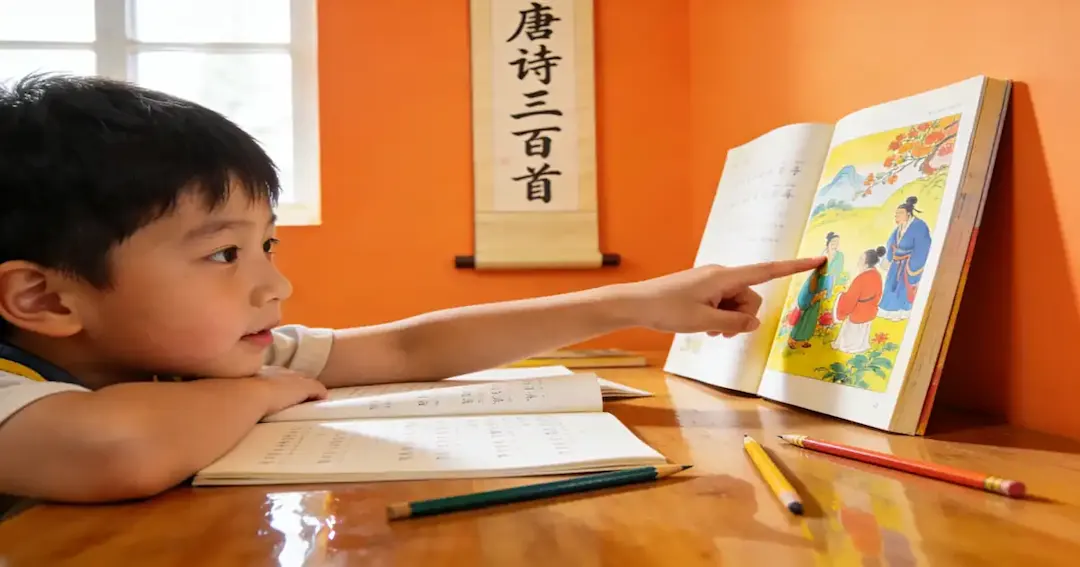
If you grew up reciting a few lines of tang poetry(唐诗), you probably remember the sound before you remember the “analysis.” The rhythm is sticky. The pictures are sharp. And the emotions—missing home, saying goodbye, noticing spring—are basically timeless.
If you didn’t grow up with Chinese, tang poetry can look like a wall of characters: beautiful, but… where do you even start?This guide is for you to know it.
What is tang poetry (and what counts as “Tang”)?
Tang poetry usually refers to classical Chinese poems written during the Tang dynasty (618–907 CE), an era often described as a golden age of Chinese poetry.
You’ll see a few common forms mentioned:
Jueju (quatrain): 4 lines, often 5 or 7 characters per line—short enough for kids to memorize.
Lüshi: 8 lines with stricter structure (beautiful, but heavier for beginners).
Recurring themes: nature, travel, friendship, farewell, quiet night scenes—topics kids can still “get” when explained plainly.
When parents search for tang poetry, they usually want something practical: “Which poems should we start with, and how do I explain them without turning it into homework?” Let’s do that next.

Top 10 tang poetry picks
Below are 10 famous, beginner-friendly picks. For each one, I’m giving you a one-sentence meaning plus a quick “how to use it” idea.
静夜思 (Quiet Night Thought) — Li Bai Meaning: Moonlight looks like frost; the traveler suddenly misses home. Try: Bedtime poem. Ask: “What do you miss when you’re away?”
春晓 (Spring Morning) — Meng Haoran Meaning: You wake to spring, hear birds, and wonder how many petals fell overnight. Try: Morning routine. Have your child name 3 sounds they hear.
登鹳雀楼 (On the Stork Tower) — Wang Zhihuan Meaning: Want a bigger view? Climb higher. Try: Motivation line for older kids—sports, music, reading.
黄鹤楼送孟浩然之广陵 (Seeing Meng Haoran Off at Yellow Crane Tower) — Li Bai Meaning: A friend sails away; the river keeps moving; you’re left with the feeling. Try: Talk about goodbyes (moving, changing schools).
相思 (Red Beans) — Wang Wei Meaning: Tiny objects can hold big “missing-you” feelings. Try: Make a small token for grandparents.
鹿柴 (Deer Park) — Wang Wei Meaning: A quiet mountain scene where light and sound feel extra sharp. Try: Calm-down poem. Read slowly; let the quiet be part of it.
望庐山瀑布 (Viewing the Waterfall at Mount Lu) — Li Bai Meaning: A waterfall looks like the Milky Way dropping from the sky. Try: Pair with a short nature clip; kids love the “wow” image.
江雪 (River Snow) — Liu Zongyuan Meaning: Everything is silent and snowy; one fisherman keeps going anyway. Try: Talk about “quiet strength.”
送元二使安西 (Farewell to Yuan Er) — Wang Wei Meaning: A friend leaves; you offer one last cup and a sincere wish. Try: Make it a “good luck” poem before a big day.
锄禾 (Weeding the Cereal Crops) — Li Shen Meaning: Food comes from hard work; don’t waste it. Try: Lunch-table poem. Connect to “respecting effort.”
Do you want your child to adopt a more structured approach to learning—one featuring reliable pronunciation, gentle correction, and lessons that integrate poetry with listening, speaking, reading, and writing skills? If so, consider booking a trial lesson with LingoAce; it is a hassle-free way to determine which proficiency level is best suited for your child. On Trustpilot, one parent wrote that their child "absolutely loves the online Chinese lessons" and that, over time, their confidence has grown as well.

25 famous Tang poems with simple English meanings
To keep this usable, the remaining 15 poems are grouped by kid-friendly themes. For each one you’ll see:
Simple English meaning
Best age range (rough guide)
One-minute parent activity (because “what do I do today?” matters)
Theme 1: Nature & “I can picture it” poems
山行 (Mountain Travel) — Du Mu Meaning: Autumn mountains, a stone path, bright leaves—travel turns into a painting. Ages: 6–12 Try: Ask your child to name 3 colors they imagine.
绝句 (Two Orioles) — Du Fu Meaning: Birds, willows, snow mountains, boats—life is busy and beautiful. Ages: 5–12 Try: Act out the “scene changes” line by line.
枫桥夜泊 (Mooring by Maple Bridge at Night) — Zhang Ji Meaning: Late-night boat, bells, moon, and that lonely “not asleep yet” feeling. Ages: 9–15 Try: Ask: “When does your brain feel most awake?”
渔歌子 (Fisherman’s Song) — Zhang Zhihe Meaning: A relaxed fisherman enjoys the landscape; nothing feels rushed. Ages: 7–15 Try: Compare “busy day” vs “slow day.”
早发白帝城 (Departing Baidi City at Dawn) — Li Bai Meaning: The boat moves fast; the scenery flies by; freedom feels real. Ages: 7–15 Try: Read it during a car ride—motion fits the poem.
Theme 2: Homesickness & family feelings
九月九日忆山东兄弟 (Missing My Brothers on Double Ninth) — Wang Wei Meaning: Holidays make missing family sharper. Ages: 8–15 Try: Record a voice note to a relative after reading.
夜雨寄北 (Night Rain Letter) — Li Shangyin Meaning: “I miss you now, and I’m already imagining when we’ll talk again.” Ages: 11–15 Try: Teach one phrase: “I can’t wait until…”
渡汉江 (Crossing the Han River) — Song Zhiwen Meaning: On the way home, you’re too nervous to ask questions—you just want to see. Ages: 10–15 Try: Ask: “Have you ever been scared to hear news?”
回乡偶书 (Returning Home) — He Zhizhang Meaning: You return after years; you sound different; kids don’t recognize you. Ages: 8–15 Try: Talk about accents and “sounding like home.”
Theme 3: Friendship, farewell, and big feelings
赠汪伦 (To Wang Lun) — Li Bai Meaning: Real friendship isn’t about distance; it’s about depth. Ages: 6–12 Try: Write a one-line “thank you” to a friend.
送杜少府之任蜀州 (Sending Du Shaofu to Shuzhou) — Wang Bo Meaning: True friends stay connected even far apart. Ages: 10–15 Try: Replace “friend” with your child’s best friend’s name—instantly more real.
别董大 (Farewell to Dong Da) — Gao Shi Meaning: Don’t panic about the future—you’ll find your people. Ages: 9–15 Try: Use it before tryouts or a new school term.
Theme 4: Effort, values, and “what grown-ups hope kids notice”
悯农 (Sympathy for the Peasants) — Li Shen Meaning: Behind every bowl of rice is someone’s hard work. Ages: 5–12 Try: Make a “thank you list” for food: farmer, driver, cook.
游子吟 (Song of the Traveling Son) — Meng Jiao Meaning: A parent’s care is quiet and constant; it’s hard to repay fully. Ages: 8–15 Try: Ask: “What’s one small thing someone did for you this week?”
咏鹅 (Ode to the Goose) — Luo Binwang Meaning: A simple, playful animal poem—perfect for first-time recitation. Ages: 3–6 Try: Turn it into a “point and say” game with pictures.

How to read tang poetry with kids
Parents usually get stuck in one of these traps:
“We must understand every character first.” (You’ll never start.)
“Just memorize it.” (Kids comply for a week, then melt down.)
“I don’t speak Chinese, so I can’t help.” (You can.)
Try this 3-step method instead. It matches how kids learn language: sound → picture → meaning.
Step 1: Sound first (30–60 seconds)
Play a clean audio reading, or read it yourself slowly. Don’t rush. Rhythm is half the magic.If tones feel stressful, keep the goal simple—steady pacing + clear syllables. Confidence first; perfect tones later.
Step 2: Picture next (1 minute)
Ask one question: “What do you see?” Even a “wrong” answer is useful—it tells you what your child is imagining.
For younger kids, doodle two quick icons (moon / river / mountain). For older kids, ask them to explain the “camera angle”—close-up or wide view?
Step 3: Meaning last (1 minute)
Give a one-sentence meaning (like the ones above). Then ask a personal connection:
“Have you ever missed home?”
“When have you said goodbye to a friend?”
“What do you do when something feels hard?”
That’s the moment the poem stops being “school” and starts being language that describes real life.
FAQ:Common questions ask about tang poetry
Is tang poetry too hard for beginners?
Not if you choose short poems and keep the goal small. Start with quatrains and focus on sound + one-sentence meaning. You can go deeper later.
What’s the best age to start?
Many kids can start around age 3–5 with very short, concrete poems. Older beginners can start anytime; they often move faster because they can discuss meaning.
Do we need pinyin?
Pinyin helps if parents don’t read characters yet, or if your child needs pronunciation support. But don’t let pinyin replace character exposure forever—use it like training wheels.
Should kids memorize or understand first?
Do both, lightly. A child can memorize one line first and understand the full meaning later. The key is avoiding “memorize or else.”
Why do people call Tang poetry the “golden age”?
Because the Tang dynasty produced an unusually rich range of poets, themes, and forms that influenced later Chinese literature for centuries.
Conclusion
The best way to use tang poetry at home is small and frequent: one poem a week, a few minutes a day, lots of gentle repetition. Use the list of 25 poems as a menu—pick what matches your child’s mood (nature, friendship, homesickness, effort) and keep the explanation simple.If you’d like extra support—especially for pronunciation, pacing, and turning poems into real language practice—book a LingoAce trial class to get a level recommendation and a child-friendly learning plan.