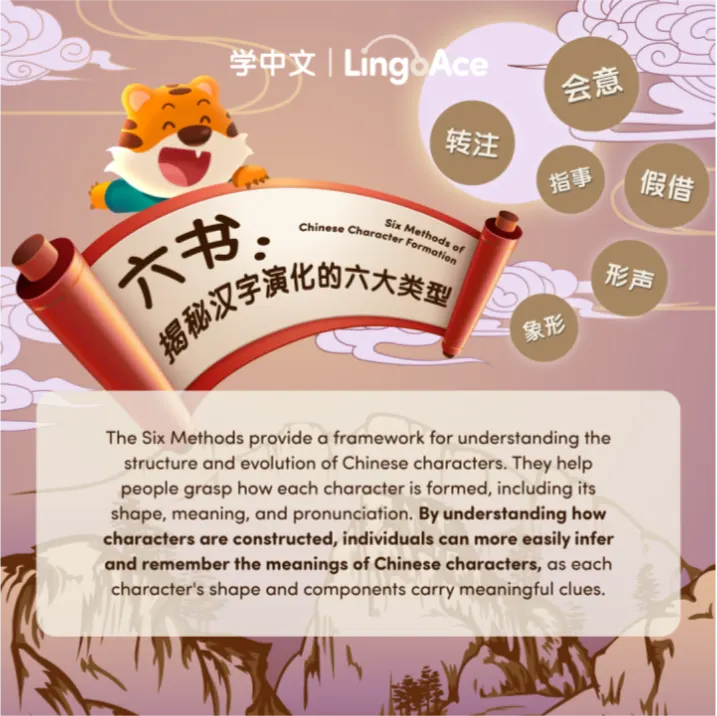
The Six Books, were the basic methods for ancient Chinese literati to learn and apply Chinese characters. It is a method of classifying and summarizing Chinese characters, which helps people better understand and apply Chinese characters by distinguishing the different characteristics of their shapes and meanings.
The methods of the Six Books help people understand and remember Chinese characters, and express their meanings more accurately in writing and reading. By studying the Six Books, one can gain a deeper understanding of the evolution and context of Chinese characters, and appreciate the charm of Chinese characters as an important component of traditional Chinese culture.
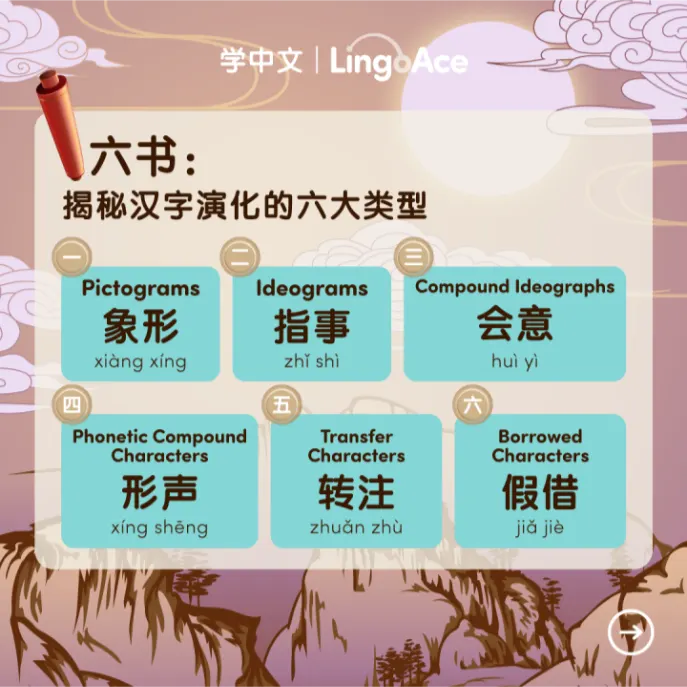
The Six Books refer to the six construction methods of Chinese characters, including pictographic, referential, semantic, phonetic, phonetic, and phonetic.
The hypothetical borrowing in the Six Books refers to using the syllable or shape of a character to represent a new concept or meaning. In borrowing, there is no direct correlation between the original meaning of a character and its new meaning, but borrowing is achieved through similarity in sound or form.

Borrowing is a common way of constructing characters, which expands the scope and meaning of characters by utilizing the similarity of their phonetics or shapes, enriching the expressive power of Chinese characters. Through borrowing, a word can represent multiple different concepts simultaneously, providing more ways of language expression.
When using borrowed words, it is important to ensure the similarity of the borrowed syllables or shapes to avoid ambiguity or confusion. At the same time, it is important to maintain the conciseness and conciseness of the text, so that readers can accurately understand the information conveyed.
The meaning of borrowing is that when a new thing appears, there is already a word in the language that represents it, but there is no word that represents it. It is necessary to borrow a word that sounds the same as its name to represent it, which is called borrowing.
For example, the original meaning of the word "Ling" is similar to that of "command", but because its pronunciation is the same as the word "Ling" of "county magistrate", it can be assumed that the word "Ling" of "command" is borrowed as the word "Ling" of "county magistrate".

In oracle bone inscriptions, the character "Zi" also resembles a nose. The original meaning of the character "Zi" is the nose, but it was later borrowed as the "Zi" character of "oneself". Therefore, a new phonetic character "Bi" was created from the sound of "Zi" and "Di", and the word "Zi" was no longer used as a "nose", so its borrowed meaning was only used.

For example, the word "jiao" originally meant "a horse that is six feet tall is proud". Later, because the pronunciation was the same, the word "jiao" was borrowed and used as the "proud" of "pride". Therefore, now only its borrowed meaning is used. I don't know how many people still know that a horse that is six feet tall is called "jiao"!

The emergence of borrowing method abolished the ideographic nature of Chinese characters, which played a significant role in replacing and compressing the number of Chinese characters with homophones in later generations.
I believe that by studying the borrowed characters in the Six Books, you will be able to use them more accurately and enhance your appreciation and understanding of the beauty of Chinese characters.
Want your child to learn Chinese? LingoAce is one of the best ways to learn Chinese for kids. Each one-on-one lesson is the product of nearly 200 hours of curriculum development, teacher training, and quality control. Our classes are tailored to meet your child’s learning needs.
Experience a redefined Chinese learning experience first-hand and book a free trial class with us today.