
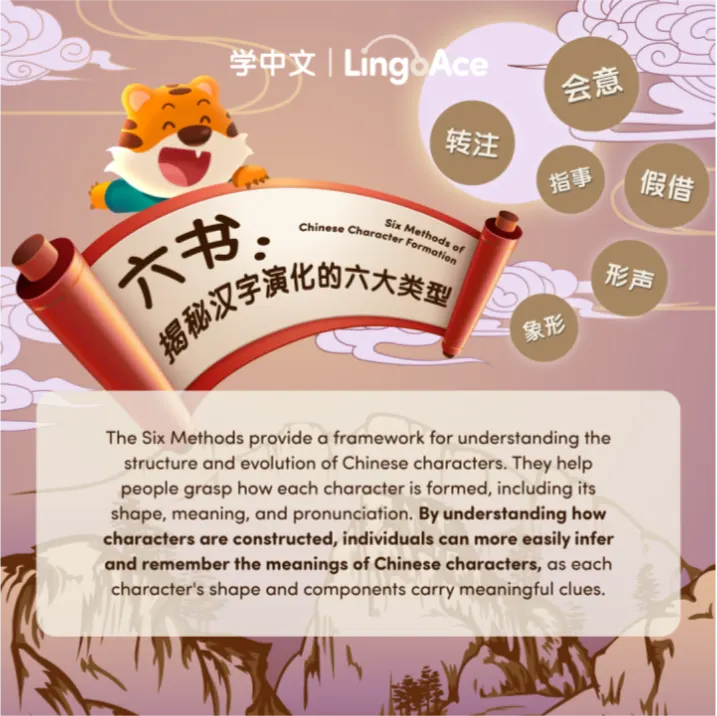
The Six Books, were the basic methods for ancient Chinese literati to learn and apply Chinese characters. It is a method of classifying and summarizing Chinese characters, which helps people better understand and apply Chinese characters by distinguishing the different characteristics of their shapes and meanings.
The methods of the Six Books help people understand and remember Chinese characters, and express their meanings more accurately in writing and reading. By studying the Six Books, one can gain a deeper understanding of the evolution and context of Chinese characters, and appreciate the charm of Chinese characters as an important component of traditional Chinese culture.
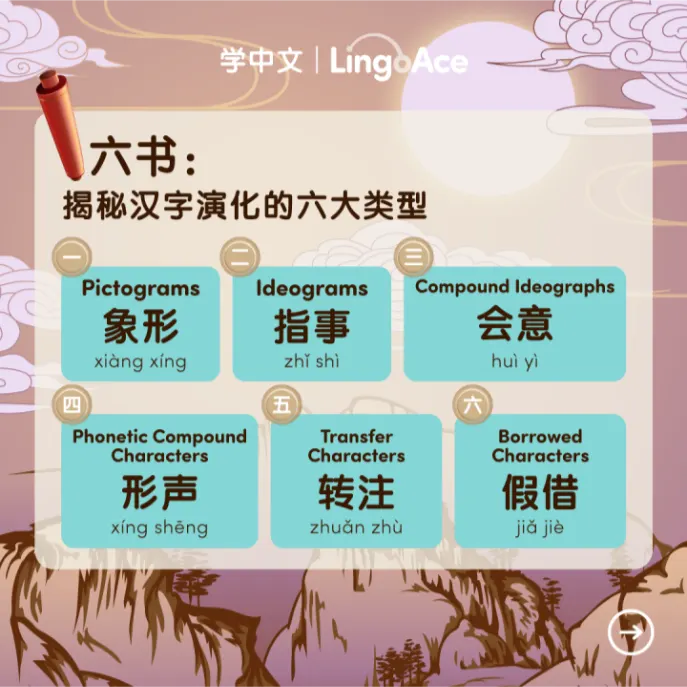
There is a traditional saying in the Six Books about the construction of Chinese character forms. It was first seen in "Zhou Li, Di Guan, Bao Shi", but did not explain the content of the six books. Until the Eastern Han Dynasty, explanations of the Six Books were found in Ban Gu's "Book of Han: Yiwen Zhi", Zheng Zhongzhu's "Zhou Li", and Xu Shen's "Shuowen Jiezi: Xu". After the Qing Dynasty, the names of the six books explained by Xu Shen and the order of Ban Gu were generally adopted, namely pictographic, indicative, understanding, phonetic, transliteration, and borrowing.

The Shuowen Jiezi also introduces a method of creating Chinese characters called Zhishi.
Referral is a way of representing concepts or meanings by directly referring to objects or features of things. It is different from pictograms, no longer expressed through the depiction of shapes, but through the directional nature of symbols.
In Zhishi characters, the part of the character form is called "shi", which represents a specific thing or concept. The part that surrounds something is called "modification", which represents the modification, attribute, or characteristic of something. Through the combination of events and modifications, various personalized characters can be formed to express more abstract and complex concepts.
The way in which characters are created is more symbolic and abstract, and different concepts and meanings can be represented through changes and combinations of shapes. In copywriting, we can use the characteristics of the character "zhishi" to optimize the text with more imaginative and symbolic expressions, making it more artistic and engaging. In Xu Shen's "Shuowen Jiezi", it is said: "You can recognize it by looking at it, and you can see its meaning by observing it. The common characters for referring to things are: Shang, Yi, Jian, Zhu."


Want your child to learn Chinese? LingoAce is one of the best ways to learn Chinese for kids. Each one-on-one lesson is the product of nearly 200 hours of curriculum development, teacher training, and quality control. Our classes are tailored to meet your child’s learning needs.
Experience a redefined Chinese learning experience first-hand and book a free trial class with us today.