Could you name a few of the nine mythical creatures in Chinese history? Today, let's journey through the ages and explore the legendary tales of these ancient Chinese creatures. These mythical beings carry the weight of a rich cultural tradition, leaving a profound imprint on the history of the Chinese nation.
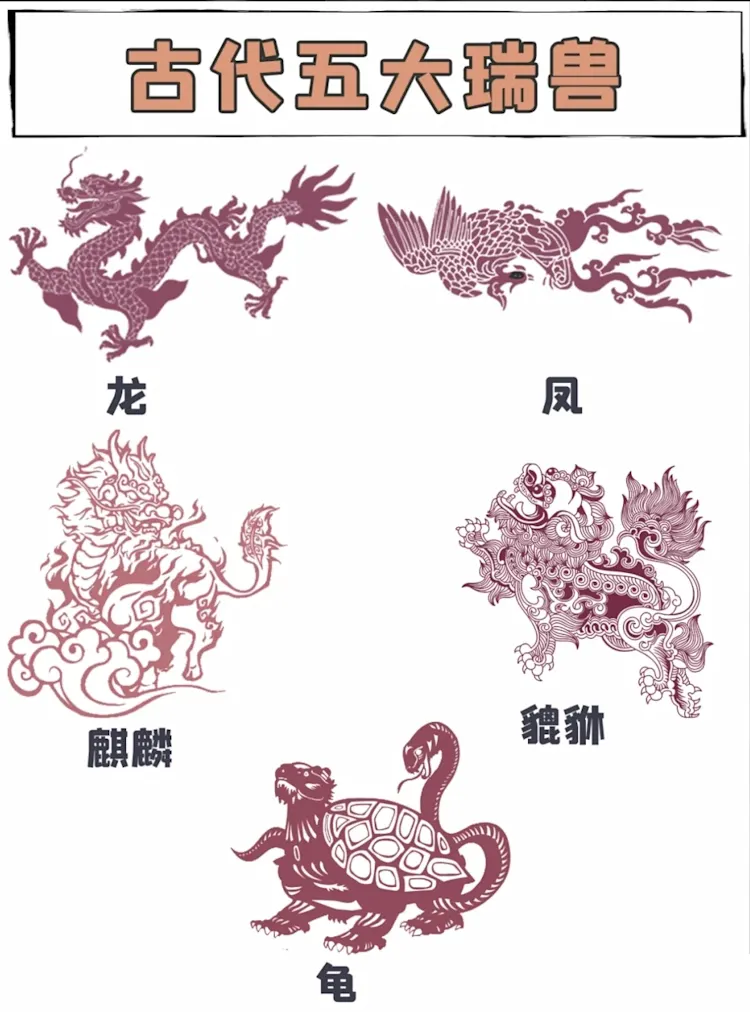
Five Auspicious Beasts
Pixiu (貔貅): Guardian Beast Pixiu, also known as Bixie, is a mythical creature in ancient Chinese mythology. With a unique appearance resembling a dragon's head, horse's body, and unicorn's feet, Pixiu is considered a guardian spirit responsible for patrolling the heavenly court and dispelling evil spirits. Legend has it that Pixiu is one of the nine sons of the Dragon King. It consumes gold, silver, and jewels, and due to violating heavenly laws, it was punished by the Jade Emperor to feed only on wealth from all directions. It is believed that Pixiu can bring good fortune, especially in terms of wealth.
Dragon (龙): Sacred Totem The dragon is one of the most iconic mythical creatures in ancient China, revered as the totem of the Chinese nation. The majestic and unique appearance of the dragon symbolizes imperial power. In ancient times, the dragon was considered a symbol of divinity, passed down through the bloodline of emperors. Today, the dragon remains the most respected mascot in Chinese culture.
Phoenix (凤凰): Bird of Auspice The phoenix is the most famous auspicious bird in ancient China, hailed as the "king of birds." As the prototype of the rooster in the Chinese zodiac, the phoenix symbolizes beauty, auspiciousness, and kindness. According to legend, the phoenix can be reborn from the ashes, symbolizing the immortality of life and the hope for rebirth.
Tortoise (龟): Mysterious Sage The tortoise is considered a mysterious and wise animal in traditional Chinese culture. Its intricate patterns are believed to hide the secrets of heaven and earth. Due to its exceptionally long lifespan, the tortoise is also a symbol of longevity. Placing a tortoise is thought to balance the yin and yang in the home, bringing good luck and longevity.
Kirin (麒麟): Leader of the Five Spirits Kirin, alongside Pixiu, Phoenix, Dragon, and Tortoise, is one of the "Five Spirits" and holds the foremost position among them. Known for its gentle nature, Kirin is considered a benevolent creature with moral virtues. In history, the appearance of Kirin was seen as a miraculous omen by emperors, symbolizing auspiciousness and divine protection. In folklore, Kirin is also believed to have the power to ward off disasters and evils.
Four Sinister Beasts
Taotie (饕餮): Beast of Greed Taotie is a mythical beast in ancient Chinese mythology, often considered the fifth son of the dragon and a gluttonous creature. Depicted with a body of a sheep, human face, eyes under the armpits, tiger teeth, and human hands, Taotie's insatiable appetite led to its eventual demise. In ancient carvings, Taotie is used to symbolize greed and desire, serving as a warning to steer clear of such desires.
Qiongqi (穷奇): Symbol of Loyalty and Betrayal Qiongqi is another mythical beast from ancient Chinese mythology, believed to be the son of Shaohao. Usually portrayed with a tiger-like appearance and wings, Qiongqi has a penchant for consuming humans. Additionally, it possesses the unique ability to understand human language and react accordingly. In ancient times, the image of Qiongqi was used as a metaphor for those who betray trust, serving as a reminder to maintain sincerity and loyalty.
Taowu (梼杌): Unrelenting Ferocity Taowu is a creature found in ancient Chinese mythology, considered the son of the Northern Emperor Zhuanxu. Often depicted as a large tiger with a human face and an elongated tail, Taowu's nature is extremely ferocious, preferring solitude and resisting any form of constraint.
Hundun (浑沌): Source of Chaos Hundun is a mythical creature in ancient Chinese mythology, believed to be a subordinate of the Yellow Emperor, the central heavenly emperor. Described as a creature without a face and with four clawed feet, Hundun is depicted in black. Hundun's character is mysterious and unpredictable, sometimes bringing disasters and misfortune.
This concludes the legendary tales of the five auspicious beasts and four sinister beasts in ancient Chinese history. These mythical creatures not only symbolize Chinese culture but also embody people's aspirations for auspiciousness, power, wisdom, and harmony. Additionally, their images are frequently used as decorations on buildings, objects, and artworks to convey good fortune and ward off evil. We hope this article provides readers with a deeper understanding of ancient Chinese mythology, and stay tuned for more exciting cultural explorations!
Would you like to make learning Chinese easy and enjoyable for your child? Consider trying LingoAce, dedicated to providing immersive and entertaining Chinese learning experiences for children aged 3-15. Through engaging storylines and lively teaching methods, we aim to help children master Chinese effortlessly.