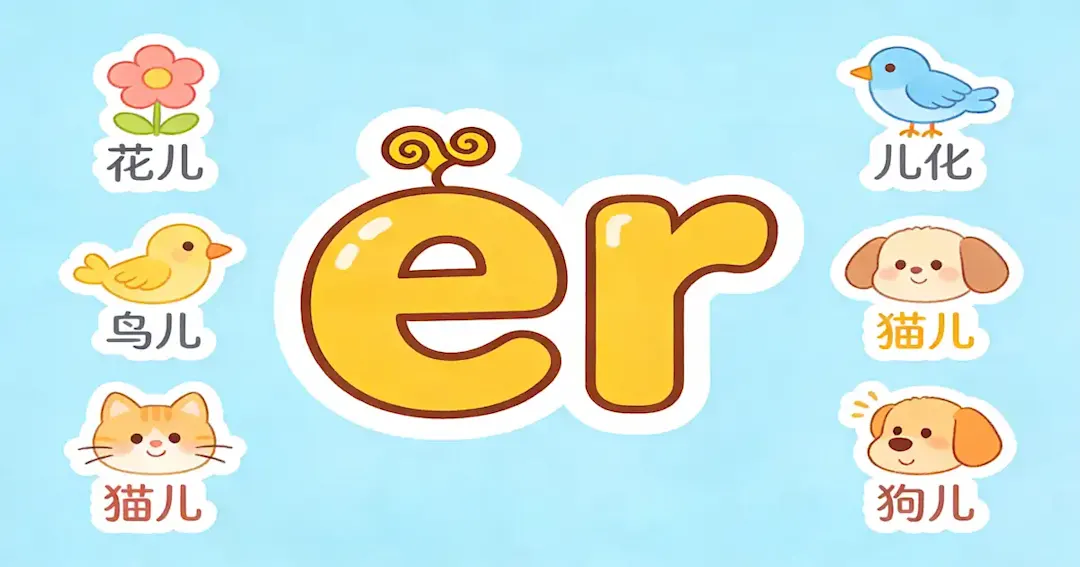
Your child says zhèr / nàr / yìdiǎnr and suddenly everything ends in “-r.” That’s erhua (儿化).Confused by erhua? You’re not alone. In this guide, you’ll learn what erhua is, why it exists, which words are “safe everywhere,” and how to practice it at home—without sounding overly Beijing or overcorrecting your kid.
What erhua is and what it isn’t
Erhua is often explained as “adding an -r sound,” but the more accurate everyday idea is:the end of a syllable becomes “r-colored,” like the syllable is tinted with an “-r” quality. Linguists call this rhotacization or r-suffixation in Mandarin.
Two quick clarifications that save a lot of confusion:
Erhua is not “bad Mandarin.”
It shows up in Standard Chinese to some extent (for example, 哪儿 “where,” 一点儿 “a little,” 好玩儿 “fun”).
Erhua is not only “Beijing accent.”
Beijing speech uses it heavily, yes, but erhua exists across many Mandarin varieties. Some places use it more, some less.

When to use erhua and when not to
This is the part parents actually need. Not the history, not the phonetic symbols—just: when do we use it?Think of erhua in three buckets:
Bucket 1: “Safe everywhere” erhua (learn early) These are so common that many learners treat them as standard everyday Mandarin. If your child learns these, nobody will blink:
哪儿 (nǎr) where
这儿 / 那儿 (zhèr / nàr) here / there
一点儿 (yìdiǎnr) a little
一会儿 (yíhuìr) in a moment / for a while
These forms are explicitly noted as appearing in standardized/official-style recordings to some extent, which is basically the green light for families.
Bucket 2: “Optional style” erhua These are more “Northern vibe.” Your child should recognize them, but doesn’t need to force them in speech early. This is where Beijing speech “amps it up,” as learners often notice.
Bucket 3: “Avoid for now” erhua This is the “adding -r to random words” phase. It’s normal—kids copy patterns. But if it becomes a habit, it can sound like a skit instead of natural Mandarin.
If you’d like someone to help you set a consistent (how much erhua to use, which words must have it, which ones to ignore for now), you can book a LingoAce trial class and ask the teacher something very specific: “Can you help my child align the safe-list erhua words—哪儿/这儿/那儿/一会儿/一点儿—and recommend a consistent model for us to follow?”

1) Erhua can change the meaning: the same character becomes a different word
These are the kinds of pairs that cause confusion if kids assume “-r is optional.”
眼 (eye) → 眼儿 (a small hole / opening)
头 (head) → 头儿 (boss / leader)
信 (letter) → 信儿 (news / word / message)
天 (day / sky) → 天儿 (weather, colloquial)
托 (to hold/support) → 托儿 (a “plant” / shill, negative)
2) Erhua can change word class: adjective/verb → noun
This is a sneaky one, and it’s why kids sometimes “get the gist” but still misunderstand.
尖 can mean “sharp” (adj.), but
尖儿 often points to “the tip” (noun).
错 can be “wrong” (result), but
错儿 can mean “fault/mistake” (noun).
画 can be “to draw” (verb), but
画儿 is “a drawing/painting” (noun).
盖 can be “to cover” (verb), but
盖儿 is “a lid” (noun).
乐 relates to “happy,” but
乐儿 can lean toward “something amusing / a laugh” in colloquial phrasing.
3) Erhua can express attitude: cute, casual… or sarcastic
This is the most “real life” category—and kids copy it fast.
a) “Small / light / casual” flavor Common everyday items and actions often appear with erhua in speech, like: 小孩儿, 牙签儿, 皮筋儿, 一会儿, 一下儿, 一块儿, 一点儿, 玩玩儿, 使劲儿, 打盹儿…
b) Affection / cuteness (especially with kids or cute things) 花儿, 鸟儿, 画儿, 好玩儿; also 宝贝儿, 小孩儿, 女孩儿, 男孩儿. And there’s even a nickname pattern: one character of a name + 儿 (older/colloquial style).
c) Contempt / mocking tone Words like 小偷儿 or phrases implying ridicule can carry that tone. You may not teach kids to say them, but it helps if they can recognize them.

A cheat-sheet table you can actually use
Here’s a starter table designed for parents: base meaning, common erhua form, and when it’s safe.
“Base idea” | Common form with erhua | What it’s used for |
where | 哪儿 (nǎr) | daily questions |
here | 这儿 (zhèr) | daily directions |
there | 那儿 (nàr) | daily directions |
a little | 一点儿 (yìdiǎnr) | polite softening |
in a moment | 一会儿 (yíhuìr) | schedules / routines |
fun (colloquial) | 好玩儿 (hǎowánr) | kid talk |
Common erhua words kids pick up in real life
This is the part that keeps kids engaged, because it sounds like what they hear.
Everyday mini-scenarios
Try these phrases as-is (don’t over-explain, just use them):
“你在哪儿?” (nǐ zài nǎr?) — Where are you?
“来这儿。” (lái zhèr.) — Come here.
“等一会儿。” (děng yíhuìr.) — Wait a moment.
“就一点儿。” (jiù yìdiǎnr.) — Just a little.
If your child is already using these, great. You don’t need to “correct them back” to non-erhua forms. These are common, widely recognized, and show up even in more standardized speech.
The “meaning shift” question
Sometimes, yes. Sometimes it’s just a habitual form. This is where learners get curious—and where kids love the idea that a tiny sound can change “vibe.”In many Mandarin varieties, erhua is associated with diminutive or word-formation functions, though usage varies.
FAQ
What is erhua in Mandarin Chinese?
Erhua (儿化) is a process where a syllable gains an “r-colored” ending, often linked to an -r suffix and rhotacization in Mandarin.
Is erhua required in Standard Mandarin in 2026?
Some erhua forms appear in standardized speech (like 哪儿, 一点儿), but heavy erhua use is more associated with certain regional varieties (especially Northern/Beijing speech).
When should beginners use erhua?
Start with “safe everywhere” words (哪儿/这儿/那儿/一点儿/一会儿). Treat most other erhua as comprehension-first until your child’s main input model is stable.
Why do Beijingers use erhua so much?
Beijing Mandarin is known for more extensive erhua than the standardized language, and speakers often have strong intuitions about where it sounds natural.
Should my child practice both erhua and non-erhua pronunciations?
If your child hears multiple accents (very common in North America), it’s useful to recognize both. Production can follow one consistent model to avoid confusion—many learners recommend comprehension first, and selective speaking practice.
Conclusion
If you’re a parent helping a child learn Mandarin, erhua doesn’t have to be a big decision. In 2026, the most practical approach is:
Learn the safe everywhere erhua words early (哪儿/这儿/那儿/一点儿/一会儿)
Understand the “more Northern” erhua forms without forcing them
Stop the random “-r on everything” habit gently, not dramatically
Practice with tiny routines and listening games, not long drills
And if you’d like a teacher to quickly sanity-check your child’s erhua and set a consistent pronunciation model, book a LingoAce trial class and ask for feedback specifically on the safe list—those five words alone make daily Mandarin sound much more natural.