Parents often ask us: In what order do you learn Mandarin?
Unlike English, where kids move easily from sounds to letters, Mandarin usually introduces tones, characters, and pinyin—all at once. Without a roadmap, families – especially of children with little to no previous exposure to Mandarin Chinese – can feel overwhelmed. Why is this?
When children first develop early language skills in English, the focus is heavily on phonics—connecting letters to sounds and blending them into words. English has a relatively simple alphabetic system with 26 letters, so once children grasp phonemic awareness (the ability to hear, identify, and manipulate sounds), they can begin decoding written text. For example, a child learns that the letter “c” can sound like /k/ in “cat” or /s/ in “city.”
Teaching English as a second language often mirrors this approach, starting with the alphabet, then phonics, followed by sight words and simple sentences. The foundation lies in building comfort with sound-letter correspondence and gradually expanding vocabulary through everyday contexts, such as songs, storybooks, and conversations.

By contrast, early language development in Chinese emphasizes tones and character recognition rather than phonics. Mandarin is tonal, meaning a single syllable (like ma) can have four different meanings depending on tone. Children first build listening and speaking skills by distinguishing tones and practicing syllables, often through songs, rhymes, and repetition. Unlike English, where letters make words, Chinese uses characters (汉字 hànzì), each carrying meaning and usually tied to imagery.
Teaching Chinese as a second language to English speakers is generally believed to be most effective to start with pinyin (the Romanized system that maps sounds and tones). This way, you build pronunciation confidence while slowly introducing characters for recognition. However, this only works if the student can read fairly fluently in English. For younger children, it may be more effective to teach Chinese as they would learn in China, which involves introducing pinyin later and focusing on character recognition first.
Let’s break down how this would work step by step. If you're looking for a structured and effective way to learn Mandarin, try a free trial class with LingoAce. We're confident you'll see a noticeable difference in your child's Mandarin after just one trial session!
Step 1: Listening Comes First
Just like babies listen before speaking, Mandarin begins with listening. Exposure to sounds and tones is the foundation.
Why it matters: Mandarin has four tones plus a neutral tone. Kids need lots of input to hear the difference between 妈 (mā, mother), 马 (mǎ, horse), and 骂 (mà, scold).
How to do it: Play Mandarin nursery songs, listen to audiobooks, and watch simple cartoons in Chinese.
Step 2: Speaking and Building Confidence
Once kids can recognize sounds, encourage them to speak—even with mistakes.
Start with greetings and polite phrases: 你好 (nǐ hǎo, hello), 谢谢 (xièxie, thank you), 对不起 (duìbuqǐ, sorry).
Add counting and colors: 一二三四五 (yī èr sān sì wǔ, 1–5), 红 (hóng, red), 蓝 (lán, blue), 绿 (lǜ, green).
Use games: Turn learning into roleplay—pretend to be at a restaurant ordering 饺子 (jiǎozi, dumplings).
Step 3: Introduce Pinyin for Pronunciation
Pinyin (拼音 pīnyīn) is the Romanized system for Mandarin sounds. Kids who learn pinyin can pronounce new words correctly and look them up easily in the dictionary.
For example, the word 学校 (xué xiào, school) can be hard to read at first, but seeing “xué xiào” makes it easier to try. One way to learn pinyin is to use flashcards or apps.
Step 4: Recognize Characters Before Writing
One common mistake is rushing into handwriting. Instead, start with character recognition. The reason for this is because Chinese characters are visual. To build literary skills, it is better for kids to focus on recognizing common ones. Start with simple, meaningful words: 妈 (mā, mom), 火 (huǒ, fire), 水 (shuǐ, water). You can also use stickers, picture cards, or bilingual books to pair characters with images.
Step 5: Writing Characters Step by Step
After recognition comes writing but keep it slow and playful.
Introduce stroke order: For example, writing 大 (dà, big) starts with the horizontal line.
Tracing practice: Apps and worksheets help kids build muscle memory.
Focus on quality, not quantity: Better to write 5 characters well than rush through 50.
Step 6: Build Vocabulary in Themes
Rather than memorizing random words, group vocabulary into themes that your child likes and cares about. Themed learning helps children connect words to real-life experiences.
Discover a world of Mandarin with a free LingoAce class! Your child will enjoy a wonderful learning experience, immersed in a wide range of engaging themes.
Family words: 妈妈 (māma, mom), 爸爸 (bàba, dad), 哥哥 (gēge, older brother).
School words: 老师 (lǎoshī, teacher), 书 (shū, book), 铅笔 (qiānbǐ, pencil).
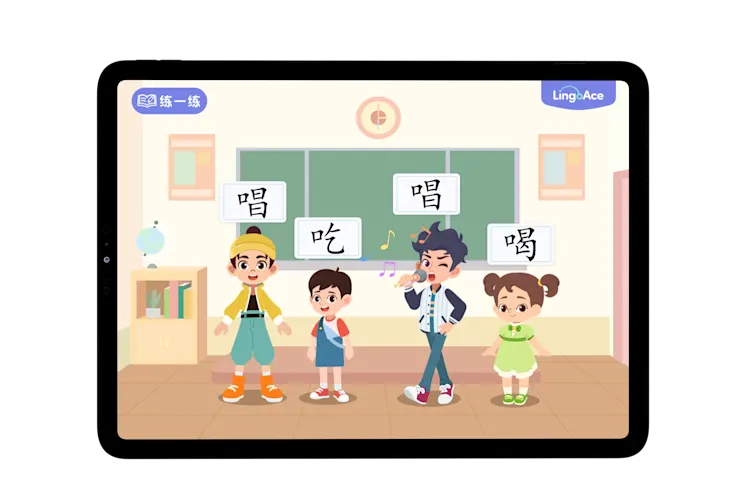
Food words: 苹果 (píngguǒ, apple), 牛奶 (niúnǎi, milk), 面条 (miàntiáo, noodles).
Step 7: Reading Simple Sentences
Once your child is familiar with characters and pinyin, introduce short sentences, such as 我爱你 (wǒ ài nǐ, I love you) or 这是我的书 (zhè shì wǒ de shū, this is my book).
This can be reinforced at home with storybooks that repeat common words. If you can, read aloud together so kids hear the rhythm of Mandarin, or get a book set with a Reading Wand or audio.
Step 8: Expand to Writing Short Phrases
When kids feel confident with Chinese characters, they can begin writing. Start small with simple notes like 你好 (nǐ hǎo) or 我爱妈妈 (wǒ ài māma).
This is a good time to encourage creativity. For example, let them label a drawing in Chinese. Also, don’t correct too harshly: Focus on effort and progress.
Step 9: Build Grammar Naturally
Unlike English, Mandarin has no verb conjugations, but word order matters. Kids learn grammar best through use, not drills. Repetition is key. Use daily phrases to reinforce these sentence structures.
For example, a common Chinese sentence structure is: Subject + Verb + Object → 我喜欢苹果 (wǒ xǐhuān píngguǒ, I like apples).
To reinforce this, practice this structure in context: “I want juice” = 我要果汁 (wǒ yào guǒzhī).
Step 10: Keep Growing Through Culture and Fun
Language learning is never “done.” To keep kids motivated, connect Mandarin to culture. Watch movies or TV shows in Chinese. Celebrate Chinese festivals if you can find local events where you live. Cook and learn food words together. This helps Mandarin stay alive in everyday family life. Here’s a quick roadmap you can follow with your child:
Listening: Songs, audiobooks, cartoons.
Speaking: Greetings, numbers, colors.
Pinyin: Learn basic pronunciation.
Character Recognition: Match symbols with meanings.
Writing: Introduce stroke order and tracing.
Vocabulary Themes: Family, school, food.
Reading: Simple sentences and stories.
Writing Short Phrases: Notes and labels.
Grammar: Practice word order naturally.
Cultural Integration: Holidays, traditions, and daily life.
Looking for an online Chinese class for your kids to learn Mandarin and Chinese culture? LingoAce is one of the best ways for kids to learn Chinese online.
Each one-on-one lesson is the product of nearly 200 hours of curriculum development, teacher training, and quality control. LingoAce classes are tailored to meet your child's learning needs.
Experience a redefined Chinese learning experience and book a free trial class with us today.