Searching “yes in Chinese” can be confusing because Mandarin doesn’t rely on one universal “yes.” People choose a reply that fits the situation: “correct,” “OK,” “of course,” a quick “mm-hmm,” or an echo of the verb in the question.
Two quick mindset shifts help:
You’re not hunting for the Chinese word for yes. You’re picking the most natural response.
You don’t need 30 phrases today. Learn 5, use them in real moments, and your brain will start choosing the right one automatically.
Use the table first, then learn 5 phrases this week. By the end, “yes in Chinese” will feel less like a translation problem and more like a choice you make on purpose.
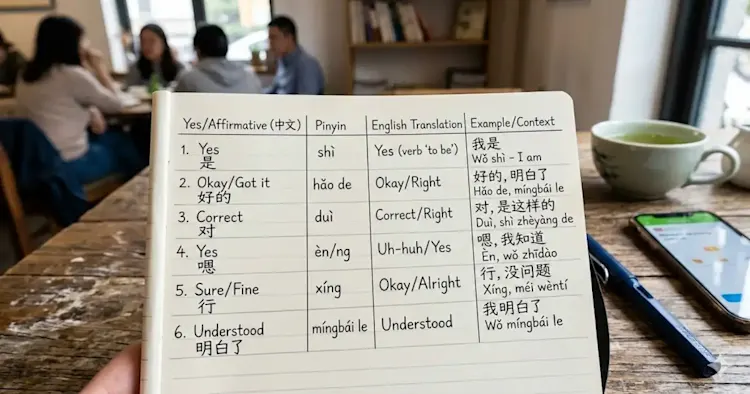
Quick Rule (20 seconds)
是/不是 question → 是 (shì) / 是的 (shì de)
Correctness → 对 (duì) / 没错 (méi cuò)
“OK / sure” → 好 (hǎo) / 好的 (hǎo de) / 可以 (kě yǐ) / 行 (xíng)
Verb-not-verb question → repeat the verb: 去不去?→ 去。
Pronunciation tip (so you don’t get stuck)
Pinyin is a pronunciation guide. Aim for “close + confident,” not perfect.
For tones: treat them like “melody.” Kids often copy tones best in short, repeated phrases.
Keep it playful: say it once, have them echo, then use it immediately in a tiny question.
Motivation cue #1: Kids love “one-word wins.” A fast reply builds confidence before grammar does.
Which “Yes” Should I Use? (Screenshot Table for ‘Yes in Chinese’)
Situation | Best options | Pinyin | Meaning | Example reply |
Correct / that’s right | 对 / 没错 | duì / méi cuò | correct | “Right?” → 对。 |
Accept a request | 好 / 可以 / 行 | hǎo / kě yǐ / xíng | OK / can | “Can you…?” → 可以。 |
Formal confirmation | 是 / 是的 | shì / shì de | yes (formal) | “Is it yours?” → 是的。 |
Friendly “sure!” | 好啊 / 可以啊 | hǎo a / kě yǐ a | sure | “Go?” → 好啊! |
Casual “yeah” | 嗯 / 嗯嗯 | èn / èn èn | mm-hmm | “Ready?” → 嗯。 |
Echo response | 去 / 要 / 吃 | qù / yào / chī | yes (by verb) | “Eat?” → 吃。 |
30 Ways to Say Yes in Chinese (Grouped by Real Life)
Bucket A — Beginner-safe “OK / sure”
好 (hǎo) — OK. Use: casual agreement. Ex: 现在走?→ 好。
好的 (hǎo de) — OK (polite). Use: parent/teacher. Ex: 请等一下。→ 好的。
可以 (kě yǐ) — can/that works. Use: permission. Ex: 我可以去吗?→ 可以。
行 (xíng) — sure/works. Use: spoken Mandarin. Ex: 明天见,行吗?→ 行。
没问题 (méi wèn tí) — no problem. Use: yes + reassurance. Ex: 你能帮我吗?→ 没问题。
当然 (dāng rán) — of course. Use: easy yes. Ex: 你想去吗?→ 当然。
Bucket B — “Correct / you’re right”
对 (duì) — right. Use: confirm facts. Ex: 是这样吗?→ 对。
对的 (duì de) — that’s correct. Use: clearer/polite. Ex: 你住在加州?→ 对的。
没错 (méi cuò) — exactly. Use: strong confirmation. Ex: 你是老师?→ 没错。
是这样 (shì zhè yàng) — that’s how it is. Use: confirm a summary. Ex: 先你们走?→ 是这样。
Bucket C — “Yes” for 是/不是 questions
是 (shì) — yes. Use: direct confirmation. Ex: 你是妈妈吗?→ 是。
是的 (shì de) — yes (more formal). Use: polite confirmation. Ex: 这是你的名字吗?→ 是的。
对,是的 (duì, shì de) — correct, yes. Use: double-confirm. Ex: 你是新同学?→ 对,是的。
Bucket D — Echo responses (native-feeling shortcut)
去 (qù) — “go.” Use: 去不去?→ 去。
要 (yào) — “want.” Use: 要不要?→ 要。
吃 (chī) — “eat.” Use: 吃不吃?→ 吃。
想 (xiǎng) — “feel like.” Use: 想不想去?→ 想。
会 (huì) — “can / will.” Use: 会不会游泳?→ 会。
Bucket E — Casual “yeah / mm-hmm”
嗯 (èn) — mm-hmm. Use: casual yes. Ex: 听懂了吗?→ 嗯。
嗯嗯 (èn èn) — yep. Use: warmer/stronger. Ex: 现在走?→ 嗯嗯。
对啊 (duì a) — yeah, right. Use: friendly agree. Ex: 很好吃对吧?→ 对啊!
好呀 (hǎo ya) — sure! Use: light yes. Ex: 周末去公园?→ 好呀!
Bucket F — Friendly “sure / sounds great”
好啊 (hǎo a) — sure! Use: enthusiastic. Ex: 一起去吧?→ 好啊!
可以啊 (kě yǐ a) — sure, works. Use: friendly. Ex: 先吃饭再写作业?→ 可以啊。
行啊 (xíng a) — alright then. Use: relaxed yes. Ex: 你来我家?→ 行啊。
当然可以 (dāng rán kě yǐ) — of course you can. Use: warm permission. Ex: 我再玩五分钟?→ 当然可以。
Bucket G — Polite / professional “yes”
可以的 (kě yǐ de) — yes, doable. Use: cooperative tone. Ex: 这周五前能做完?→ 可以的。
好的,谢谢 (hǎo de, xiè xie) — OK, thanks. Use: service/teacher. Ex: 请在这里签名。→ 好的,谢谢。
明白了 (míng bái le) — got it. Use: confirm instructions. Ex: 记得带作业。→ 明白了。
Bucket H — Strong yes (commitment)
没问题,交给我 (méi wèn tí, jiāo gěi wǒ) — leave it to me. Use: committed yes. Ex: 你能负责吗?→ 没问题,交给我。
Texting & quick replies (what people actually send)
If you’re replying in a chat, you’ll often see short, low-effort yes in Chinese choices:
嗯 / 嗯嗯 (èn / èn èn): quick “yeah”
行 (xíng): “sure/works”
好 (hǎo): “OK”
可以 (kě yǐ): “can”
A simple rule: if the message is asking for action (“Can you…?”), use 好/行/可以. If it’s confirming a fact (“Right?”), use 对/没错.Motivation cue #2: Once learners can reply quickly in text, speaking feels less scary—because the response pattern is already familiar.
Parent Cheat Sheet: Teach These 5 First (Your fastest ‘Yes in Chinese’ starter set)
Start here: 好 / 可以 / 对 / 嗯 / 没问题
2-minute practice: ask one tiny yes/no question at breakfast, one at bedtime, and let your child answer with one word. Keep it light.
Motivation cue #3: The goal is “automatic.” When the reply comes out without thinking, real conversation starts.
Common mistakes (quick fix)
Overusing 是的 → switch to 好/可以/行 (OK) or 对 (correct) depending on the question.
Using 对 when you mean “OK” → remember 对 = correct, not “sure.”
Skipping echo responses → try repeating the verb for 去不去、要不要、吃不吃 questions.
Mini practice dialogues (say these out loud once)
Parent: 现在洗手,好吗?(xiàn zài xǐ shǒu, hǎo ma?) → Kid: 好。(hǎo.)
Teacher: 你明白了吗?(nǐ míng bái le ma?) → Student: 明白了。(míng bái le.)
Friend: 你去不去?(nǐ qù bù qù?) → You: 去。(qù.)
Parent: 你要不要喝水?(nǐ yào bù yào hē shuǐ?) → Kid: 要。(yào.)
If your child knows these words but freezes in real talk, guided speaking practice helps. A short LingoAce trial lesson is one option families use to practice high-frequency replies (like “yes”) with a teacher supporting pronunciation and real dialogue.

FAQ (Yes in Chinese)
What is “yes” in Chinese? It depends: 对 (correct), 好/可以/行 (OK), 是/是的 (is/isn’t), or echo the verb.
Is 是的 (shì de) formal? Often yes. It’s correct—just not the only choice, especially in casual speech.
对 vs 是 vs 好 — what’s the difference?
对 = “correct / that’s right”
是 = “yes” for 是/不是 questions
好 = “OK / sounds good” (agreeing to do something)
How do I say “yes” politely to a teacher? Try 好的, 可以的, or 好的,谢谢.
Why echo the verb? Because it answers the question directly (and avoids overthinking a separate “yes” word).
Conclusion
Think “match the moment,” not “translate yes.” That’s the core trick behind sounding natural when you say yes in Chinese. Pick 5 phrases, use them all week, then add echo responses next.
Motivation cue #4: When your child can answer quickly, they start speaking more—not because they learned more words, but because they feel safe responding.
If you want steady progress beyond phrase lists, a simple weekly speaking routine makes it stick. LingoAce offers trial lessons that help kids turn short replies into real conversation—so “yes in Chinese” becomes automatic in daily life.