
When you search "you're welcome in Chinese," you're mostly looking for a safe and appropriate response—something you can say naturally and without awkwardness when someone says "thank you." However, in Chinese, "you're welcome" isn't the only answer. The expression changes depending on the context and the relationship, which is why many learners often use "you're welcome" but sometimes feel it doesn't sound authentic.This article will explain the shortest path: the safest default response, how to choose between "you're welcome" and "you're welcome," and more colloquial alternatives.
What does “you re welcome in chinese” mean, really?
When English speakers say “You’re welcome,” we’re often acknowledging the favor: Yes, I did that for you, and it’s fine. Mandarin tends to soften the moment differently. Many common replies are closer to:
“Don’t be so polite.”
“No need to thank me.”
“It’s nothing.”
“Of course (I should help).”
That’s why “one perfect translation” doesn’t quite exist. The phrase you choose depends on what happened and who you’re talking to—teacher, classmate, an adult, a cashier, or family.
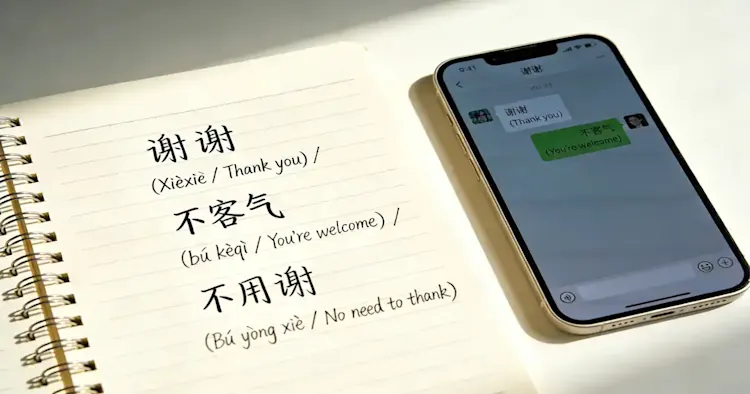
“you re welcome in chinese”—the safest reply to teach first
不客气 (bú kè qì)
It’s widely understood, polite, and works in most everyday situations after 谢谢 (xiè xie). That’s why you see it everywhere.
A simple rule remember:
Someone says “谢谢 / xie xie” → you can say 不客气
If you helped with something small (like handing a pencil) → you can also say a shorter “no big deal” option (we’ll cover those)
“you re welcome in chinese” phrases kids should learn early
Think of these as your family’s starter pack. You don’t need all of them in one week. Pick 2–3 and rotate.
1) 不客气 (bú kè qì) — polite default
Use it when: most situations; safe with adults, teachers, strangers. Kid version: short, clear, easy to memorize.
2) 不用谢 (bú yòng xiè) — “no need to thank me”
Use it when: someone thanks you directly; slightly more “this is no trouble.” Many learners ask if it’s more “correct.” In practice, it’s simply another common reply, and it’s especially clear when the other person literally said “thank you.”
3) 没事 (méi shì) — “no worries / it’s fine”
Use it when: the “thank you” is attached to a small inconvenience or a tiny favor (“sorry and thanks” moments). note: it can feel casual, so it’s best for familiar situations.
4) 应该的 (yīng gāi de) — “of course / I should”
Use it when: you want to sound warm and supportive, especially in family settings.
5) 别客气 (bié kè qì) — more like “don’t be shy / feel free”
This one confuses families because it looks similar to 不客气. In many contexts, 别客气 is closer to “make yourself at home,” though it can overlap depending on the moment. When in doubt, keep it as an “extra” rather than a beginner must-have.
Bu ke qi vs Bu yong xie: the “you re welcome in chinese” difference actually need
If you’ve ever googled you re welcome in chinese, this is probably the part you wanted.
Here’s the simple version you can tell your child:
不客气 = “Don’t be so polite.” (Polite, broad, safe.)
不用谢 = “No need to thank me.” (Directly answers the “thank you.”)
In everyday life, many people use them interchangeably, and nobody is going to scold a child for choosing one over the other.
So what’s the actual “difference” that matters?
If your child tends to freeze, 不客气 is a reliable autopilot line.
If your child is practicing a clear “thank you → response” pattern, 不用谢 feels like a neat pair with 谢谢.
A small detail: you may see 不谢 (bú xiè) in casual speech or fast speech, but “不用谢” is the more standard written form.
“you re welcome in chinese” alternatives that sound less textbook
Once your child has a default reply, the next step is helping them sound natural in kid life—school hallways, sports practice, playdates.Here are a few upgrades that are easy and not cringey:
“No worries” style
没事 (méi shì) — “It’s fine.”
没关系 (méi guān xì) — “No problem.” (Often used for “it doesn’t matter,” overlaps with apologies.)
“It’s nothing” style
小事 (xiǎo shì) — “Small thing.” (Casual, friendly.)
“Sure / of course” style
当然 (dāng rán) — “Of course.” (Tone depends on delivery; kids should say it warmly.)
应该的 (yīng gāi de) — “I should.”
Parent reality check: kids don’t need a huge list. Two “safe” lines plus one casual upgrade is plenty at first.
Real-life situations: “you re welcome in chinese” at school, playdates, and with grandparents
This is where kids usually get stuck: the phrase isn’t hard, the moment is.
Situation 1: Teacher thanks your child
Teacher: 谢谢你帮忙。 Child (safe): 不客气。 Child (warm): 应该的。
Situation 2: Friend thanks your child for sharing
Friend: 谢谢! Child (casual): 没事。 / 小事。 Child (safe): 不客气。
Situation 3: Grandparent thanks your child (big heart moment)
Grandparent: 谢谢你。 Child (warm): 应该的。 / 不用谢。
Situation 4: Small “sorry + thanks” moment
Someone bumps into your child, then says “sorry, thanks” as they pass. This is where 没事 shines because it covers “it’s fine” more than “you’re welcome.”
If you want a one-line coaching tip for your child:
If it was a favor → 不客气 / 不用谢
If it was about something being okay → 没事 / 没关系
That’s it. That’s the whole map.
Common mistakes: “you re welcome in chinese” errors that make kids freeze
Mistake 1: Treating it like a single translation
Kids get nervous when they think there’s only one “correct” answer. Give them a default + two backups.
Mistake 2: Using the same phrase for every situation
If a friend thanks them for something tiny, “不客气” can sound a little formal. It’s not wrong—it just feels “school-ish.” That’s why we add 没事 or 小事.
Mistake 3: Overthinking pronunciation in the moment
Your child doesn’t need perfect tones to be polite. A calm delivery beats perfect pronunciation. The goal is confidence first, polish later.
Mistake 4: Missing the social purpose
These phrases aren’t a test. They’re social glue. If your child learns that early, they’ll keep using Chinese instead of avoiding it.
That’s one of the big “parent wins” with language learning: when kids feel socially competent, they speak more. When they feel awkward, they go quiet.
A 10-minute practice plan for saying “you’re welcome” in Chinese
Here’s a routine families actually stick with.
Minute 1–2: Pick today’s “default”
Choose one:
不客气 (most days)
不用谢 (if you’re reinforcing “thank you → response”)
Minute 3–6: Do 6 fast roleplays
You say “谢谢,” your child replies. Keep it light and quick. If they hesitate, you model it once, then they copy.
Minute 7–9: Add one “real life” situation
Pick something that happened today:
“Thank you for helping with homework.”
“Thank you for sharing.”
“Thank you for holding the door.”
Let them choose the reply. If they pick a formal line for a casual moment, don’t correct harshly. Just say: “That’s polite. Want a more casual one too?”
Minute 10: One tiny “upgrade”
Add 没事 or 小事 as the casual backup.
If your child is in a phase where they want to speak Chinese but you’re not sure how to keep momentum, this is a good moment to consider guided speaking practice—especially if you don’t speak Mandarin yourself. A teacher can keep the conversation moving, correct gently, and help your child build these “social scripts” across dozens of situations.
If you want your child to practice real conversational Chinese (not just single words), you can book a LingoAce trial class and ask the teacher to focus on everyday manners like “thank you / you’re welcome,” greetings, and school situations.

can your child pick the right “you’re welcome” reply in Chinese?
Try these out loud. Let your child answer first, then show the “good” options.
A friend says “谢谢” after borrowing a marker. Good replies: 没事 / 小事 / 不客气
A teacher thanks your child for helping clean up. Good replies: 不客气 / 不用谢
Grandma thanks your child for bringing water. Good replies: 不用谢 / 应该的 / 不客气
Someone says “sorry—thanks” while squeezing past. Good replies: 没事 / 没关系
Your child helped a younger kid. The parent says “谢谢你.” Good replies: 不客气 / 不用谢 (both work; choose what feels easiest)
Your child feels shy and needs a one-word autopilot. Best reply: 不客气
If your child can do 4 out of 6 without freezing, you’re in a great place.
FAQ: “you re welcome in chinese” questions parents keep asking
1) Do kids always need to respond after someone says 谢谢?
Not always. A smile or nod can be fine in a quick passing moment. But for kids learning, practicing a short reply builds confidence and helps Chinese feel usable.
2) What if someone says 不客气 first?
Sometimes people say it quickly as part of the flow. Your child doesn’t need to “reply back.” A smile, “嗯,” or simply moving on is normal.
3) Is 不谢 okay?
You’ll hear it in casual speech or as a shortened form, but “不用谢” is the more standard written form. For kids, teaching “不用谢” is usually the cleaner path.
4) Is there one “most polite” option?
不客气 is very safe and polite in most situations. Some learners describe it as the “most polite” among common casual options, but context and tone matter more than a ranking.
5) Simplified vs traditional—does it matter for this topic?
Not for speaking. The spoken phrases are the same. If your family uses traditional characters, you can learn the writing later; the social skill is still identical.
Conclusion
If you take nothing else from this guide, take this:
Teach 不客气 as the default.
Add 不用谢 as a clear “thank you → response” partner.
Add 没事 (or 小事) as the casual backup for kid life.
Practice through tiny roleplays so your child doesn’t freeze in the moment.
And if your child needs more real conversation practice than you can comfortably provide at home, a teacher-led speaking routine can make these social phrases automatic.If you’d like a structured, kid-friendly way to practice everyday Mandarin (including polite replies like “thank you / you’re welcome”), consider booking a LingoAce trial class and ask for situation-based dialogues tailored to your child’s age and confidence level.