If you’ve ever seen your child write zai and then pause—because they’re not sure whether it’s 在 or 再—you’re not alone. The tricky part is that both characters share the same pinyin “zai”, but they do very different jobs in a sentence.
Here’s the fastest way to think about it:
在 (zài) = at / in / on (location) and “in the middle of doing” (progress in action)
再 (zài) = again / one more time / then (repeat or do the next step)
That’s the whole idea. The rest of this article is about making it feel automatic—especially for kids learning Chinese in an English environment, where word order and “-ing” habits can quietly cause confusion.
A 10-second answer box: Is it 在 or 再?
When you see or hear “zai,” ask these three questions:
Is it about where someone is? (at/in/on) → 在
Is it about an action happening right now? (in progress) → 在
Is it about doing something again, or doing something next? → 再
If you only keep one thing from this article, keep that.
If your child can answer these three questions out loud, they’re already most of the way to using “zai” correctly in daily speech.

“Zai” isn’t one word: why you keep seeing two characters
In Chinese, pinyin tells you pronunciation, not meaning. Many characters share the same pinyin, and “zai” is a classic example.
在 is a high-frequency character kids meet early because it’s useful everywhere: at school, at home, at the park
再 is also common because routines involve repetition and sequencing: say it again, do it again, then we go
A simple parent-friendly way to explain it is this:
在 is the “place / right now” zai
再 is the “again / next” zai
Part 1: 在 (zài) — location “at / in / on”
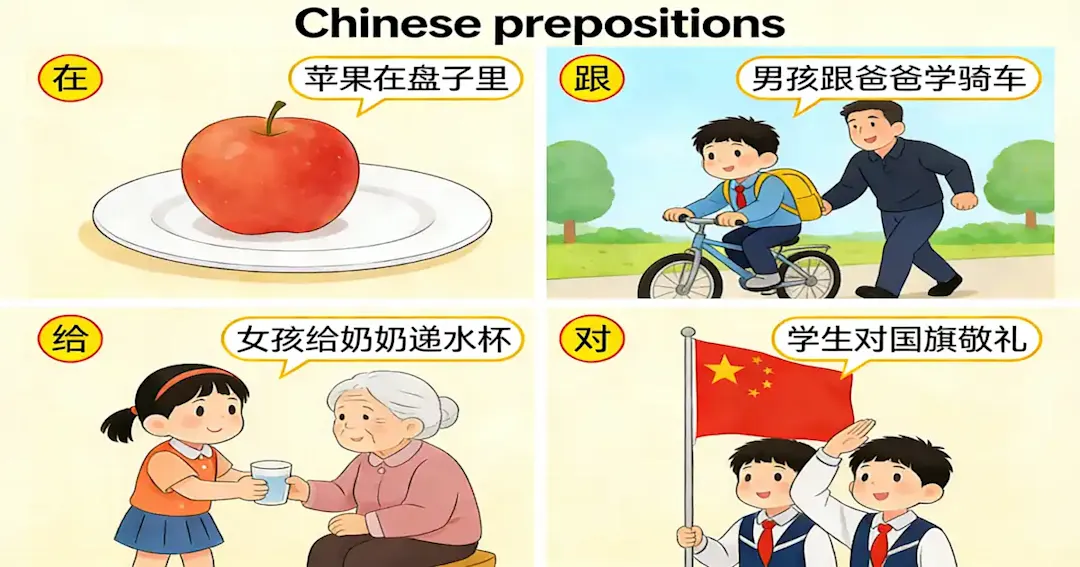
Rule 1: Subject + 在 + Place
This is the most beginner-friendly structure.
我在家。Wǒ zài jiā. = I’m at home.
她在学校。Tā zài xuéxiào. = She’s at school.
书在桌子上。Shū zài zhuōzi shàng. = The book is on the table.
Kid-life examples you can use today:
爸爸在厨房。Bàba zài chúfáng. = Dad is in the kitchen.
你的水杯在这儿。Nǐ de shuǐbēi zài zhèr. = Your cup is here.
Common kid confusion: English speakers often want to say “is” directly. Chinese often uses 在 to show location instead.
“Dad is in the kitchen.” → 爸爸在厨房。 (not 爸爸是厨房)
Rule 2: Subject + 在 + Place + Verb
This is where kids start to sound more natural.
我在客厅看书。Wǒ zài kètīng kàn shū. = I read in the living room.
他在学校写作业。Tā zài xuéxiào xiě zuòyè. = He does homework at school.
我们在公园玩。Wǒmen zài gōngyuán wán. = We play at the park.
Mini drill (60 seconds): Pick one verb your child uses every day: 看书 (read), 吃饭 (eat), 玩 (play), 画画 (draw). Now rotate places: 家 / 学校 / 公园 / 房间. You’ll get fast, repeated exposure to 在 + place without it feeling like homework.
Motivation nudge: This is the kind of repetition that sticks—especially for heritage learners who don’t get many chances to speak Chinese spontaneously.
Part 2: 在 (zài) — “in progress” (the Chinese “-ing” helper)
Rule 3: Subject + 在 + Verb (+ Object)
This 在 doesn’t mean “at.” It signals that something is happening right now.
我在吃饭。Wǒ zài chīfàn. = I’m eating.
她在看电视。Tā zài kàn diànshì. = She’s watching TV.
他们在做作业。Tāmen zài zuò zuòyè. = They’re doing homework.
A few family phrases you’ll actually use:
你在干什么?Nǐ zài gàn shénme? = What are you doing?
我在找我的书包。Wǒ zài zhǎo wǒ de shūbāo. = I’m looking for my backpack.
Where kids get stuck: “在” placement and overuse
Putting 在 too late
Awkward: 我吃饭在。
Natural: 我在吃饭。
Using 在 as a universal “is”
Wrong idea: “I am happy” → 我在开心 (sounds off)
Better: 我很开心 / 我开心。
A quick parent rule:
Use 在 for where someone is or what someone is doing right now.
Don’t use 在 just because English uses “am/is/are.”
If your child keeps inserting 在 everywhere, it usually means they’re translating English word-for-word. Once you show them the two “jobs” of 在, accuracy jumps fast.If understands the rules but still freezes when speaking, that’s a sign they need live correction and repetition—especially with tones and word order. One option some families use is a LingoAce trial Chinese class, where a teacher can listen, correct in the moment, and guide short speaking practice so “在 vs 再” becomes automatic in real sentences.

Part 3: 再 (zài) — “again / one more time / then”
Now we switch to the other “zai.”
Rule 4: 再 + Verb = do it again (usually next time / one more time)
再说一遍。Zài shuō yí biàn. = Say it again.
再来一次。Zài lái yí cì. = One more time.
再试试。Zài shìshi. = Try again.
These are extremely useful for families:
你再读一遍。Nǐ zài dú yí biàn. = Read it again.
再慢一点。Zài màn yìdiǎn. = A little slower (again).
Rule 5: …再… = then / after that
This is sequencing—great for routines.
先洗手,再吃饭。Xiān xǐshǒu, zài chīfàn. = Wash hands first, then eat.
做完作业,再玩。Zuò wán zuòyè, zài wán. = Finish homework, then play.
This one line alone can become a “home Chinese routine script.” If you say it consistently, kids start copying the structure naturally.
The big confusion: 在 vs 再 — a simple decision trick that works
Here’s a parent-approved “decision trick.” It’s basic, but it works.
Step 1: Replace “zai” with an English clue
If it fits at/in/on → 在
If it fits again/then → 再
Step 2: Say the sentence out loud with the clue
Kids often pick correctly once they hear the meaning.
Let’s try 12 quick examples. Choose 在 or 再:
我___家。 (I’m at home.) → 在
我___看书。 (I’m reading right now.) → 在
你___说一遍。 (Say it again.) → 再
先吃饭,___写作业。 (Eat first, then do homework.) → 再
他___学校。 (He’s at school.) → 在
她___画画。 (She’s drawing.) → 在
明天___去公园。 (Go to the park again tomorrow.) → 再
我的鞋___门口。 (My shoes are by the door.) → 在
___来一个。 (One more, please.) → 再
你___干什么? (What are you doing?) → 在
我们___客厅聊天。 (We chat in the living room.) → 在
今天太晚了,明天___说。 (It’s too late today; talk again tomorrow.) → 再
If your child gets 8/12 right on the first try, they’re already building the right instinct. If they get 3/12, that’s still useful—you now know exactly which “job” of zai needs practice.
再 vs 又 — both can mean “again,” but not the same
Many learners hit this next: “If 再 is again, what is 又?”
A beginner-friendly rule:
再 = again from now (planned or future repetition / next step)
又 = again already happened (repeated event, often a “here we go again” feeling)
Examples:
我明天再去。 = I’ll go again tomorrow. (future)
他又迟到了。 = He’s late again. (it already happened)
Family-friendly pair:
你明天再练一次。 = Practice one more time tomorrow.
你又忘了书包。 = You forgot your backpack again.
If you teach kids 再 = next time and 又 = again (already), you’ll prevent a lot of later confusion.
the 10 most common beginner errors
This section is where parents usually feel relief, because it matches what they see at home.
1) Writing 再 when you mean “at”
Wrong: 我再学校。
Right: 我在学校。 Why: “at school” is location → 在.
2) Writing 在 when you mean “again”
Wrong: 你在说一遍。
Right: 你再说一遍。 Why: “say again” is repetition → 再.
3) Putting 在 at the end (English word order leak)
Awkward: 我吃饭在。
Natural: 我在吃饭。 Why: 在 (progress) usually comes before the verb.
4) Using 在 for feelings because English uses “am”
Off: 我在累。
Better: 我很累 / 我累了。 Why: In Chinese, feelings often don’t need 在.
5) Mixing 在/再 inside routines
Wrong: 先洗手,在吃饭。
Right: 先洗手,再吃饭。 Why: “then” is 再.
6) Overusing 再 as “and then” in every sentence
Kids sometimes start stacking 再 because it feels like a connector.
Better fix: Teach two connectors: 先…再… and 然后… Goal: variety, not just “zai, zai, zai.”
7) Confusing 再见 as “at see”
If a child writes 在见, it’s usually because they hear “zai” and guess.
Fix: explain 再见 = “see you again,” so 再 belongs there.
8) Not hearing tone differences (zài vs zǎi etc.)
For many kids, tones are the invisible culprit. They may understand the rule but still hesitate when speaking.
9) Using 在 for ownership (“I have…”)
Wrong: 我在一个铅笔。
Right: 我有一支铅笔。 Why: “have” is 有, not 在.
10) Trying to translate English “again” too literally
Sometimes English says “again” but Chinese would phrase it differently depending on context (再 / 又 / 还). The fix is not memorizing labels—it’s practicing short, real scenes.
When mistakes keep repeating, it’s rarely a “knowledge” problem. It’s a feedback problem—kids need to say sentences, get corrected quickly, and repeat the corrected version while it’s still fresh.

Sentence practice
You don’t need long worksheets. You need short, repeatable scenes.
1 : “Point and say where it is” (在)
Parent points to objects and asks:
书在哪里? Child answers:
书在桌子上。 Switch it up:
玩具在沙发上。
水杯在这儿。
Keep it playful: If they answer in English, let them echo one Chinese line after you. Echoing is still practice.
2: “Right now vs next” (在 vs 再)
Ask two quick questions:
你在干什么? (right now)
你等一下再做什么? (what next)
Kids love this when it’s about real life:
我在吃饭。吃完饭再写作业。
3: “Routine scripting” (先…再…)
Have your child write or say a 3-step routine:
先…再…再… Example:
先复习中文,再写作业,再玩十分钟。
This gives them sequencing language that instantly improves speaking and writing.
Mini quiz: fill in 在 or 再
Let your child answer fast—no overthinking. Then review.
我___写作业。
书___书包里。
你___来一次。
先吃饭,___看电视。
妈妈___客厅。
我___找我的鞋。
明天___去图书馆。
你___说慢一点。
他___学校打篮球。
太难了,我___试试。
Answer key: 1 在 2 在 3 再 4 再 5 在 6 在 7 再 8 再 9 在 10 再
Quick reference cheat sheet
Use 在 when…
It’s about location: 我在家 / 书在桌子上
It’s about right now: 我在吃饭 / 他们在学习
Use 再 when…
It’s again / one more time: 再说一遍 / 再来一次
It’s then / next step: 先…再… / 做完…再…
If you remember only two lines:
在 = place / right now
再 = again / then
FAQ :for common “zai meaning” searches
What does “zai” mean in Chinese?
“Zai” most commonly refers to 在 or 再. 在 is for location or actions happening right now; 再 is for doing something again or doing the next step.
Is “zai” always 在?
No. If the meaning is “again” or “then,” it’s usually 再, not 在.
How do I know if it’s 在 or 再 in a sentence?
Ask: Is it where (at/in/on) or right now (-ing)? → 在. Is it again or then/next? → 再.
What’s the difference between 再 and 又?
Beginner shortcut: 再 is “again (from now / next time),” while 又 is “again (already happened).”
Why is “goodbye” 再见?
Because it literally means “see you again,” so it uses 再.
Summary (80–120 words)
“Zai meaning” usually comes down to two characters: 在 and 再. 在 covers location (at/in/on) and actions happening right now (like “-ing”). 再 covers repetition (“again,” “one more time”) and sequencing (“then”). If your child asks “which zai,” use the three-question trick: location? right now? again/then? A few minutes of daily speaking practice makes the difference—especially for kids growing up in an English environment. If you want structured feedback and faster speaking confidence, you can also try a LingoAce trial Chinese lesson.