Since the Gregorian calendar has become the standard for measuring time for much of the modern Since the Gregorian calendar has become the standard for measuring time for much of the modern world, many think of time as "years" and "months." But truth be told, time is measured differently in different cultures.
The traditional Chinese calendar has 24 "months" called solar terms. These Chinese 24 solar terms are based on seasonal changes and traditional Chinese agricultural practices. While not widely used, they still have some modern-day applications, especially during cultural holidays.
Learning these traditions is central to mastering the Chinese language. At LingoAce, our courses are designed to connect students with this profound cultural heritage.
What are the 24 Solar Terms in the Chinese Calendar?
The Chinese 24 solar terms divide the year into 24 segments, each approximately 15 days long. They are based on the sun's position in the zodiac and reflect the changing seasons. Chinese people have used solar terms for thousands of years to guide agricultural activities, daily life, and cultural practices. Each solar term is associated with weather patterns, natural phenomena, and human activities.
History and Importance of the 24 Solar Terms
The concept of the 24 solar terms dates back to the Western Zhou Dynasty (1046–771 BC). Initially, they assisted in agricultural planning, ensuring that crops were planted and harvested at the most opportune times. Over time, these terms became deeply embedded in Chinese culture, influencing festivals, customs, and daily life. For example,
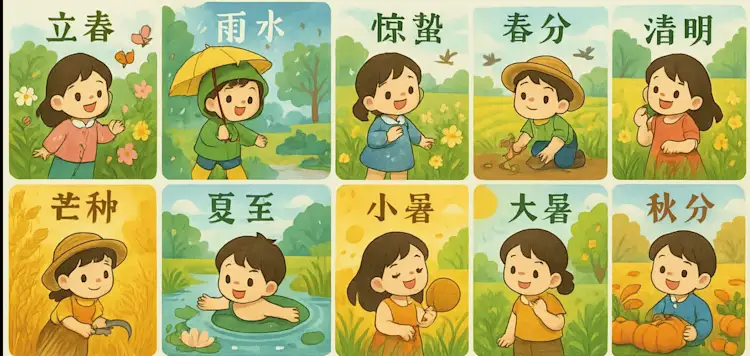
Chinese farmers would rely on these solar terms to determine the best times for planting, harvesting, and other agricultural tasks. For example, the term "立春" (Lìchūn, Beginning of Spring) signals the start of the agricultural year, prompting farmers to prepare their fields and sow early crops. Likewise, 惊蛰 (Jīngzhé, Insect Awakening) marks the period in spring when many insects come out of hibernation. "芒种" (Mángzhòng, Grain in Ear) indicates the time for sowing grains, while "秋分" (Qiūfēn, Autumn Equinox) is a critical period for harvesting.

The solar terms also help farmers adapt to seasonal changes and local climate conditions. For instance, "小暑" (Xiǎoshǔ, Minor Heat) and "大暑" (Dàshǔ, Major Heat) mark the hottest periods of the year, guiding farmers to take measures to protect crops from heat stress and ensure adequate irrigation. Conversely, "霜降" (Shuāngjiàng, Frost Descent) indicates the onset of frost, prompting farmers to harvest remaining crops before the cold sets in. By following the solar terms, Chinese farmers maintain a harmonious relationship with nature, optimizing their agricultural practices to enhance crop yields and ensure food security. The integration of solar terms into farming not only reflects traditional wisdom but also continues to be a practical guide for modern agriculture in China.
In 2016, UNESCO recognized the 24 solar terms as an Intangible Cultural Heritage of Humanity, highlighting their historical and cultural significance. This system is a testament to ancient Chinese agricultural wisdom and embodies the harmonious relationship between humans and nature.
24 Solar Terms in Today
While modern technology has lessened the reliance on solar terms for agricultural purposes, they still hold cultural and practical significance in contemporary China. Many traditional festivals, like the Qingming and Mid-Autumn festivals, are closely linked to solar terms. Additionally, the terms are used to predict weather changes and seasonal activities, serving as a cultural touchstone for the rhythms of rural life.
24 Solar Terms Calendar
Here is a comprehensive table of the Chinese 24 solar terms, including their Chinese names, corresponding dates, and meanings:
Solar Term | Chinese Name | Month/Date | Meaning |
Start of Spring | 立春 (Lìchūn) | February 3-5 | Beginning of spring |
Rain Water | 雨水 (Yǔshuǐ) | February 18-20 | Increase in rainfall |
Insects Awaken | 惊蛰 (Jīngzhé) | March 5-7 | Awakening of insects |
Spring Equinox | 春分 (Chūnfēn) | March 20-22 | Equal length of day and night |
Clear and Bright | 清明 (Qīngmíng) | April 4-6 | Clear and bright weather |
Grain Rain | 谷雨 (Gǔyǔ) | April 19-21 | Rain beneficial for grain growth |
Start of Summer | 立夏 (Lìxià) | May 5-7 | Beginning of summer |
Grain Full | 小满 (Xiǎomǎn) | May 20-22 | Grains become full |
Grain in Ear | 芒种 (Mángzhòng) | June 5-7 | Grain crops mature |
Summer Solstice | 夏至 (Xiàzhì) | June 21-23 | Longest day of the year |
Minor Heat | 小暑 (Xiǎoshǔ) | July 6-8 | Start of hot weather |
Major Heat | 大暑 (Dàshǔ) | July 22-24 | Hottest period |
Start of Autumn | 立秋 (Lìqiū) | August 7-9 | Beginning of autumn |
Limit of Heat | 处暑 (Chùshǔ) | August 22-24 | End of hot weather |
White Dew | 白露 (Báilù) | September 7-9 | Dew becomes white |
Autumn Equinox | 秋分 (Qiūfēn) | September 22-24 | Equal length of day and night |
Cold Dew | 寒露 (Hánlù) | October 8-9 | Colder dew appears |
Frost's Descent | 霜降 (Shuāngjiàng) | October 23-24 | Frost begins to form |
Start of Winter | 立冬 (Lìdōng) | November 7-8 | Beginning of winter |
Minor Snow | 小雪 (Xiǎoxuě) | November 22-23 | First light snow |
Major Snow | 大雪 (Dàxuě) | December 6-8 | Heavy snow arrives |
Winter Solstice | 冬至 (Dōngzhì) | December 21-23 | Shortest day of the year |
Minor Cold | 小寒 (Xiǎohán) | January 5-7 | Start of cold weather |
Major Cold | 大寒 (Dàhán) | January 20-21 | Coldest period |
FAQ
What are the 24 solar terms for the beginning of summer?
The solar term marking the beginning of summer is 立夏(Lìxià), which occurs around May 5-7. It signifies the onset of warmer weather and the end of spring.
What were the 24 solar terms used to guide in the earlier days?
In ancient times, the 24 solar terms guided agricultural activities. Farmers relied on them to determine the best times for planting, cultivating, and harvesting crops. The terms also helped people anticipate weather changes, prepare for seasonal activities, and celebrate various festivals.
Looking for an online Chinese class for your kids to learn Mandarin and Chinese culture? LingoAce is one of the best ways to learn Chinese for kids online. Each one-on-one lesson is the product of nearly 200 hours of curriculum development, teacher training, and quality control. LingoAce classes are tailored to meet your child's learning needs.
Experience a redefined Chinese learning experience and book a free trial class with us today.