
If you’ve ever tried to “teach Mandarin at home” and ended up… just negotiating bedtime in English again, you’re not alone. Chinese Children’s Songs are one of the few tools that work even when you’re busy, your accent isn’t perfect, and your kid’s attention span is basically a goldfish.
This list is organized so you can pick fast: a few for movement, a few for routines, a few for calming down. You’ll get pinyin, a simple meaning, and one parent tip for each—so these aren’t just cute songs, they’re usable.
Quick start: 6 “no-fail” picks to try tonight
Here are six Chinese Children’s Songs that tend to land well in real homes (car rides, bath time, that weird 6:30pm meltdown window):
两只老虎 (liǎng zhī lǎo hǔ) — animals + repetition
小星星 (xiǎo xīng xīng) — calm + slow pace
头肩膀膝脚趾 (tóu jiān bǎng xī jiǎo zhǐ) — body parts + movement
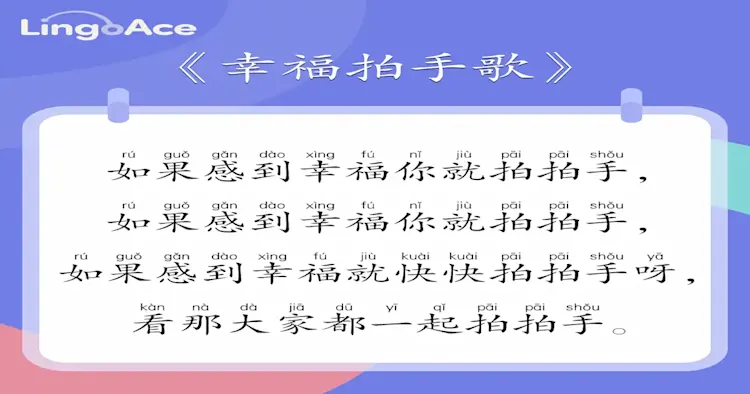
如果感到幸福你就拍拍手 (rú guǒ gǎn dào xìng fú nǐ jiù pāi pāi shǒu) — emotions + action
洗手歌 (xǐ shǒu gē) — routines (especially preschoolers)
生日快乐歌 (shēng rì kuài lè gē) — the one you’ll reuse all year
The 18-song table (save this and reuse it)
This table is the “fast scan” version—then right below, you’ll see quick notes for each song (why it matters + how to use it at your child’s age). Chinese Children’s Songs work best when you repeat them in the same daily moment.
# | Song (Chinese) | Pinyin | Simple meaning | Best age/stage | What it teaches | When to use | Parent tip |
1 | liǎng zhī lǎo hǔ | Two Tigers | 3–8 | animals, numbers, rhythm | car ride | pause after each line; kid fills in 1 word | |
2 | xiǎo xīng xīng | Little Star | 2–7 | slow tones, “twinkle” vocab | bedtime | whisper-sing once, normal-sing once | |
3 | 找朋友 | zhǎo péng you | Find a Friend | 3–6 | greetings, social words | playtime | act it out with stuffed animals |
4 | 生日快乐歌 | shēng rì kuài lè gē | Happy Birthday | 3–10 | celebratory phrases | parties | have kid “host” and say 1 line |
5 | 头肩膀膝脚趾 | tóu jiān bǎng xī jiǎo zhǐ | Head/Shoulders/Knees/Toes | 3–8 | body parts | morning energy | speed up slowly—kids love “challenge mode” |
6 | 如果感到幸福你就拍拍手 | rú guǒ gǎn dào xìng fú… | If You’re Happy… | 3–9 | feelings + verbs | after school | swap actions: stomp/jump/wave |
7 | 洗手歌 | xǐ shǒu gē | Handwashing Song | 2–6 | routines, sequencing | bathroom | sing only while washing—instant habit cue |
8 | 刷牙歌 | shuā yá gē | Toothbrushing Song | 3–7 | daily verbs | bedtime | let kid lead; you follow |
9 | 起床歌 | qǐ chuáng gē | Wake-up Song | 3–8 | morning phrases | mornings | use the same 2 lines daily |
10 | 再见歌 | zài jiàn gē | Goodbye Song | 2–6 | polite exits | leaving home | kid waves + says “zài jiàn” clearly |
11 | 一闪一闪亮晶晶 | yì shǎn yì shǎn liàng jīng jīng | Twinkle, twinkle | 2–7 | repetition + clear syllables | bedtime | point to a light; connect meaning |
12 | xiǎo tù zi guāi guāi | Little Bunny, Be Good | 3–7 | story-ish phrases | calm time | turn it into a mini puppet show | |
13 | 拔萝卜 | bá luó bo | Pulling a Radish | 3–7 | teamwork verbs | playdate | everyone “pulls” together—lots of laughter |
14 | 你笑起来真好看 | nǐ xiào qǐ lái zhēn hǎo kàn | Your Smile Looks Great | 5–12 | compliments, modern phrases | family time | record a 10-sec clip; kid replays + copies |
15 | 太阳当空照 | tài yáng dāng kōng zhào | The Sun Is Shining | 3–8 | nature words | morning | sing while opening curtains |
16 | 企鹅舞 | qǐ é wǔ | Penguin Dance | 4–10 | action verbs | parties | use it as a “Mandarin movement break” |
17 | 春天在哪里 | chūn tiān zài nǎ lǐ | Where Is Spring? | 5–12 | seasons, questions | walks | ask “zài nǎ lǐ?” about real objects |
18 | 小手拍拍 | xiǎo shǒu pāi pāi | Little Hands Clap | 2–6 | simple verbs | transitions | 30 seconds to reset attention |
How to turn Chinese Children’s Songs into real speaking
Pick one song. Do one of these. Stop while it’s still fun.
Echo-singing (30 seconds)
You sing a line. Your child repeats just the last 2–3 words. Tiny win. Builds pronunciation.
Swap-a-word game (2 minutes)
Keep the rhythm, swap one noun: tiger → bunny → panda. Same sentence frame, new vocab.
One-line “real life” after the song (2 minutes)
After a body-parts song: “Where is your head?” After a feelings song: “Are you happy?” Your child answers with one short phrase. That counts as speaking.
If you’re thinking, “Okay, but what if my tones are off?”—that’s a very normal parent worry. A teacher can correct small pronunciation habits early, before they get sticky. If you want that structure, you can book a trial class with LingoAce and ask the teacher to build a weekly routine around your child’s favorite songs
Best picks by age (so you don’t accidentally choose the wrong vibe)
Parents usually don’t quit because songs “don’t work.” They quit because the song doesn’t match the child’s stage.
Ages 2–5: choose short, repetitive, with actions
Best: 小手拍拍, 洗手歌, 小星星, 头肩膀膝脚趾
Ages 6–9: choose routines + simple “story” songs
Best: 拔萝卜, 小兔子乖乖, 找朋友, 再见歌
Ages 10–12: choose songs with usable phrases (compliments, seasons, questions)
Best: 春天在哪里, 你笑起来真好看, 企鹅舞
Also, a quick nerdy-but-useful point: research has linked music training/programs with improvements in phonological awareness (the skill of hearing and working with sounds), which is a foundational language-and-reading skill.You don’t need to “teach reading through singing” at home… but it explains why a short song can do more than a worksheet some days.
FAQ
1) What are the easiest Chinese Children’s Songs for beginners?
Look for short, repetitive songs with actions: 小手拍拍, 小星星, 洗手歌, 两只老虎. Beginners need predictability more than variety.
2) Where can I find Chinese children’s songs with pinyin?
Parent blogs often compile Chinese children’s songs with pinyin plus sing-along tips; many families start with lists that include pinyin and simple English meanings.
3) Are Chinese nursery rhymes good for learning tones?
They can be, because rhythm and repetition help kids “hear” patterns. But you still want slow tempo early and gentle correction—especially for tone pairs that sound similar.
4) What if parents don’t speak Mandarin—can Chinese Children’s Songs still work?
Yes. Choose action songs and routine songs first (you can follow your child’s cues). If you can, use a teacher or a structured program occasionally to check pronunciation so you don’t unknowingly lock in a mispronunciation.
5) How long should we do songs each day?
Five minutes is enough. Consistency beats long sessions. If your child wants more, great—stop _before_ they burn out.
Conclusion
If your goal is “my child actually uses Mandarin,” Chinese Children’s Songs are the lowest-friction entry point: predictable, repeatable, and emotionally safe. Kids don’t feel tested; they feel like they’re playing.
If you want help choosing the right songs for your child’s level—and you want pronunciation feedback without turning into “homework police”—a short trial lesson with LingoAce can give you a plan that fits your family schedule.