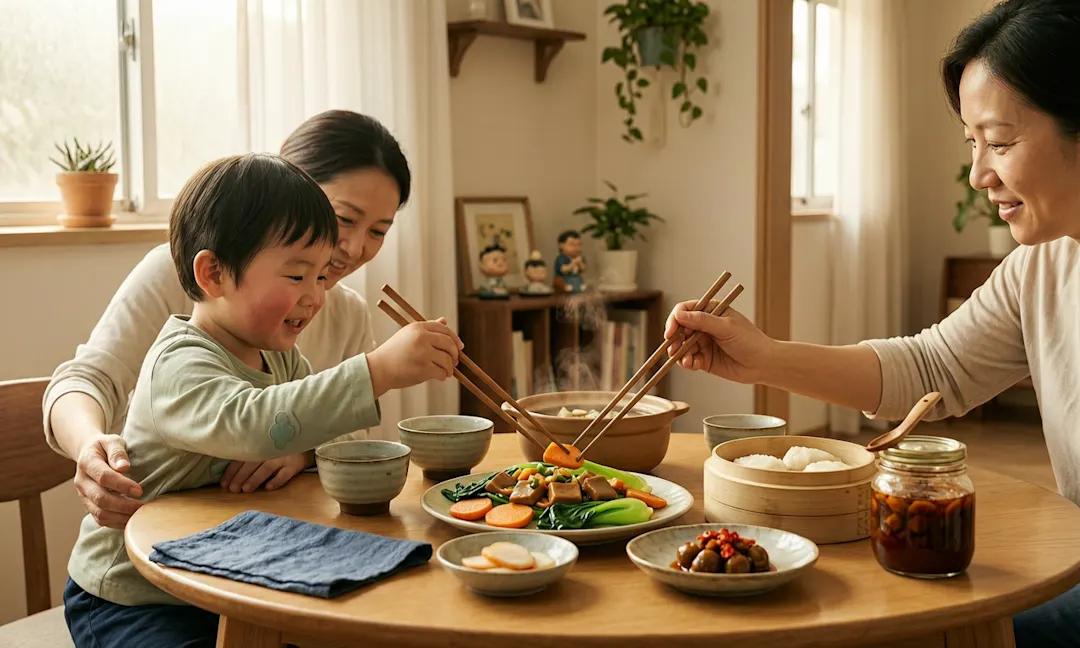
Dinner moment you probably recognize: your kid is staring at noodles like they’re a puzzle, you’re trying to help, and someone says, “Can I just get a fork?” Fair. Also… this is a sneaky-good chance to learn a real, usable Chinese word and build a little confidence with chopsticks at the same time.
In this guide, you’ll learn how to say chopsticks in Chinese, how to use chopsticks without the hand-cramp drama, and a simple “teach it at dinner” routine that works even when you only have ten minutes.
What “筷子 (kuàizi)” means and how to say it
In Mandarin, chopsticks are 筷子, commonly written as 筷子 and pronounced kuàizi.
If tones make you freeze up, don’t overthink it. Kids learn this the same way they learn “spaghetti” or “Pokémon”—by hearing it in a real situation, repeatedly, with a little rhythm.
Try this quick cue:
“kwai” (like “quiet” without the “et”)
then “dzuh” (soft, quick)
And yes, your first few tries might sound off. That’s normal. The point is: say it, use it, repeat it… then improve.
A tiny dinner-table phrase kit using “chopsticks”
Here’s a mini set of phrases you can keep on a sticky note. (You’ll notice I’m not giving a giant vocabulary dump—just what you’ll actually say.)
Situation | What you can say (Chinese) | Easy English meaning |
Asking for chopsticks | 筷子呢?(Kuàizi ne?) | Where are the chopsticks? |
Offering | 你要筷子吗?(Nǐ yào kuàizi ma?) | Do you want chopsticks? |
Encouraging | 慢慢来。(Màn man lái.) | Take it slow. |
Coaching | 上面那根动。(Shàngmiàn nà gēn dòng.) | Only the top one moves. |
Resetting | 我们再试一次。(Wǒmen zài shì yí cì.) | Let’s try one more time. |
Praise | 你进步了!(Nǐ jìnbù le!) | You improved! |

Use chopsticks the easy way: follow these steps
This is the part most guides make weirdly complicated. So here’s the clean version: one chopstick stays still, the other does the work. That’s the “aha” for most beginners.
Step 1: Choose the right chopsticks for beginners
For learning chopsticks, friction is your friend.
Start with: slightly textured or bamboo/wood chopsticks (less slippery).
Skip at first: super glossy metal ones (hard mode).
Kid shortcut: if your child is younger, training chopsticks can reduce frustration early on—just don’t treat them like a permanent crutch.
Step 2: Place the bottom chopstick so it stays still
Put the “bottom” chopstick where it can rest:
It sits against the base of the thumb.
It rests on the ring finger area (not the index finger).
This one should feel… boring. Good. Boring = stable.
Step 3: Move only the top chopstick
Now hold the top chopstick like a pencil-ish grip:
Thumb + index finger guide it,
middle finger supports.
Then open and close only the top one.
If your kid keeps moving both sticks, try this sentence:
“Bottom stick is sleeping. Top stick is working.”
It sounds silly, but it clicks faster than anatomy explanations.
Step 4: Practice with the right food sequence (big → small → slippery)
People fail at chopsticks because they start with noodles. Noodles are chaos.
Try this progression:
Big, easy: bread cubes, large fruit pieces
Medium: dumplings, tofu cubes, chicken bites
Small: peas, corn, small beans
Slippery: noodles (later—promise)
You’re building confidence first, not showing off.
Step 5: Reset your grip in 5 seconds when everything collapses
When the sticks cross, slip, or turn into a weird scissor shape:
Put them down.
Shake out the hand once.
Slide fingers lower on the chopsticks (most people hold too high).
Restart with the “bottom stick sleeps” idea.
Resetting is a skill. Not a failure.
Step 6: Make it kid-friendly with 3 tiny games (5 minutes each)
If your child is learning chopsticks, practice should feel like play, not an after-school punishment.
Game A: Cotton Ball Pickup
Bowl of cotton balls → move them one by one.
Goal: accuracy, not speed.
Game B: “Treasure Transfer”
Move small blocks or beads into a cup.
Add a silly rule: “quiet hands” or “no dropping treasures.”
Game C: Family Relay
Everyone gets three tries.
Celebrate “best improvement,” not “best performance.”
If your child is learning Chinese, chopsticks become a surprisingly useful “real life lesson.” You get vocabulary (筷子), tiny sentence patterns, and a reason to speak Chinese at home without it feeling forced.And if you’d rather have a teacher handle pronunciation and speaking confidence—especially for kids who freeze up—trying a short LingoAce trial class can give you that live feedback loop.

Chopsticks etiquette: what kids should avoid at the table (and what to do instead)
You don’t need to scare kids with etiquette. But it _is_ nice to avoid the classic mistakes that get corrected at family dinners.
Here are the big ones:
Don’t stick chopsticks upright in a bowl of rice
This is widely described as a taboo because it resembles a funerary offering. Instead, rest chopsticks across the bowl/plate, or use a chopstick rest if there is one.
Don’t point, drum, or “hunt” through dishes
A lot of etiquette guides mention that waving chopsticks around, tapping them, or digging through a shared dish looks rude. If you’re choosing food, pause, look, then pick.
Don’t pass food chopsticks-to-chopsticks
Some etiquette explanations connect “passing from chopsticks to chopsticks” with funeral-related customs in certain cultures, so it’s safer to place food on a plate instead.
Quick “Chinese restaurant” checklist
Use serving utensils if provided (or serving chopsticks).
Rest chopsticks neatly when you pause.
If your kid drops them… you’re allowed to laugh and get a replacement.

Troubleshoot chopsticks fast: 5 common problems parents actually see
1) The death grip
If your child squeezes like the chopsticks are trying to escape: loosen the grip and lower the hand position. Small adjustment, big difference.
2) Holding too high
High grip = low control. Slide fingers down closer to the tips.
3) Both sticks moving
Return to the rule: only the top chopstick moves.
4) Chopsticks keep crossing
Usually means the top chopstick is rotating. Straighten it like a pencil, and keep the bottom one still.
5) Food keeps slipping
Switch foods. Seriously. Go back to bigger pieces, then work down.
FAQ
How do you say chopsticks in Chinese for kids?
The most common Mandarin word for chopsticks is 筷子 (kuàizi). Start by using it in one repeatable dinner phrase—like “你要筷子吗?”—and let your child copy it naturally.
What’s the easiest way to teach kids to use chopsticks without frustration?
Use the “bottom stick sleeps, top stick works” rule, then practice with large, easy foods first (not noodles). Keep practice short—5 minutes of success beats 20 minutes of tears.
What are the biggest chopsticks etiquette mistakes kids should avoid?
The most commonly mentioned one is sticking chopsticks upright in rice. Also avoid pointing, drumming, and passing food from chopsticks to chopsticks; place food on a plate instead.
Are training chopsticks helpful, or do they slow learning?
They can help early, especially for younger kids who need finger placement support. Just plan a gradual transition—otherwise the first “real chopsticks” experience feels like starting over.
Why do my chopsticks keep crossing?
Usually the top chopstick is twisting or both sticks are moving at once. Lower your grip, stabilize the bottom stick, and focus on moving only the top stick.
Conclusion
If you take only three things from this:
Chopsticks in Chinese are 筷子 (kuàizi), and you can teach it through one dinner phrase at a time.
Using chopsticks gets easier when the bottom stick stays still and the top stick does the work.
Kids learn faster with short games, easier foods, and fewer “corrections” mid-bite.
If you want your child to go beyond “knowing the word” and actually _using Chinese_ comfortably in everyday moments—dinner talk included—book a LingoAce trial class and let a teacher guide pronunciation, speaking, and confidence in a kid-friendly way.