
The first sign isn’t fireworks.It’s the smell.
A warm, slightly sweet steam clinging to the kitchen curtains. A salty, savory note drifting from the stove. That quiet feeling that tonight isn’t just dinner—tonight is tradition.In many homes, Spring Festival doesn’t arrive with a calendar reminder. It arrives with Spring Festival food.
Even if you live far from where your parents grew up. Even if your child’s Mandarin is still “in progress.” Even if your celebration is a weekday night with a tiny table and a bigger-than-usual to-do list. Spring Festival food still finds its way into the house, because food doesn’t need perfect language to carry meaning.
This is a story about Spring Festival food—how it travels across global Chinese communities, how it changes, and why it still feels like home in 2026.

Spring Festival food meaning: the night food turns into wishes
A parent’s plan often starts small.
“Let’s just do a few Spring Festival food dishes,” you tell yourself. Nothing complicated. Nothing stressful. Just enough to make the night feel special.
Maybe it’s dumplings from the freezer. Maybe it’s fish because you remember someone saying fish means “extra luck.” Maybe it’s tangerines on the counter, bright as tiny suns. It’s not a banquet—just a handful of Spring Festival food that feels familiar.
Then your child walks in, pauses, and asks the one question that changes everything:
“What’s that smell?”
And suddenly, you’re not just cooking. You’re storytelling—without meaning to.
That’s the best part of Spring Festival food meaning. You don’t have to teach it like a lesson. You simply explain what the food is “saying”:
Dumplings look like little gold ingots → wealth
Fish sounds like “surplus” → abundance
Noodles should be long → long life
Sticky rice cake sounds like “higher year” → progress
Sweet rice balls are round → togetherness
That’s the quiet power of Spring Festival food: each dish is an edible wish, and the whole table becomes a message to the year ahead.
If you want your child to go from tasting Spring Festival food to describing it in real sentences, LingoAce can help. With a teacher guiding practice step by step, kids learn to talk about foods like 饺子 (jiǎozi) and 年糕 (niángāo) naturally—so holiday curiosity becomes everyday speaking ability (without parents feeling like they have to teach like a tutor).
Spring Festival food for kids: the “one dish” trick that actually works
If your child is picky, don’t try to win the whole table in one night. Start with one dish your child will accept, one dish that feels fun, and one dish that feels sweet.
That’s the easiest way to make Spring Festival food for kids feel safe and familiar.
Here’s the kid-friendly starter combo:
Dumplings 饺子 (jiǎozi) — the “easy yes”
Longevity noodles 长寿面 (chángshòu miàn) — the slurp-friendly one
Tangyuan 汤圆 (tāngyuán) — the warm dessert moment
Kids don’t need ten dishes. They need one good bite that makes them say, “Can we have this Spring Festival food again next year?” That’s how Spring Festival food for kids becomes a real tradition.
A small table of big meanings (save-this Spring Festival food cheat sheet)
Even in a storytelling post, parents love one quick anchor. So here’s a fast reference for Spring Festival food you’ll see again and again across global Chinese communities:
Spring Festival food | Chinese + pinyin | Meaning |
Dumplings | 饺子 (jiǎozi) | Wealth and good fortune |
Fish | 鱼 (yú) | Abundance / surplus |
Longevity noodles | 长寿面 (chángshòu miàn) | Long life |
Sticky rice cake | 年糕 (niángāo) | “Higher year” / progress |
Sweet rice balls | 汤圆 (tāngyuán) | Togetherness and reunion |
Tangerines | 橘子 (júzi) | Luck and bright beginnings |
This is the simplest way to share Spring Festival food meaning with kids—without turning dinner into homework.
Scene 1: Dumplings—the “gold” you can fold
Dumplings don’t look like gold to kids. They look like tiny pillows. Little moons. Weird folded hats.
But dumplings—饺子 (jiǎozi)—show up in almost every Spring Festival food story because they symbolize wealth. And dumplings have a secret power: they turn dinner into an activity.
Kids love the assembly line:
one wrapper
one spoon of filling
fold, pinch, squish
and then announce proudly: “I made this one!”
Are the dumplings messy? Yes. Do they leak sometimes? Also yes. Do they still taste like Spring Festival food tradition? Always.
Even if your family uses frozen dumplings, it still counts. In global Chinese communities, the most common truth is simple: Spring Festival food doesn’t have to be perfect to be meaningful.
Scene 2: Fish—the only night leftovers feel lucky
Fish—鱼 (yú)—is the Spring Festival food with the most famous word-play. “Fish” sounds like “surplus,” which is why families love the wish:
年年有余 (nián nián yǒu yú) — May you have extra every year.
Here’s the funny part: your child will try to finish the fish. Kids love completing things.
So you explain the playful rule: “Tonight, we leave a little bit.”
Your child looks at you like you’ve invented a new law of physics.
“Why?”
Because for one night, leftovers mean luck.Because one small leftover is the symbol that the family will have more than enough.That’s why Spring Festival food meaning sticks—kids remember the weird little rules more than any lecture.
Scene 3: Longevity noodles—the slurping tradition nobody minds
Longevity noodles—长寿面 (chángshòu miàn)—sound simple, but they’re one of the most loved Spring Festival food choices for modern families.
They come with one rule: don’t cut them. Long noodles = long life.
Kids love noodles because they get permission to do something adults normally correct: slurp.
A bowl of noodles becomes a ritual. A funny one. A cozy one. A loud one.
And because noodles are easy, they’re one of the best Spring Festival food for kids options when you want tradition without stress.
Scene 4: Sticky rice cake—the sweet wish for “better”
Sticky rice cake—年糕 (niángāo)—is one of the most symbolic Spring Festival food dishes.Because it sounds like “higher year.” Like steady progress.Better grades. Better health. Better luck. Better momentum.This is the dish that makes parents smile quietly, because the wish behind Spring Festival food isn’t always huge success. Sometimes it’s simply:
“May this year go a little better than the last.”And 年糕 (niángāo) says it without needing a speech.
Scene 5: Tangyuan—the warm dessert that feels like reunion
Tangyuan—汤圆 (tāngyuán)—are sweet rice balls served in warm soup. They symbolize togetherness.Round shape. Round family.If your Spring Festival feels bittersweet—grandparents far away, travel impossible, life too busy—tangyuan hits differently. It’s comfort food with a soft message:
“Even if we’re far, we’re still connected.”
That’s why this Spring Festival food survives across global Chinese communities. It carries emotion in the simplest way.
Traditional Spring Festival food becomes language (the parent moment)
This is the part parents don’t always expect.
After a few bites of traditional Spring Festival food, kids suddenly want to talk.
“How do you say dumplings again?” “What’s that sweet cake called?” “Can I learn the words?”
That’s your chance.
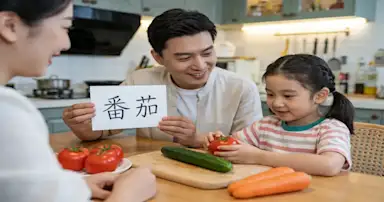
A few easy words kids can actually say:
Dumplings: 饺子 (jiǎozi)
Fish: 鱼 (yú)
Noodles: 面条 (miàntiáo)
Sticky rice cake: 年糕 (niángāo)
Tangyuan: 汤圆 (tāngyuán)
Delicious!: 好吃 (hǎochī)
And one sentence kids love to perform:我想吃饺子 (wǒ xiǎng chī jiǎozi) — I want dumplings.
That’s how traditional Spring Festival food turns into real bilingual confidence—one dinner sentence at a time.

Global Chinese communities twist: the same Spring Festival food, different tables
The most beautiful thing about Spring Festival food is that it doesn’t look identical everywhere.
Some families cook dumplings and noodles and fish. Others set out roast meats, rice cakes, and a big pot of something bubbling. Many global Chinese communities serve a mix that feels honest:
dumplings + pizza (because kids)
fish + salad (because time)
niangao + brownies (because school parties)
Is that still Spring Festival food tradition? Yes—because tradition isn’t a museum display. Tradition is what families repeat with love.
That’s why Spring Festival food doesn’t disappear. It adapts, and it stays.

FAQ: Spring Festival food (Parents’ Quick Answers)
1 Do I have to cook Spring Festival food from scratch?
Not at all. In many global Chinese communities, families mix homemade and store-bought Spring Festival food. Frozen dumplings, pre-made 年糕 (niángāo), and takeout still “count,” because what matters is the meaning and the family moment.
2 What are the most important Spring Festival food dishes to serve at dinner?
If you want a simple core set, choose 3–5 Spring Festival food dishes that carry the biggest wishes:
Dumplings 饺子 (jiǎozi) — wealth
Fish 鱼 (yú) — abundance
Longevity noodles 长寿面 (chángshòu miàn) — long life
Sticky rice cake 年糕 (niángāo) — progress
Tangyuan 汤圆 (tāngyuán) — togetherness
Even a small table can feel complete with Spring Festival food.
3 What is the easiest way to explain Spring Festival food meaning to kids?
The easiest version of Spring Festival food meaning is: each dish is a New Year wish you can eat. Dumplings = “we’ll have enough.” Fish = “we’ll have extra.” Noodles = “we’ll live long.” Tangyuan = “we’ll stay close.”
4 What are the best Spring Festival food for kids, especially picky eaters?
For Spring Festival food for kids, start with dumplings 饺子 (jiǎozi), noodles 面条 (miàntiáo), and tangyuan 汤圆 (tāngyuán). They’re friendly textures, familiar flavors, and fun to eat—perfect for kids who need an easy first win.
5 Can we celebrate with only 1–2 Spring Festival food dishes and still be “traditional”?
Yes. Many families start with one signature Spring Festival food dish, and that’s still tradition. If you only pick one, dumplings 饺子 (jiǎozi) are the easiest. If you prefer a dessert tradition, tangyuan 汤圆 (tāngyuán) is a cozy start.
6 Is “Lunar New Year food” the same as traditional Spring Festival food?
They overlap, but they aren’t always the same. Traditional Spring Festival food is tied to Chinese Spring Festival customs, while Lunar New Year food can include dishes from multiple cultures celebrating the Lunar New Year.
7 If we don’t eat seafood, can Spring Festival food meaning still work without fish?
Absolutely. Fish is popular, but Spring Festival food meaning can still be complete without it. Dumplings, noodles, and sweets like 年糕 (niángāo) or 汤圆 (tāngyuán) still carry the “wishes” tradition beautifully.
8 What are 3 beginner Chinese words from Spring Festival food for kids?
If you want fast wins from Spring Festival food for kids, teach:
Dumplings: 饺子 (jiǎozi)
Fish: 鱼 (yú)
Delicious: 好吃 (hǎochī) Kids love saying 好吃!(hǎochī!) at the table.
9 What’s a simple family menu using Spring Festival food that won’t overwhelm parents?
Here’s a low-stress Spring Festival food menu:
Dumplings 饺子 (jiǎozi)
Longevity noodles 长寿面 (chángshòu miàn)
Tangerines 橘子 (júzi)
Tangyuan 汤圆 (tāngyuán) It’s doable, meaningful, and kid-friendly.
10 How can traditional Spring Festival food help kids practice Chinese speaking at home?
The easiest way is “one dish, one sentence.” With traditional Spring Festival food, give your child a line like:
我想吃饺子 (wǒ xiǎng chī jiǎozi) — I want dumplings.
这是鱼 (zhè shì yú) — This is fish.
我喜欢年糕 (wǒ xǐhuān niángāo) — I like sticky rice cake. This turns Spring Festival food into real language practice.
Ending: what kids remember isn’t the perfect recipe
Years later, your child won’t remember whether the dumplings were handmade or store-bought.
They’ll remember:
the smell that filled the kitchen
the laughter when noodles wouldn’t stop sliding
the “rule” about leaving fish
the warm bowl of tangyuan
the feeling that this night mattered
That’s what Spring Festival food does.It turns culture into memory.And in 2026, Spring Festival food is still one of the simplest, warmest ways to keep heritage alive—one bite, one story, one wish at a time.
If your child is curious about Spring Festival food and starts asking how to say the food names—or why the dishes mean what they mean—don’t let that curiosity fade. A LingoAce class can help kids turn holiday vocabulary into real speaking confidence, so they don’t just enjoy Spring Festival food, they can talk about it in Chinese with pride.