If your child can say nǐ hǎo (你好) but freezes when it’s time to answer naturally—“okay,” “sounds good,” “all done,” “so pretty!”—you’re in familiar territory. 好 (hǎo) is one of those tiny characters that shows up everywhere, and it doesn’t always behave like the English word “good.”
This list is built for real life: school drop-off, dinner time, playdates, family rules, and quick replies on the go. Use it as a “copy-and-say” menu—pick a handful, practice them for a week, and you’ll hear the difference.

Quick Reference Table (Start here)
Category | Chinese | Pinyin | What it feels like | Kid-friendly use |
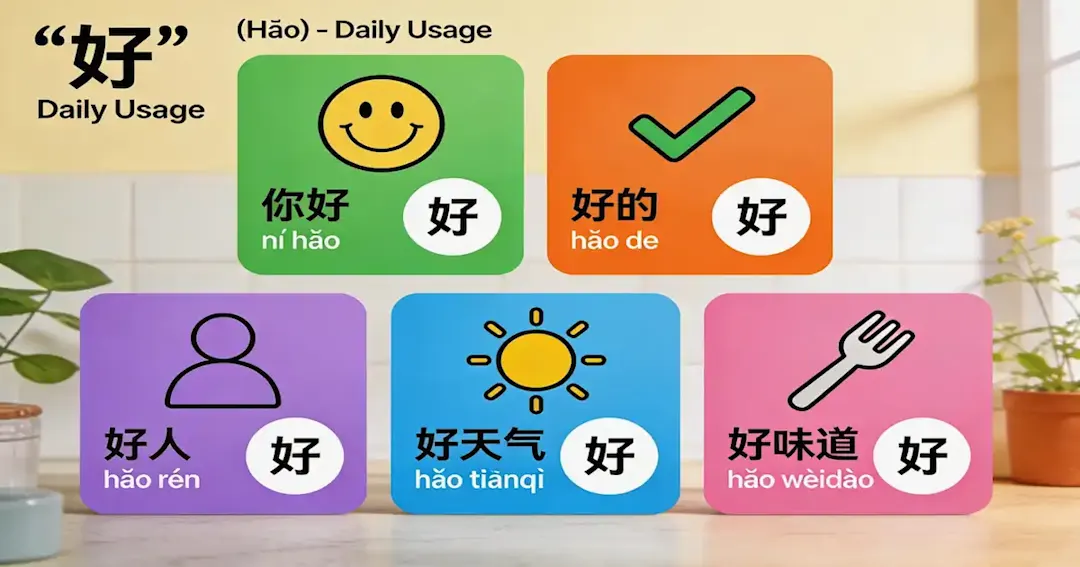
Greetings | 大家好 | dà jiā hǎo | “Hi everyone” | Class / gatherings |
Greetings | 老师好 | lǎo shī hǎo | “Hello, teacher” | School |
Replies | 好的 | hǎo de | “Okay” (polite) | Accepting requests |
Replies | 好啊 | hǎo a | “Sure!” (warm) | Friendly yes |
Replies | 好吧 | hǎo ba | “Okay then…” (reluctant) | Agreeing, not thrilled |
“Very” | 我好饿 | wǒ hǎo è | “I’m sooo hungry” | Emotions |
Result | 写好了 | xiě hǎo le | “Finished writing” | Homework |
Easy to | 这个好用 | zhè ge hǎo yòng | “This is easy to use” | Practical talk |
Compounds | 好吃 | hǎo chī | “Tasty” | Food |
Tone trap | 我好中文 | wǒ hào zhōng wén | “I like Chinese” | Older kids |
If your child keeps mixing tones or sounds “flat,” it’s not a motivation problem—it’s a feedback problem. Hearing and fixing tones early saves a lot of frustration later.If you want your child to practice these lines with clear tone guidance and natural replies—instead of guessing—a short LingoAce trial lesson can help them build the habit of speaking out loud with confidence.

The 55 “Hao” Uses (Grouped so you can find what you need fast)
Group 1 — Greetings beyond 你好 (1–8)
大家好 — dà jiā hǎo — Hi everyone. (Group/class greeting)
老师好 — lǎo shī hǎo — Hello, teacher. (School must-know)
同学们好 — tóng xué men hǎo — Hi, classmates. (Classroom)
早上好 — zǎo shang hǎo — Good morning. (Polite, common)
下午好 — xià wǔ hǎo — Good afternoon. (More formal)
晚上好 — wǎn shang hǎo — Good evening. (Greeting, not “good night”)
你好呀 — nǐ hǎo ya — Hii! (Cute, friendly; great for kids)
你好吗? — nǐ hǎo ma? — How are you? (Textbook-y but still useful)
Group 2 — Agreeing and responding (9–18)
These are the ones that trip parents up because they’re all “hao,” but they don’t all feel the same.
好 — hǎo — Okay. (Short, neutral; can sound firm)
好的 — hǎo de — Okay. (Polite, cooperative)
好啊 — hǎo a — Sure! (Warm, upbeat)
好呀 — hǎo ya — Okayyy! (Playful, kid-friendly)
好吧 — hǎo ba — Fine, okay then. (A bit reluctant)
好呢 — hǎo ne — Okay then / sounds good. (Soft, gentle)
好啦 — hǎo la — Alrighttt. (Casual, “let’s move on”)
好了 — hǎo le — Okay, that’s enough / done now. (Stops or wraps)
好哇 — hǎo wa — Sounds great! (More expressive)
好嘞 — hǎo lei — You got it! (Cheery; common in some regions)
If your child can master 好的 / 好啊 / 好吧 with the right tone, they’ll sound instantly more natural in playdate conversations.
Group 3 — “So / very” intensifier (19–25)
This is the “hao” kids love because it matches big feelings.
我好饿 — wǒ hǎo è — I’m sooo hungry.
我好累 — wǒ hǎo lèi — I’m so tired.
我好开心 — wǒ hǎo kāi xīn — I’m really happy.
我好紧张 — wǒ hǎo jǐn zhāng — I’m so nervous.
好漂亮! — hǎo piào liang! — So pretty!
好可爱! — hǎo kě ài! — So cute!
好厉害! — hǎo lì hai! — So awesome! / That’s impressive!
Group 4 — “Good to / easy to” (好 + verb/adj) (26–31)
Think: “easy to…” or “good for…”
这个好用 — zhè ge hǎo yòng — This is easy to use.
这个好学 — zhè ge hǎo xué — This is easy to learn.
这个好记 — zhè ge hǎo jì — This is easy to remember.
这个好懂 — zhè ge hǎo dǒng — This is easy to understand.
这个好找 — zhè ge hǎo zhǎo — This is easy to find.
这家店好进 — zhè jiā diàn hǎo jìn — This place is easy to get into. (Easy access)
Group 5 — Result/completion: do it “finished” (V + 好 / …好了) (32–39)
This group is gold for home routines: homework, cleanup, getting ready.
写好 — xiě hǎo — Finish writing it.
写好了 — xiě hǎo le — I finished writing.
做好 — zuò hǎo — Do it properly / finish it.
做好了 — zuò hǎo le — Done. (Finished it)
收好 — shōu hǎo — Put it away safely / store it well.
收好了 — shōu hǎo le — Put away already.
准备好 — zhǔn bèi hǎo — Get ready / prepared.
准备好了 — zhǔn bèi hǎo le — I’m ready.
Motivation nudge: When kids can say “准备好了” on their own, mornings get… noticeably less dramatic.
Group 6 — Everyday “hao” compounds kids actually use (40–47)
好吃 — hǎo chī — Delicious.
好喝 — hǎo hē — Tastes good (drink).
好看 — hǎo kàn — Looks good / pretty.
好听 — hǎo tīng — Sounds good (music/voice).
好玩 — hǎo wán — Fun.
好笑 — hǎo xiào — Funny.
好用 — hǎo yòng — Useful / easy to use.
好睡 — hǎo shuì — Easy to fall asleep / sleeps well. (Common in family talk)

Group 7 — The tone trap: hǎo (3rd) vs hào (4th) (48–51)
Same character. Different tone. Different meaning. You don’t need a lecture—just remember the contrast.
好 (hǎo) — hǎo — good / okay. Example: 很好 (hěn hǎo) = very good.
好 (hào) — hào — to like / be fond of. Example: 爱好 (ài hào) = hobby.
我好中文 — wǒ hào zhōng wén — I like Chinese. (More formal; older kids)
他好吃甜的 — tā hào chī tián de — He likes eating sweet things. (A bit formal; still useful)
Group 8 — Copy-and-say mini dialogues (52–55)
Short, practical, and repeatable. Read them like scripts for a week.
Before school A: 准备好了吗? (zhǔn bèi hǎo le ma?) Ready? B: 准备好了! (zhǔn bèi hǎo le!) Ready!
Homework A: 写好了吗? (xiě hǎo le ma?) Finished writing? B: 写好了。 (xiě hǎo le.) Finished.
Snack time A: 这个好吃吗? (zhè ge hǎo chī ma?) Is it tasty? B: 好吃! (hǎo chī!) Delicious!
Playdate plan A: 我们去公园,好吗? (wǒ men qù gōng yuán, hǎo ma?) Park, okay? B: 好啊! (hǎo a!) Sure!
FAQ
What does “hao” mean in Chinese? Most commonly 好 (hǎo) means “good,” “okay,” or “nice,” and it also appears in tons of everyday words like 好吃 (tasty) and 准备好 (ready).
Is “hao” always third tone? Often it’s hǎo (3rd tone), but it can also be hào (4th tone) meaning “to like / be fond of,” especially in more formal expressions.
What’s the difference between 好的, 好啊, and 好吧?
好的 = polite “okay”
好啊 = friendly “sure!”
好吧 = “fine… okay then” (a little reluctant)
How can I help my child use 好 more naturally? Don’t chase all 55. Choose one group (like replies or routines), practice 5–7 lines for a week, and use them in the same daily moments. Repetition in real context beats drilling.
Is “好” the same as “很”? Not exactly. 很 is a steady “very.” 好 often feels more emotional or conversational—like “so” in “so hungry!”
Conclusion
Ages 3–6: Start with 暖回应 (好呀 / 好啊) + compounds (好吃/好玩/好看). Make it playful and short.
Ages 7–10: Add result phrases (写好了/准备好了/收好). These fit routines, so they stick fast.
Ages 11–15: Teach nuance: 好的 (polite), 好吧 (reluctant), 好了 (wrap it up). This is where kids start sounding “native-like.”
If you only practice five lines this week, do these: 好的 / 好啊 / 好吧 / 准备好了 / 写好了. They show up everywhere.
Want a simple next step? Pick one group above and do a 3-minute daily routine: read → repeat → use once in a real moment (breakfast, homework, bedtime). And if you’d rather have a teacher guide tone, pacing, and natural replies—so your child doesn’t just memorize but actually speaks—you can try a LingoAce trial lesson as a low-pressure way to get started.