
If your child has watched Mulan and then asked, “Was she a real person?”, you’re not alone. It sounds like a simple question, but the best answer is more interesting than a basic yes or no.
The short version: Mulan is generally understood as a legendary figure rooted in an early Chinese ballad, not a fully verified historical person with clear documentary proof. That doesn’t make the story “fake” in the way many people assume. It means Mulan belongs to a category that matters deeply in Chinese culture: stories preserved through literature, retelling, and shared values, even when modern historians cannot confirm every detail as biography.
That distinction is exactly where many English-language explanations go wrong. Some reduce Mulan to “just a myth.” Others treat a movie version as if it were the original Chinese story. Both miss the point.
This guide is for parents and families who want the real cultural context. We’ll answer the true-story question clearly, explain what the Ballad of Mulan is, unpack the Chinese cultural values behind the legend, and show what most people misunderstand—especially when comparing the story with Disney adaptations. If you’re raising a child with interest in Chinese language or Chinese culture, Mulan can also be a surprisingly strong starting point for deeper learning.

Is Mulan Based on a True Story? The Short Answer First
The simple answer parents can use
If you want one sentence you can use at home, use this:
Mulan is based on a traditional Chinese legend recorded in an old poem, but historians do not have enough evidence to confirm her as a fully documented historical person.
That answer is accurate, clear, and age-friendly.
It also helps avoid the two most common overreactions:
“So she was completely fake.”
“So everything in the movie really happened.”
Neither is a good summary.
What “true story” means in this case
When people ask whether Mulan is based on a true story, they often mix together several different things:
Question Type | What it asks | Why it matters |
Historical biography | Was there a provable person named Hua Mulan with records? | This is the strictest standard |
Literary source | Is there an old Chinese text about Mulan? | Yes — this is central |
Cultural truth | Does the story reflect real cultural values and social concerns? | Very much so |
Adaptation accuracy | Does a modern movie match the original legend? | Not exactly |
This is the key framework for understanding Mulan correctly. A story can be historically uncertain and still be culturally important, textually old, and deeply meaningful.
What Is the Ballad of Mulan, and Why Does It Matter?
The Ballad of Mulan is the core source behind the legend
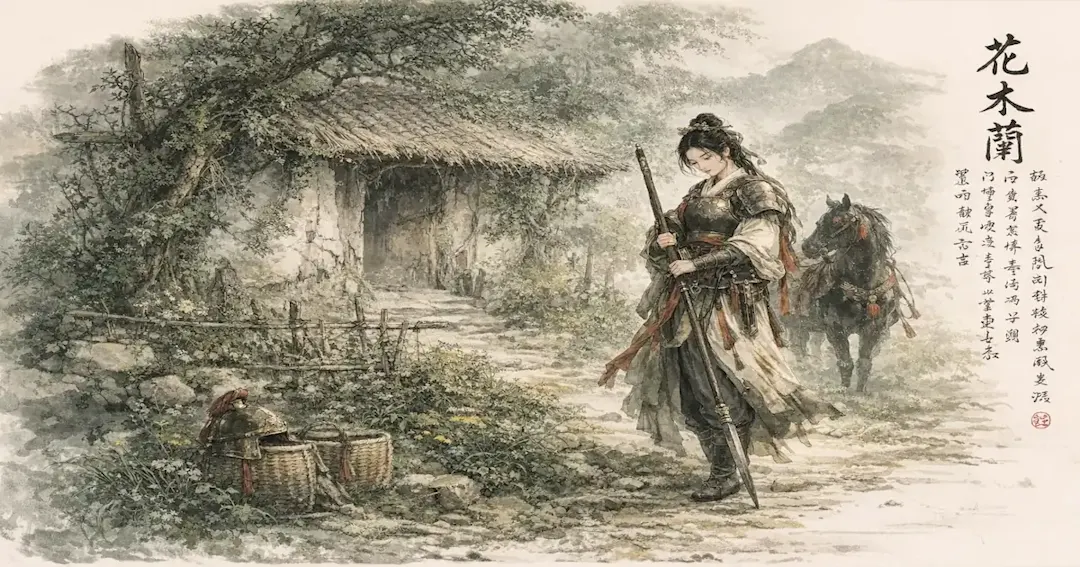
When people talk about “the original Mulan story,” they are usually referring to the Ballad of Mulan (often called Mulan Ci / The Ballad of Mulan), an early Chinese poem that preserved the story in a concise literary form.
This matters because many readers assume Mulan began as a modern children’s tale or a film character. She didn’t. Mulan is part of a much older Chinese storytelling and literary tradition.
The original poem is also much shorter and more restrained than most modern retellings. That surprises people. The Mulan many families know today comes from layers of retelling, adaptation, dramatization, and reinterpretation across centuries.
What happens in the traditional story (briefly)
Across common versions of the traditional legend, the broad narrative is familiar:
Mulan learns her father is being called to serve in war.
She takes his place (often described as an act of family duty and protection).
She serves for years in the army.
She returns home after military service.
Her comrades later discover she was a woman (in the classic poetic reveal).
Even in this simple outline, you can see why the story lasted. It combines action, duty, family responsibility, endurance, and identity—without needing a lot of plot machinery.
Why the original story feels different from the version most people know
Many families come to Mulan through Disney, which is totally understandable. But the emotional structure of the original ballad is different.
The traditional legend is often:
more compressed,
less centered on personal self-expression,
more focused on family duty and social role,
less dependent on a romance arc,
and less interested in explaining every emotional beat.
That difference is not a flaw. It reflects a different storytelling logic—and a different cultural emphasis.
For parents, this is a great teaching moment: children can learn that stories change across cultures and across time, and that “the version I know” is not always “the original version.”

Chinese Cultural Values in the Mulan Story
If your goal is to understand Chinese culture, this is the most important section. The Mulan story isn’t only remembered because of its plot. It lasts because it carries values, tensions, and social questions that many families still recognize today.
1) Family responsibility and filial care (not just a slogan)
A lot of summaries reduce Mulan to one word: filial piety. That’s not wrong, but it can be too shallow if left unexplained.
In a family context, what Mulan represents is not simply “obedience.” It is closer to:
responsibility under pressure,
care for parents,
willingness to carry a burden,
and action taken when a family is vulnerable.
That’s one reason parents around the world connect with the story, even outside Chinese culture. The emotional core is recognizable: someone sees a family crisis and steps forward.
For kids, this can be discussed in age-appropriate terms:
“How do we help our family?”
“What does responsibility look like?”
“What is brave help vs. showing off?”
Those are rich cultural conversations, not just vocabulary drills.
2) Duty, loyalty, and social role
Mulan is also often read through themes of duty and loyalty. In traditional Chinese storytelling contexts, characters are frequently evaluated not only by what they feel, but by how they act within family and society.
This doesn’t mean Chinese stories “ignore feelings.” It means feelings are often expressed through choices, sacrifice, and conduct.
That distinction can help children understand why older stories sometimes feel less verbally emotional than modern films. The meaning is still there. It is simply carried differently.
3) Courage in Mulan is more than battlefield strength
Many modern retellings frame Mulan mainly as a warrior heroine. That’s part of it—but culturally, her courage is often more layered than “being good at fighting.”
Her courage can also be read as:
enduring hardship without public reward,
protecting family at personal risk,
carrying identity tension in difficult conditions,
returning home without demanding status.
That last point matters. In many versions of the story, the ending emphasizes return and homecoming rather than a triumph speech. This makes the story feel very different from a standard modern “hero rises and wins power” arc.
4) Why Mulan still resonates with global families
Even when families are not Chinese, they often connect with Mulan because the story sits at the intersection of themes children understand early:
family
fairness
courage
identity
expectation
belonging
For Chinese heritage families, Mulan can also function as a bridge between home culture and mainstream media conversations. For non-Chinese families, it can become a respectful entry point into Chinese literature, storytelling traditions, and cultural values—if it is taught with context.
This is also where many parents realize something important: a story can spark interest, but children usually need guided language and cultural support to go beyond “I know the character’s name” into real understanding.
What Most People Get Wrong About Mulan
This is where the title’s promise comes in. The biggest misunderstandings are not just factual mistakes. They are category mistakes.
Mistake 1: Treating Disney as the original story
Disney adaptations introduced Mulan to millions of families. That cultural impact is real. But Disney is not the original source.
When people say “Mulan is inaccurate,” they are sometimes comparing one modern adaptation to another modern expectation, without first grounding themselves in the older Chinese legend and the Ballad of Mulan.
A better approach is:
Start with the legend / ballad tradition.
Then look at later retellings.
Then evaluate modern adaptations.
That order changes the conversation.
Mistake 2: Assuming “not historically verified” means “not meaningful”
This is probably the most common misunderstanding in English-language discussions.
A story can be:
difficult to verify as biography,
old and textually important,
socially influential,
culturally meaningful,
and still worth teaching seriously.
Many cultures preserve foundational stories through epic, legend, oral tradition, and literary adaptation. Mulan belongs in that broader conversation.
If a parent says, “So it’s just fiction,” children may miss the cultural value entirely. A better phrase is: “It’s a traditional legend that tells us something important about values and history-minded storytelling in Chinese culture.”
Mistake 3: Thinking there is only one fixed version of Mulan
There isn’t one single Mulan story frozen in time.
There is:
the early ballad tradition,
later literary and theatrical retellings,
modern nationalist readings,
schoolbook versions,
film adaptations,
and global pop-culture versions.
This is normal. Stories that survive tend to evolve.
Teaching kids that “stories change while core themes remain” is one of the best ways to build cultural literacy—especially in a multilingual world.
Mistake 4: Reducing Mulan to only a “girl power” story
Mulan can absolutely be meaningful in conversations about girls, gender, and strength. But if that is the only frame, a lot of Chinese cultural context disappears.
The story is also about:
family duty,
social responsibility,
war and service,
reputation,
return,
and the tension between personal identity and social role.
A narrower modern slogan can make the story easier to market, but less useful to understand.
Mistake 5: Assuming every “Chinese-looking” element in modern adaptations is culturally accurate
This is especially important for parents trying to teach respectfully.
Movies often blend:
different dynasties,
regional aesthetics,
symbolic motifs from unrelated traditions,
and modern fantasy elements.
Children usually don’t need a lecture on historical accuracy. But they do benefit from a simple habit: asking, “Is this from the original legend, later Chinese retellings, or a modern movie change?”
That question alone improves cultural understanding a lot.

Mulan Legend vs Disney Mulan: A Quick Comparison for Parents
This table is not meant to “grade” anyone’s favorite movie. It’s a practical guide to help families separate legend, retelling, and adaptation.
Aspect | Traditional Mulan Legend / Ballad Core | Common Later Retellings | Modern Disney Adaptations (general) | Why this matters for kids |
Source | Early Chinese ballad tradition | Expanded literary/dramatic versions over time | Modern commercial film adaptation | Helps kids understand source vs adaptation |
Story length/style | Short, compressed, poetic | More narrative detail added | Full dramatic arcs, side characters, cinematic conflict | Shows how stories change format |
Family focus | Strong | Still important | Present, but reframed for modern audiences | Good entry point for discussing values |
Romance emphasis | Limited or not central in early core | Varies by version | Often more visible or implied for modern storytelling | Kids can compare “plot additions” |
Villains/conflict | Simpler structure in early text | Expanded in later versions | Clearly dramatized antagonists | Useful for identifying adaptation choices |
Supernatural/fantasy elements | Not central in the ballad core | Varies | May be added/altered based on film version | Teaches children not to assume all symbols are original |
Ending emphasis | Return home, identity reveal, closure | Varies | Often built around emotional payoff and cinematic resolution | Shows different storytelling goals |
Cultural values highlighted | Duty, family, endurance, role | Broader depending on era | Often identity/self-expression + spectacle | Good for comparing value emphasis |
A useful parent prompt after watching any version: “What parts of this story feel like old legend, and what parts feel like modern movie storytelling?”
That question invites curiosity without turning family time into a correction session.
Is Mulan “True” in a Historical Sense? What Historians Can and Cannot Confirm
What would count as historical proof?
For historians, a “true story” claim usually needs more than popularity or repetition. They look for things like:
contemporaneous records,
reliable historical texts,
cross-referenced names and events,
documentary consistency,
and evidence that can be dated and checked.
Mulan’s case is difficult because the story survives primarily through a literary tradition, not a clean historical archive that modern readers would recognize as biography.
Why historians are careful (and why that’s a good thing)
When historians say Mulan is legendary or historically unverified, they are not saying, “This story is worthless.” They are saying they are applying a specific standard of evidence.
That distinction is important for children to learn early:
History asks one set of questions.
Literature and culture ask another set.
Both matter.
This is actually one of the best educational opportunities in the Mulan topic. A child can learn that “real” does not only mean “documented in a modern way.” Some stories are culturally real because they shape language, values, and identity over generations.
A parent-friendly way to explain it to kids
Try this:
“Mulan is a famous Chinese legend from an old poem. We can’t prove every part like a history textbook, but the story is still important because it teaches values and shows how people passed stories down.”
That sentence usually works well for elementary and middle-school ages. It is clear, respectful, and accurate enough to build on later.
How to Use Mulan as a Chinese Culture Learning Topic at Home
This is where Mulan becomes more than a movie discussion. It becomes a practical, high-interest learning topic.
Ages 5–8: story + characters + simple cultural words
At this age, don’t over-explain “historical verification.” Start with:
characters,
family roles,
basic values,
simple Chinese words tied to the story.
You can use a mini word set like:
family
brave
father
daughter
home
duty
love
courage
If your child is learning Chinese, you can add a few beginner-friendly terms or characters (depending on level) without turning it into memorization pressure. The goal is recognition and connection.
Simple activity ideas:
story sequencing cards (“what happened first?”)
“legend or movie addition?” guessing game
draw a scene and label 2–3 key ideas (family, courage, home)
Ages 9–12: compare versions and discuss values
This is a great age for version comparison.
Instead of asking, “What’s the right answer?”, ask:
What changed between the legend and the movie?
Why would a movie change this?
What values are strongest in each version?
Which parts feel most Chinese-culture-focused? Which parts feel most Hollywood-style?
These questions build both cultural literacy and critical thinking.
Many parents find this stage surprisingly rewarding because children begin to notice that stories carry values, not just events.
Ages 13–15: culture, history, and interpretation
Older kids can handle the richer conversation:
legend vs historical proof
adaptation vs source text
how cultures are represented in global media
why stories are retold differently in different eras
This is where Mulan becomes a meaningful entry point into broader Chinese culture learning:
literature
history context
social values
language expressions
narrative tradition
If your child is already asking “Which version is accurate?” or “What did the original say?”, that is usually a sign they are ready for more structured cultural and language learning—not just random videos or one-off summaries.
When parents may want structured support
A common pattern is this: a child is curious, but the parent is not sure how to guide the next step—especially if they want to connect the topic to real Chinese learning instead of staying at the movie level.
That is a strong moment to use a structured class format, where a teacher can connect:
story topics
age-appropriate Chinese vocabulary
cultural context
speaking practice
comprehension
If your family wants to build on a topic like Mulan while the interest is still fresh, a LingoAce trial class can be a practical next step. It helps turn “my child likes this story” into actual Chinese learning momentum in a way that feels guided, not overwhelming.

How to Talk About Mulan Respectfully Without Overcorrecting Kids
Parents sometimes swing too far in one of two directions:
“Everything in the movie is accurate enough.”
“The movie is wrong, forget it.”
A better middle path is to use the movie as a doorway, then add context.
Try this 3-step script:
Validate interest: “It’s a great story, and lots of people know Mulan because of the movie.”
Add context: “The story comes from an old Chinese legend and poem.”
Invite curiosity: “Want to see what’s different between the legend and the movie?”
This keeps the conversation positive while still building cultural accuracy.
It also models an important habit for children in general: enjoying a story while asking where it came from.
FAQ: Is Mulan Based on a True Story?
Is Mulan based on a true story or a legend?
Mulan is generally understood as a Chinese legend rooted in the Ballad of Mulan, rather than a fully verified historical biography. The story is culturally important even though historians cannot confirm every detail as documented fact.
Was Hua Mulan a real person in Chinese history?
There is no broad scholarly consensus supported by clear historical records proving Hua Mulan as a fully documented historical person in the way modern readers usually mean. Most explanations describe her as a legendary figure preserved through literature and retellings.
What is the Ballad of Mulan, and is it the original story?
The Ballad of Mulan is the earliest and most important source associated with the Mulan legend. It is an old Chinese poem and the foundation behind many later retellings and modern adaptations.
How accurate is Disney’s Mulan compared with the Chinese legend?
Disney adaptations are inspired by the Mulan legend but include many modern storytelling changes. They are best understood as adaptations, not direct translations of the original Chinese ballad tradition.
Why is Mulan important in Chinese culture?
Mulan matters in Chinese culture because the story carries themes such as family responsibility, duty, courage, and identity. It also shows how a legend can remain meaningful across centuries through retelling and reinterpretation.
Final Thoughts
So, is Mulan based on a true story? The most accurate answer is: Mulan is based on a traditional Chinese legend preserved in an early ballad, not a fully verifiable historical biography.But that answer only gets you halfway there.
What makes Mulan worth learning—especially for families—is not just the “true or false” question. It’s the deeper cultural layer: how stories preserve values, how legends evolve, and how children can learn to enjoy a story while also asking thoughtful questions about source, history, and meaning.
If your child is already curious about Mulan, that curiosity can become a powerful starting point for Chinese culture and language learning. And if you want support turning story interest into real progress, you can try a LingoAce trial class to help your child explore Chinese in a structured, age-appropriate way.