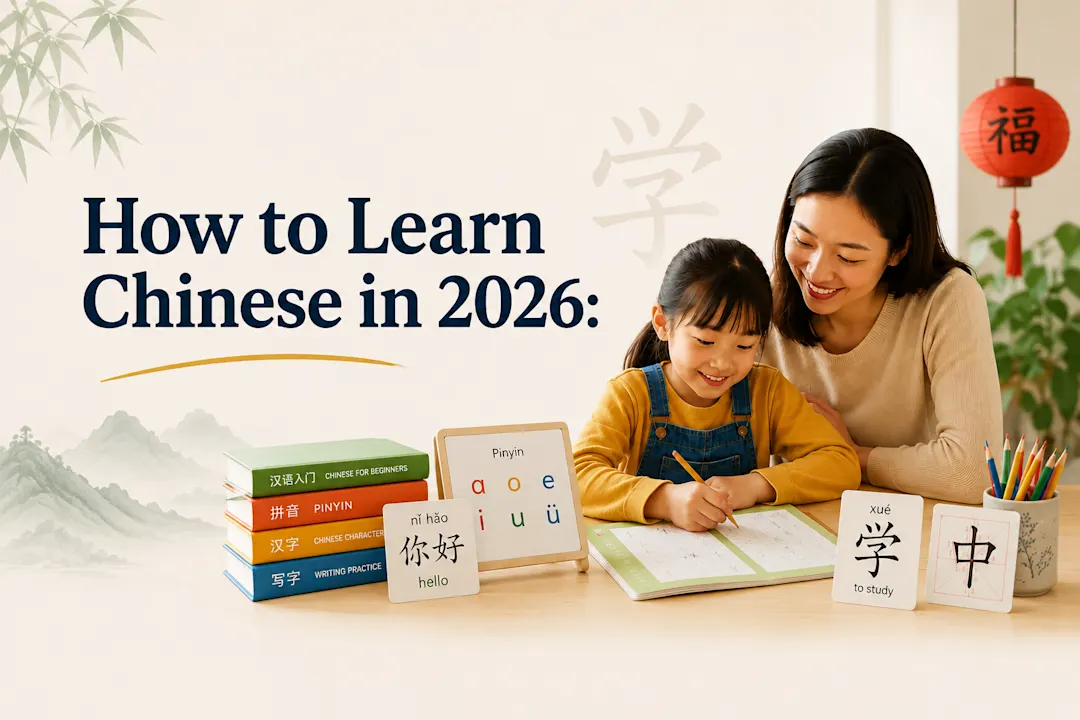
A practical roadmap for helping kids build Mandarin confidence through pinyin, speaking, Chinese characters, and real-life writing practice.
A lot of parents start with the same little worry: “My child knows a few Chinese words… so why do they freeze when Grandma asks a simple question?”
It is not always a motivation problem. Many children living outside China hear Chinese only in short, scattered moments: a weekend class, a video call, a song in the car, maybe a few phrases at home. Then adults expect them to speak, read, recognize Chinese characters, and somehow write neatly too. That is a lot.
This guide explains how to learn Chinese in a way that makes sense for children and families in 2026. We will cover the Chinese language, the common “Chinese alphabet” misunderstanding, how Chinese characters actually work, and how to build Chinese writing without turning it into a battle at the kitchen table.
The goal is not to make your child memorize everything. Not even close. The goal is to help them use Mandarin in small, real moments until the language starts to feel less like homework and more like something that belongs in their life.
How to Learn Chinese Starts with Understanding the Chinese Language Before choosing apps, books, tutors, worksheets, or online classes, parents need one simple starting point: the Chinese language does not work like English. English uses an alphabet. A child sees letters, blends sounds, and slowly learns to decode words. Mandarin is different. Sound, tone, meaning, and written form are connected, but not in the same straight line. That is why a child can sometimes say a word correctly but not recognize the written character. Or recognize a character but feel unsure about how to pronounce it. That gap is normal. What makes the Chinese language different from English? In Mandarin, tone changes meaning. The syllable “ma” can mean different things depending on tone. For children who are used to English, this feels strange at first. They may hear the sound but miss the tone. Or they may copy the tone once, then forget it in real conversation. Chinese grammar can actually feel simpler in some ways. There are no verb conjugations like “go, went, gone.” No plural “s” in the same way English uses it. But pronunciation and character recognition need steady exposure. That is one reason parents often feel stuck when they search how to learn Chinese. The advice can be all over the place: start with speaking, start with writing, start with pinyin, start with characters, use an app, hire a tutor, watch cartoons. Some of it is useful. Some of it is too much for a seven-year-old who just got home from school and wants a snack. A better approach is layered:
Hear Chinese often.
Say useful phrases.
Learn pinyin as a tool.
Recognize high-frequency Chinese characters.
Add Chinese writing slowly.
Use the language with real people.
Not fancy. But it works better than dumping everything on a child at once. Why children need sound before symbols For most kids, Mandarin should begin with sound and meaning. They need to hear “māma,” “wǒ yào,” “wǒ xǐhuān,” “nǐ kàn,” and connect those phrases to people, actions, food, games, and emotions. Then the written side has somewhere to land. A child who already knows the word 家 as “home” or “family” will have a much easier time learning the character 家. Without that oral foundation, the character just looks like lines. A tiny roof, a complicated bottom, and no meaning. No wonder some kids resist. Parents can start small today. Use one Chinese phrase during a predictable routine:
At breakfast: “吃饭了.”
In the car: “我们走吧.”
Before bed: “晚安.”
During play: “轮到你.”
One phrase. Repeated often. Not a lecture. Just life.
This is also where structured programs can help. A good class gives children repeated sound exposure, teacher correction, and chances to answer in Mandarin instead of only listening. LingoAce’s approach fits this need well because it combines live interaction with age-based Chinese learning, so children are not just watching Chinese. They are responding, practicing, and slowly building confidence.
Does the Chinese Language Have a Chinese Alphabet?
Many parents search for “Chinese alphabet” because they are trying to find the Chinese version of A, B, C. It is an understandable question. But the honest answer is: there is no Chinese alphabet in the English sense.
Mandarin uses Chinese characters, not letters. Each character usually carries meaning and sound, but it is not built by spelling words with letters. This is one of the biggest early surprises for families learning Chinese.
The honest answer: there is no Chinese alphabet like A to Z
When people say “Chinese alphabet,” they usually mean pinyin.
Pinyin uses Roman letters to show Mandarin pronunciation. For example:
Pinyin | Character | Meaning |
mā | 妈 | mom |
mǎ | 马 | horse |
jiā | 家 | home/family |
rén | 人 | person |
shuǐ | 水 | water |
So yes, your child will see familiar letters. But pinyin is not the actual Chinese writing system. It is a bridge. That bridge matters. It helps children hear sounds, practice tones, type Chinese on a keyboard, and look up new words. But if a child only learns pinyin, they are not yet reading Chinese. They are reading a pronunciation guide. What pinyin actually does for children Pinyin is useful because it lowers the entry barrier. A child does not need to recognize many Chinese characters on day one. They can begin with sounds, songs, short phrases, and basic conversation. For young learners, pinyin helps with:
Pronouncing new words
Noticing tones
Reading aloud with support
Typing Mandarin
Connecting spoken Chinese to written Chinese later
But there is a catch. A child can become too comfortable with pinyin. They may read “wǒ ài wǒ de jiā” perfectly, then freeze when they see 我爱我的家. That is why pinyin should not stay alone for too long. Pair it with Chinese characters early, even if the child is only recognizing a few. Parent tip: do not let pinyin become a comfort blanket Here is a simple habit: whenever your child learns a new pinyin word, show the character too. Not ten characters. One is enough. If the word is jiā, show 家. Use it in tiny phrases:
我家
回家
家人
家里
Let your child notice that one character can appear in many useful words. This turns Chinese characters from “random drawings” into familiar faces. That sounds small, but for a child it can change the feeling completely. How to Learn Chinese Characters Without Making Your Child Hate Them For many families, Chinese characters are the scary part. Parents worry because they remember copying pages of characters as children. Kids worry because the shapes look impossible. Non-Chinese-speaking parents worry because they cannot check whether the writing is right. But Chinese characters are not random. They have patterns, parts, and stories. Once children begin seeing those patterns, the whole thing becomes less mysterious. Chinese characters are not random drawings Many Chinese characters are built from smaller components. Some components hint at meaning. Some hint at sound. Some simply help organize the character. For example:
口 often relates to mouth or openings.
木 relates to tree or wood.
氵 often connects to water.
女 appears in many characters historically connected to female-related meanings.
心 relates to heart or feelings.
Children do not need a long lecture about radicals. They just need a few “clues” that help them look at Chinese characters differently. Instead of saying, “Memorize this,” a parent can ask: “What part do you notice?” “Does this character look like another one we saw?” “Can you find the water part?” It becomes a small detective game. Not always magical, of course. Some days kids will still say, “This is too hard.” Fair. But the structure gives them something to hold onto. Start with useful characters, not huge lists A common mistake is starting with too many characters. A child sees a list of 50 or 100 and shuts down before beginning.
Start with characters that appear in real family life.
Character | Pinyin | Meaning | Kid-friendly use |
人 | rén | person | 家人, 大人 |
口 | kǒu | mouth/opening | 门口 |
日 | rì | sun/day | 生日 |
月 | yuè | moon/month | 月亮 |
家 | jiā | home/family | 我家 |
水 | shuǐ | water | 喝水 |
火 | huǒ | fire | 火车 |
山 | shān | mountain | 山上 |
大 | dà | big | 大苹果 |
小 | xiǎo | small | 小猫 |
These characters are not just for memorization. They connect to things children can say. That matters. A child who learns 水 can say 我要喝水. A child who learns 家 can tell a grandparent 我在家. Suddenly a written word is attached to a voice, a person, a need. That is the difference between learning Chinese as a living language and treating it like a worksheet. Use stories, not pressure Some Chinese characters are easier to remember through stories. Take 明. It combines 日 and 月, sun and moon, and means bright. Children usually remember that quickly because the image makes sense. Not every character works this neatly. And honestly, some explanations get stretched too far. Parents do not need to turn every character into a myth. But a few memorable stories can make Chinese characters feel less cold. Try this weekly routine:
Choose 3 characters.
Say each one aloud.
Find one small component.
Use the character in one real phrase.
Let your child draw, type, trace, or write it.
Yes, type counts too. Especially for older kids. Chinese literacy in 2026 includes handwriting, recognition, typing, and reading on screens. Chinese writing still matters, but it does not have to mean endless copying. How to Learn Chinese Writing in a Way That Actually Helps Reading Chinese writing can either support learning or ruin the mood very quickly. It depends on how it is introduced. If a child is asked to copy one character twenty times before they know what it means, the brain learns one thing: Chinese is boring. Maybe painful. Maybe something to avoid. But when writing is connected to sound, meaning, and real use, it becomes part of the learning loop. Chinese writing is more than handwriting
Chinese writing includes several skills:
Knowing stroke order
Seeing character structure
Writing by hand
Typing characters
Building words
Making sentences
Using written Chinese for real messages
For a 5-year-old, Chinese writing might mean tracing 人 and saying “rén.” For a 9-year-old, it may mean writing 我爱妈妈 on a card. For a 13-year-old, it could mean texting a short message to a cousin or writing a simple paragraph about school. Same language. Different expectations. That age difference matters. A preschooler should not be forced into the same writing routine as a middle schooler. And a heritage learner who understands spoken Mandarin may need a different path from a complete beginner. Stroke order matters, but perfection is not the first goal Stroke order helps children write more smoothly and recognize structures faster. It gives characters a rhythm. Top to bottom, left to right, horizontal before vertical in many cases. These patterns make writing less chaotic. But parents should be careful. If every writing attempt turns into correction, children may stop trying. There is a time to fix stroke order, and there is a time to say, “Good, you remembered the word.” Try a four-step practice:
Look at the character.
Say the word aloud.
Write it once or twice with attention.
Use it in a phrase.
For example:
Character: 月
Say: yuè
Write: 月
Use: 月亮, 一个月
This is small enough for a school night. That is the point. A 10-minute Chinese writing routine for busy families Here is a routine that works better than long weekend cramming:
Time | Activity | Example |
2 minutes | Review 2 old characters | 人, 家 |
3 minutes | Learn 1 new character | 水 |
3 minutes | Write or type 1 useful word | 喝水 |
2 minutes | Say 1 sentence | 我要喝水 |
Ten minutes. Then stop. Stopping before the child melts down is an underrated parenting skill. For families who want a steadier path, a live online program can help because the teacher handles pacing, feedback, and review. LingoAce classes are designed for children learning Mandarin at different levels, including kids who need help moving from spoken words to Chinese characters and Chinese writing. Parents can book a trial class to see where their child is now and what kind of learning rhythm fits best. How to Learn Chinese at Home When Your Child Has Little Mandarin Environment This is the part many articles miss. A child may attend class once or twice a week, but the rest of life happens in English. School is English. Friends are English. Sports, games, library books, birthday parties — mostly English. So when parents wonder how to learn Chinese at home, the real question is: how do we keep Chinese alive between lessons? The biggest problem is not motivation. It is missing context. Many children do not reject Chinese because they dislike it. They reject it because it feels disconnected from their day. They learn “apple” in Mandarin, but nobody asks for an apple in Mandarin at home. They learn family terms, but cousins speak English. They learn a poem, but they cannot use it at soccer practice or in the cafeteria. For heritage families, this can feel emotional. A parent may think, “I grew up speaking Chinese. Why won’t my child answer me?” But the child is growing up in a different language world. A softer approach helps. Instead of turning every conversation into a correction, create small moments where Chinese has a job. Build tiny Chinese moments into normal life Try these:
Put sticky notes on three objects: 门, 桌子, 水.
Ask one dinner question in Mandarin: 你喜欢什么?
Let your child order one item at a Chinese restaurant.
Send one voice message to a grandparent each week.
Watch a short Chinese story and ask for one word they remember.
Use Chinese numbers while climbing stairs.
Let your child label a drawing with one Chinese character.
These moments are tiny, but they add up. More importantly, they tell the child: Chinese is not only something adults test me on. Chinese helps me connect, play, ask, joke, and belong. That is also why live interaction matters. Apps can be useful. Videos can be useful. Flashcards can be useful. But children need someone to listen and respond. They need a teacher who notices when a tone is off, when a sentence is half-built, when confidence is starting to grow. This is where LingoAce can fit naturally for many families: not as the only way to learn Mandarin, but as a structured environment where children practice speaking, reading, and writing with teachers who understand age-level learning. A 2026 Roadmap: How to Learn Chinese Step by Step If you are trying to plan how to learn Chinese for your child, think in stages. Not a race. More like building a house where the foundation actually has time to dry. Stage 1: Hear and speak before worrying about writing The first stage should be sound, rhythm, and simple meaning. Useful goals:
Greet someone
Say name and age
Name family members
Ask for food or water
Understand basic classroom phrases
Repeat short sentences with correct tone patterns
At this stage, parents should not panic if the child cannot read many Chinese characters yet. Recognition will come more easily when spoken words already feel familiar. Stage 2: Learn pinyin and tones as tools, not the final goal Pinyin helps children organize sounds. Tones help them avoid meaning mix-ups. Together, they make early Mandarin less foggy.
But remember: pinyin is a tool. It is not the destination. A child should gradually connect pinyin to Chinese characters:
wǒ → 我
nǐ → 你
hǎo → 好
jiā → 家
shuǐ → 水
This pairing helps children move from sound to print. It also prevents the “I can read pinyin but not Chinese” problem. Stage 3: Add Chinese characters through meaning groups Group characters by theme:
Theme | Starter characters |
Family | 人, 家, 妈, 爸 |
Nature | 日, 月, 山, 水 |
Size and number | 大, 小, 一, 二, 三 |
Food and daily life | 米, 口, 茶, 饭 |
Feelings and actions | 爱, 看, 去, 来 |
Children remember better when characters belong to a world they understand. Family words go with family photos. Food words go with dinner. Nature words go with drawings or weekend walks. A little messy? Yes. But real life is sticky, and sticky memories last. Stage 4: Move from Chinese characters to Chinese writing Once children recognize a few characters, writing can become more meaningful. Start with:
Their Chinese name, if they have one
Family words
Favorite foods
Animals
A holiday greeting
A short self-introduction
For example: 我叫安安。 我喜欢猫。 我爱我家。 These sentences are simple, but they give a child ownership. They are not copying random lines. They are writing something about themselves. That shift matters. Stage 5: Keep Chinese alive outside class Long-term Mandarin learning depends on use. Even a strong class cannot do everything if Chinese disappears after the lesson ends. Parents can build a weekly rhythm:
One live lesson or structured learning session
Two short review moments
One family-use moment
One culture moment, such as food, festival, story, song, or call with relatives
This is why LingoAce emphasizes both language and culture. Children often stay more engaged when Mandarin is tied to stories, celebrations, family identity, and things they can actually talk about. For non-heritage learners, culture gives Chinese a world. For heritage learners, it can give Chinese a place in their own story. Common Mistakes Parents Make When Helping Kids Learn Chinese Even well-meaning parents can accidentally make Mandarin harder than it needs to be. Here are the mistakes worth avoiding. Mistake 1: Starting with too much writing Writing is important, but too much too early can make children feel defeated. If a beginner’s first experience is copying complicated characters, they may decide Chinese is “too hard” before they have tasted any success. Start with listening and speaking. Add recognition. Then writing. Mistake 2: Treating pinyin as the Chinese alphabet This one is common. Pinyin uses letters, so it looks like an alphabet. But the Chinese alphabet idea can confuse children if it is not explained clearly. A better explanation is: “Pinyin helps us say the word. Chinese characters show the real written word.” That sentence is simple enough for kids, and accurate enough for parents. Mistake 3: Changing resources every two weeks One app for tones. Another app for writing. A YouTube playlist. A workbook. A printable chart. A tutor trial. Then another class. Parents do this because they care. But too many tools can create noise. Children need repetition, not constant novelty. Pick a path and stay with it long enough to see progress. Usually, that means several months, not several days. Mistake 4: Expecting bilingual results without enough output Children do not become confident speakers just by hearing Chinese in the background. Listening helps, but output builds fluency. They need chances to answer questions, make mistakes, repair sentences, and try again. A teacher, parent, grandparent, classmate, or small learning group can provide that.
The key is safe pressure. Enough challenge to grow. Not so much that the child shuts down. What to Look for in a Chinese Learning Program for Kids Not every Chinese class is right for every child. Before choosing a program, parents should look at how it handles level, speaking time, reading, writing, and cultural connection. Clear placement and level progression A child who “knows some Chinese” may still have uneven skills. Maybe they understand family conversation but cannot read. Maybe they can read pinyin but do not know tones well. Maybe they recognize characters but cannot speak in full sentences. Good placement should identify those gaps. Ask:
Can the program assess speaking, listening, reading, and writing separately?
Does it adjust by age?
Does it support both heritage and non-heritage learners?
Will parents understand what the child is working on next?
A clear level path reduces guessing. Parents should not have to wonder for months whether a class is too easy or too hard. Real conversation, not only memorization Memorization has a place. Children do need words and phrases. But Mandarin class should not stop there. Look for lessons where children:
Answer real questions
Describe pictures
Retell simple stories
Use new words in their own sentences
Speak with teacher support
Review old material in new contexts
This is especially important for families outside China. Children need a Mandarin-speaking space where they are expected, gently, to use the language. Reading and writing that grow with age A good program should not rush every child into heavy handwriting. It should also not avoid Chinese writing forever. The balance changes by age:
Age group | Better focus |
3–6 | Listening, speaking, songs, simple recognition, tracing |
7–10 | Pinyin, high-frequency characters, guided reading, short writing |
11–15 | Reading comprehension, sentence building, typing, handwriting, cultural topics |
Children grow. The program should grow with them. Cultural topics that make Chinese feel meaningful Language without culture can feel flat. Kids may learn words but not understand when, why, or how people use them. Cultural topics can include:
Lunar New Year
Zodiac animals
Chinese food
Family titles
Idioms and stories
Festivals
School life in different countries
Respectful greetings
These topics help children see Mandarin as more than vocabulary. It becomes a way to understand people, family, stories, and identity. For parents comparing options, LingoAce is worth considering because its online Mandarin classes are built around structured learning, live teacher interaction, and culturally rich content for children. If your child has tried Chinese before but never found a rhythm, a trial class can help you see whether a guided path feels easier than piecing everything together alone. FAQ About How to Learn Chinese What is the best way to learn Chinese for kids in 2026? The best way is to combine listening, speaking, pinyin, Chinese characters, and age-appropriate writing. For most children, it works better to begin with useful spoken phrases and then connect those sounds to characters. A steady routine beats a huge resource list. Does the Chinese language have a Chinese alphabet? No, the Chinese language does not have a Chinese alphabet like English has A to Z. What many people call the Chinese alphabet is usually pinyin, a Roman-letter system that shows pronunciation. Children should learn pinyin, but they also need to recognize Chinese characters.
Should my child learn pinyin or Chinese characters first?
Most children benefit from learning sounds and pinyin early, then adding simple Chinese characters soon after. Pinyin helps with pronunciation, while characters build real reading ability. The two should support each other instead of competing.
How can children practice Chinese writing without getting bored?
Keep Chinese writing short, meaningful, and connected to real life. Children can write their name, family words, favorite foods, birthday cards, or tiny diary sentences. Writing one useful sentence is often better than copying one character twenty times.
How long does it take to learn Chinese characters?
It depends on age, exposure, consistency, and goals. A child can recognize a small set of useful Chinese characters within weeks, but reading comfortably takes longer. The key is regular review and using characters in words, phrases, and stories.
Conclusion: The Best Way to Learn Chinese Is to Make It Usable
Parents searching how to learn Chinese often want one perfect answer. There is not one. But there is a practical path: begin with sound, use pinyin wisely, introduce Chinese characters through meaning, build Chinese writing slowly, and keep Mandarin alive in daily life.
Your child does not need to master everything at once. They need enough success to continue.
If you want help understanding your child’s current Mandarin level and building a learning path that fits your family routine, you can book a LingoAce trial class. A good first step is not a giant plan. It is seeing where your child is today, then helping them move one level forward.