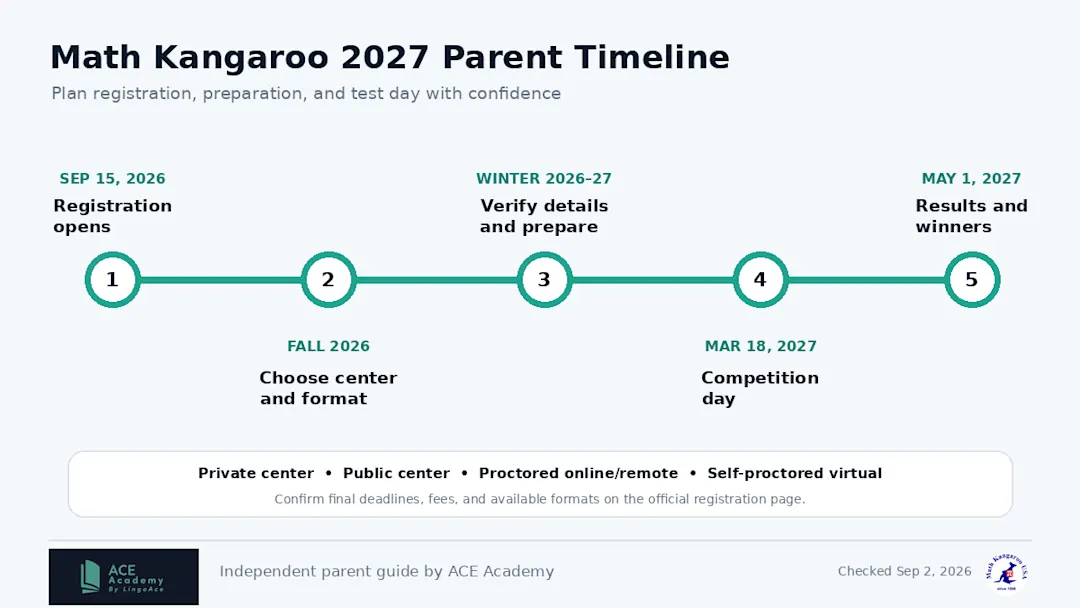
For students preparing for Math Kangaroo 2027, start with grade-appropriate sample questions, strengthen the reasoning behind missed answers, and introduce timed practice gradually. The standard U.S. individual competition is March 18, 2027. A paid course is optional; students ready for sustained competition study can explore AMC 8 or AMC 10 preparation after a placement assessment. These are separate competitions with different requirements, not automatic next levels of Math Kangaroo.
Written by Darren Smith, Education Researcher at ACE Academy. Information checked September 28, 2026.
This guide is published by ACE Academy, which offers paid mathematics courses. Competition rules come from the organizers; course details come from ACE Academy’s program materials and website. Study plans and readiness suggestions below are editorial guidance.
A guide to U.S. Math Kangaroo registration, preparation, and longer-term learning options.
Math Kangaroo 2027 at a glance
Math Kangaroo offers a structured opportunity to try unfamiliar mathematical problems. For a first-time participant, the immediate goal should be understanding the format and learning to choose a useful strategy.
Parent question | Direct answer |
When is the U.S. individual competition? | Thursday, March 18, 2027; verify the selected center’s arrangements. |
Who can participate? | K–12 students who can read and answer independently. Kindergarten students take the grade 1 test. |
When is regular registration? | September 15–December 31, 2026. Registration is open as of this guide’s review date. |
What does registration cost? | $20 during regular registration; $35 during late registration, ending February 1, 2027. |
How long is the test? | 75 minutes. |
Is a preparation class required? | No. Start with official samples and decide whether additional instruction would help. |
Dates and fees follow Math Kangaroo USA’s 2027 season information. Confirm availability, session details, and the final fee before registering.
How to register for Math Kangaroo 2027
Use the official Math Kangaroo registration page and select an available center or format. Registration for a class at an education provider is separate from registration for the competition.
Ask whether the student’s school has a participating center. Private centers may require an invitation code.
If needed, search for an open registration center and check the applicable state residency rules.
Verify the student’s grade, location, testing format, and session instructions.
Save the confirmation and review the center’s instructions again before test day.
Check the participation conditions carefully. The organizer distinguishes proctored testing from self-proctored virtual participation, which does not qualify for official rankings or awards. Available options and arrangements must be checked for the selected season and center.
What Math Kangaroo tests
Math Kangaroo asks students to make sense of unfamiliar problems using mathematical knowledge and reasoning. A student may need to interpret a diagram, organize possibilities, identify a pattern, or work backward before doing any calculation.
School grades alone do not show how a student responds to this kind of challenge. Try a few official Math Kangaroo sample questions and listen to the explanation, not just the answer. Can the student identify the relevant information? Explain why a diagram helps? Check whether the result satisfies every condition?
Research on mathematical competition problem design examines how unfamiliar problems differ from routine classroom tasks. It offers a reason to choose practice problems thoughtfully, rather than assume that more worksheets automatically produce better reasoning.
Math Kangaroo test format and scoring
The U.S. individual test is multiple choice. The number of questions depends on grade level, while the time limit stays the same.
Grade group | Questions | Time | Maximum score |
Grades 1–4, including kindergarten taking grade 1 | 24 | 75 minutes | 96 points |
Grades 5–12 | 30 | 75 minutes | 120 points |
Questions in the first, middle, and final thirds are worth 3, 4, and 5 points respectively. Incorrect answers do not subtract points. Students can use practice sessions to learn when to move on and return to a difficult problem later.
Sources: the organizer’s test FAQ and scoring guide. Use the specific 2027 registration information above for current fees.
Question counts and maximum scores vary by grade. Kindergarten students take the grade 1 test.
Is Math Kangaroo a good fit for the student
Math Kangaroo can be worth exploring when a student enjoys puzzles and can work independently. Readiness matters more than a gifted label. For younger students, check reading confidence as well as mathematical understanding.
What you notice | A useful next step |
Enjoys puzzles but struggles to read the instructions | Build independent reading and use accessible, untimed problems first. |
Calculates accurately but does not know how to start | Practice drawing models, listing cases, and explaining the first step. |
Understands solutions but makes rushed mistakes | Introduce short timed sets and a checking routine. |
Solves grade-level samples comfortably and wants more challenge | Discuss a longer-term enrichment or competition pathway after assessment. |
Has gaps in fractions, ratios, or basic equations | Strengthen those concepts alongside selected reasoning problems. |
These observations are planning prompts, not a diagnostic test. For families deciding between foundational study, Honors Math, and competition work, ACE Academy’s math programs provide an overview of the available learning directions.
How to prepare for Math Kangaroo without overloading the schedule
Begin with understanding, then add pacing. A productive practice session ends with the student explaining what changed in their approach, rather than simply recording a score.
Use a simple problem-review routine
Read: Restate the question and identify the conditions.
Represent: Draw a diagram, make a table, or list a small set of cases.
Solve: Choose a strategy and show enough work to check it.
Explain: Describe why the approach works and why another answer would fail.
Revisit: Try a related problem later without copying the solution.
Keep an error log with the problem, the reason for the mistake, and the next strategy to try. A reading error, an unfamiliar concept, and a counting mistake need different kinds of practice.
Follow a flexible eight-week practice plan
This is a suggested family schedule, not an official requirement or a course enrollment commitment. Adjust session length to the student’s age, concentration, and starting level.
Stage | Focus | Evidence of progress |
Week 1 | Try a small sample set without a timer | Identify reading, concept, and strategy gaps. |
Weeks 2–3 | Review missed concepts and draw models | Explain each step independently. |
Weeks 4–5 | Mix geometry, patterns, counting, and logic | Apply a strategy to a different-looking problem. |
Week 6 | Introduce short timed sets | Move past a difficult question without losing focus. |
Week 7 | Try a longer practice session | Maintain attention and record answers carefully. |
Week 8 | Review useful strategies and test-day instructions | Approach the competition with a manageable plan. |
If the work repeatedly causes frustration, reduce the difficulty before increasing the volume. A first competition can be a way to learn about the student’s interests and habits; it does not need to become a high-stakes outcome.
How to choose a Math Kangaroo preparation program
Choose instruction based on the student’s current needs. Ask the provider to show how placement, teaching, and feedback work before discussing a score target.
Placement: How will the starting level be determined?
Teaching: Will students compare approaches and explain their reasoning?
Feedback: Will the teacher identify the misconception behind a wrong answer?
Challenge: How is the difficulty adjusted when work is too easy or too difficult?
Progress: What work samples or assessments will show development?
Scope: Is the course specifically designed for Math Kangaroo, or is it broader mathematical enrichment?
Do not assume that any course labeled “competition math” follows the same syllabus or test format. Ask about the actual course, lesson duration, total commitment, and tuition. No provider can responsibly guarantee an award from enrollment alone.
How Math Kangaroo relates to AMC 8 and AMC 10
Math Kangaroo, AMC 8, and AMC 10 all involve problem solving, but participation in one does not qualify a student for another. The right choice depends on eligibility, mathematical preparation, and the student’s interest.
Competition | Eligibility summary | Test format |
Math Kangaroo USA | K–12; independent reading and answering required | 75 minutes; 24 or 30 questions by grade |
AMC 8 | Grade 8 or below and under 15.5 on competition day | 25 questions in 40 minutes |
AMC 10 | Grade 10 or below and under 17.5 on competition day | 25 questions in 75 minutes |
The AMC rules above come from the Mathematical Association of America. Course placement and eligibility to sit an exam are separate decisions.
AMC 8 may suit eligible students ready to study middle-school competition topics more systematically. AMC 10 requires broader preparation in algebra, geometry, number theory, and counting. A strong Math Kangaroo result alone does not establish readiness for either course.
For an example of how problem-solving demands can extend beyond calculation, read ACE Academy’s 2026 AMC 8 results and exam analysis, which includes Dr. Hui Jin’s discussion of reasoning and problem structure. Historical results describe a past cohort; they do not predict an individual student’s outcome.
ACE Academy courses for students ready for the AMC pathway
ACE Academy’s AMC courses are an option for students seeking sustained competition study beyond a single Math Kangaroo event. They should be selected through placement, rather than treated as required Math Kangaroo preparation.
Regular AMC 8 formats and the documented 2026 fall AMC 10 format. Placement and current cohort details should be confirmed.
AMC 8 Basics
AMC 8 Basics builds a foundation across algebra, number theory, geometry, and counting. Topics include ratios and percentages, equations, data and statistics, primes and factors, the Pythagorean theorem, area, and systematic counting.
The program is generally aimed at grades 5–8, approximately ages 10–14. It may fit students with a solid Pre-Algebra foundation who are beginning systematic AMC 8 preparation. Prior contest experience can inform placement, but is not the only evidence of readiness.
AMC 8 Advanced
AMC 8 Advanced develops more demanding applications of the same four areas. Topics include algebraic transformations, sequences, integer solutions, irregular areas, volume, special permutations, path counting, and probability.
It may fit students who can already handle foundational competition problems and need practice combining ideas across multiple steps. Placement determines whether Advanced is the right starting point; enrollment does not guarantee an Honor Roll result.
AMC 10 Competition
The documented AMC 10 course covers four modules: algebra, geometry, number theory, and counting. Lessons include linear and quadratic equations, modular arithmetic, functions, sequences, triangles and circles, coordinate and solid geometry, and probability. The course materials also specify mock-exam homework after lessons 6 and 13.
The intended audience includes students continuing from AMC 8, grades 9–10 students with strong foundations but limited competition experience, and mathematically advanced grades 6–8 students who pass placement. This is an introductory AMC 10 pathway; advanced academic preparation still matters even when prior contest experience is limited.
Course detail | AMC 8 Basics or Advanced | AMC 10 Competition |
Regular course length | 18 lessons per level | 13 lessons in the documented 2026 fall course |
Lesson duration | 90 minutes | 120 minutes |
Frequency | Once per week | Once per week |
Scheduled class time | 27 hours per 18-lesson level | 26 hours across 13 lessons |
Class size | 6–12 students | Up to 15 students |
Delivery | Live online, English instruction | Live online, English instruction; replay access described in the course materials |
Placement | Required for new students, with applicable continuation exceptions | Required before enrollment |
Course structure is based on ACE Academy’s supplied AMC 8 product materials and AMC 10 course training guide. The AMC 10 schedule describes the 2026 fall offering; confirm the next available cohort rather than assuming an identical 2027 schedule.
How much do the courses cost
ACE Academy’s website lists the following reference packages for its 90-minute Competition Math format. Confirm that the selected AMC 8 Basics or Advanced cohort uses the applicable package before enrolling.
Package or course | Lessons and duration | Tuition information |
Competition Math reference package | 18 lessons × 90 minutes | $899 total |
Competition Math reference package | 36 lessons × 90 minutes | $1,619 total |
AMC 10 Competition, documented fall format | 13 lessons × 120 minutes | Contact ACE Academy for the current course quote. |
Pricing checked September 28, 2026 on ACE Academy’s math program page, under Competition Math. AMC 10 uses a different class format and requires a separate tuition quote. Ask the advisor to confirm course assignment, start date, included services, and enrollment terms.
ACE Academy’s curriculum team includes Dr. Hui Jin, whose published profile lists a Caltech Ph.D. in Electrical Engineering and a China Mathematical Olympiad gold medal, and Dr. Yuan Zhao, whose profile lists a Stanford Ph.D. in Linguistics and Cognitive Science. Families can review the team’s published backgrounds when evaluating the program’s curriculum expertise.
To discuss the appropriate starting point, explore ACE Academy Competition Math and request a placement conversation. Share the student’s grade, completed math coursework, and recent problem-solving work.
Frequently asked questions
Does every Math Kangaroo student need AMC classes
No. Students can prepare for Math Kangaroo using official samples and targeted practice. AMC courses are relevant when the student is ready for a broader competition goal and meets the course’s placement requirements.
Can a student take AMC 10 without first taking AMC 8
Yes. Prior AMC 8 participation is not an AMC 10 eligibility requirement. The student must meet MAA’s age and grade rules; readiness for a particular preparation course is a separate placement decision.
Are Math Kangaroo and AMC registration included in tuition
Do not assume they are included. Confirm exam registration arrangements with the organizer or participating center, and ask ACE Academy what the selected course package covers.
When will Math Kangaroo 2027 results be released
Use the organizer’s announcements and registration account for the confirmed results schedule. This article does not assume that an earlier season’s release date applies to 2027.