For seven-year-old Leo, the upcoming holiday wasn't about the family reunion or the dumplings. It was about the math.
"Mom," Leo asked, tapping on a calculator, "If Grandma gives me $50 and Auntie gives me $20... I can finally buy that new video game, right?"
Sarah, his mother, froze. To Leo, the red envelopes for Chinese New Year were nothing more than a seasonal payday. The deep cultural meaning—blessings, protection, and love—had been replaced by a simple transaction.
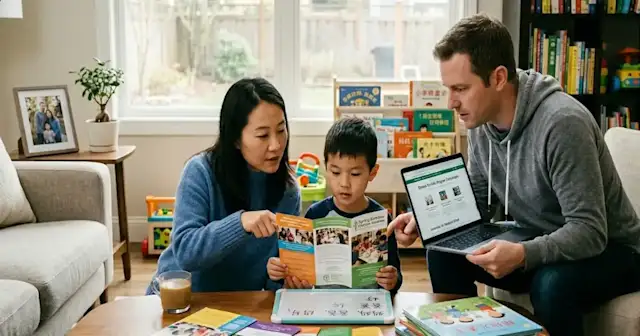
It’s a struggle many overseas parents face: How do we teach our children that the red paper matters more than the cash inside? Sarah realized that simply speaking Chinese at home wasn't enough; she needed to bridge the cultural gap, perhaps with help from immersive Chinese learning resources like LingoAce. She looked at Leo's calculator and made a promise: this year would be different.
The "Transaction" Trap: A Parent’s Dilemma
The memory of last Lunar New Year still made Sarah’s stomach turn. It wasn't the noise or the crowd—the living room was buzzing with happy family energy. It was what happened when her son finally got his hands on the red packet. When Leo’s uncle handed him a red packet, Leo didn't bow. He didn't say "thank you." Instead, he tore open the envelope right there in the middle of the room, shook out the twenty-dollar bill, and tossed the torn red paper onto the coffee table like a candy wrapper.
"Is that it?" he had asked, disappointment written all over his face.
The room had gone silent for a split second before the adults laughed it off. "He's just very Americanized," they excused him. But for Sarah, it wasn't funny. It was a sign of a deeper disconnection.
Living in the suburbs of California, Leo’s world was shaped by Western values. He lacked the immersive cultural context that Sarah grew up with. To him, red envelopes for Chinese New Year (Hongbao) were simply gift cards in a different format. He didn't see the centuries of history; he only saw the currency.
Sarah realized she couldn't just lecture a seven-year-old on "respect" and expect it to stick. Abstract concepts don't work on kids. To truly change his perspective, she needed to capture his imagination. She needed to go back to the source.

From Cash to Culture: The Legend of Sui
A few days before the festival, Sarah turned off the TV and sat Leo down. The atmosphere changed.
"We need to talk about your red envelopes," she said quietly. Leo looked up, expecting a lecture about saving money. "Not the money inside, but why the paper is red. Do you know the story?"
Leo shook his head.
Sarah began to weave the tale of the Legend of Sui, turning the history lesson into a bedtime story.
"Long ago," she began, "there was no money inside the envelopes. There was a terrifying little demon named Sui. On New Year's Eve, when the world was dark, Sui would sneak into houses and touch the heads of sleeping children. The touch would make them sick or forgetful."
Leo’s eyes widened. The "transaction" was forgotten; now, there was a monster involved.
"Parents were terrified," Sarah continued. "One couple prayed to the Eight Immortals to protect their son. The Immortals turned themselves into eight copper coins. The parents wrapped these coins in red paper and placed them under the boy's pillow."
"When Sui crept in that night, reaching out its claw," Sarah lowered her voice for dramatic effect, "a sudden burst of golden light shot out from the red packet! The light was so bright that it scared the demon away, never to return."
"Whoa," Leo whispered.
"That is why we give them," Sarah explained, tapping the red envelope on the table. "It’s called Yasuiqian 压岁钱—money to suppress the demon. The red color symbolizes fire and energy to ward off evil spirits. It’s not a payment, Leo. It’s a shield. It’s protection."
For the first time, Leo looked at the envelope not as a wallet, but as a magical object. The narrative had shifted.
Bringing in the Experts: The LingoAce Experience
While the story sparked Leo's interest, Sarah knew that bridging the cultural gap required more than just one legend. She needed him to understand the language of the tradition. Without the language, he was still an outsider looking in.
She decided to enroll Leo in a special Lunar New Year cultural session at LingoAce. She wanted him to see that this wasn't just "Mom's rule," but a shared heritage enjoyed by millions of kids.
The class was nothing like the boring Saturday school drills Sarah remembered from her childhood. It was immersive and gamified.
In the virtual classroom, the LingoAce teacher, Teacher Wang, used colorful animations to guide Leo through a "New Year Adventure." Leo wasn't just memorizing words; he was helping a cartoon character navigate a virtual Chinese village during the Spring Festival.
"Look, Leo!" Teacher Wang said, pointing to the screen. "When the elders give the Hongbao, what does the little boy do?"
Leo watched as the character on screen didn't just grab the packet. He stopped. He stood straight. He clasped his hands together—left over right—in a perfect bow.
"This is called Zuo Yi(bowing with hands folded)," the teacher explained. "It unlocks the luck."
Throughout the lesson, Leo practiced specific phrases. He learned that saying "Gong Xi Fa Cai" (Wishing you prosperity) is great, but saying "Shen Ti Jian Kang" (Wishing you good health) shows you care about the person, not just the money. He learned to pronounce the tones correctly, realizing that a slight change in pitch could change the meaning entirely.
By the end of the session, Leo was practicing his bow in the mirror. He wasn't doing it to get paid; he was doing it because he wanted to be like the hero in the story—the one who knows how to activate the "shield."
A Tradition Restored
The real test came on New Year's Eve. The family gathered around the iPad for a video call with Leo’s grandparents in Shanghai. The distance was physical, but Sarah hoped the cultural distance had shrunk.
When Grandma appeared on screen, she held up a bright, gold-embossed red envelope to the camera. "Leo! Look what Grandma has for you!" she beamed.
Sarah held her breath. This was the moment.
Leo didn't ask "How much?" He didn't ask "Can you Venmo me?"
Instead, he stood up straight in front of the iPad. He clasped his hands together in the traditional greeting he had practiced.
"Grandma, Grandpa," Leo said, his voice steady. "Happy New Year."
Then, switching to the Chinese he had learned, he added carefully, "Zhu Ye Ye Nai Nai, Shen Ti Jian Kang, Sui Sui Ping An." (Wishing Grandpa and Grandma good health, and peace year after year.)
Grandma paused, surprised by the sudden maturity. She wiped a tear from her eye. "Oh, Leo has grown up! He speaks so well now!"
Leo turned to Sarah, whispering, "Did I do it right? Is the Sui monster gone?"
"You did perfect," Sarah smiled, ruffling his hair. The transaction was gone. The connection was back.

The Ultimate Guide: 5 Rules for Red Envelopes Every Parent Should Know
Sarah’s story highlights a key parenting insight: traditions only survive if we explain the "why" and the "how." If you are preparing red envelopes for Chinese New Year, it’s not enough to just hand them over.
To help you navigate this tradition with your own children, here is a comprehensive guide to Hongbao etiquette that combines cultural depth with modern parenting.
1. The Rule of the "Fresh Bills"
In the story of Sui, the coins were magical. In reality, we simulate this "newness" by using crisp, brand-new banknotes.
Why it matters: Explain to your kids that we never use old, crumpled money for red envelopes. New money symbolizes a new beginning and a fresh start for the year. It shows that you prepared for this moment and didn't just pull cash from your wallet last minute.
2. The "Forbidden" Numbers
Before your child opens an envelope (or prepares one for a cousin), teach them the math of luck.
What to avoid: Never give amounts with the number 4 (e.g., $4, $40), as the pronunciation of "four" sounds like "death" in Chinese.
What to aim for: Even numbers are preferred because "good things come in pairs." The number 8 is the gold standard, symbolizing wealth and prosperity. This turns the "transaction" into a fun cultural math lesson.
3. The "Two-Hand" Etiquette
This is the most visible sign of a child who understands the culture versus one who just wants the cash.
The Rule: Always accept (and give) red envelopes with both hands.
The Lesson: Explain that using one hand feels casual, like buying a snack at a store. Using two hands signifies that you are cherishing the gift and respecting the giver. It’s a physical act of mindfulness.
4. The "No-Peek" Policy
This was Leo's biggest mistake in the past.
The Rule: Never, ever open the red envelope in front of the person who gave it to you.
The Lesson: Teach your child that in Western culture, opening a gift immediately is a sign of excitement. But in Chinese culture, keeping the envelope sealed is a sign of politeness. It shows you value the sentiment (the red paper) more than the content (the money).
5. Decode the Greetings (The Secret Password)
Don't just make them memorize sounds. Explain the meaning so they feel sincere.
Instead of just "Gong Xi Fa Cai" (Make lots of money): Teach them "Xue Ye Jin Bu" (May your studies improve) or "Shen Ti Jian Kang" (Good health).
The LingoAce Approach: When a child understands that Sui (the monster) sounds like Sui (age), they understand why the money is about "safe passage" into the new year. Language is the key to unlocking the culture.
Conclusion
By the end of the night, Leo was sleeping soundly. He had placed the red envelope Grandma promised him (represented by a placeholder Sarah gave him) under his pillow.
He felt rich, not because of the dollar amount, but because he was part of a story much bigger than himself. He was no longer just a kid in California; he was a protector against the Sui, a grandson who knew the right words, and a link in a chain that stretched back thousands of years.
Red envelopes during Chinese New Year are bridges connecting our children to their heritage. But a bridge needs a foundation. That foundation is built on stories, language, and understanding.
If you want to help your child go beyond the "transaction" and truly understand the language and culture behind the traditions, LingoAce is here to support your journey. Our immersive, game-based learning platform turns cultural lessons into adventures that kids actually enjoy.
Book a Free Trial Class Today and give your child the gift of connection this New Year. Let’s make their heritage something they are proud to own.